

Otunnu Posts Even Split in Second UN Security Council Straw Poll
• From trending topic: Olara Otunnu Gains Ground in UN Secretary-General Straw Poll
Summary
Olara Otunnu recorded five encourage votes, five discourage votes and five no-opinion ballots in the UN Security Council’s second informal straw poll for secretary-general. The 5-5-5 result, described in an evidence-supported account of the vote, leaves him neither clearly advancing nor eliminated in a field that remains unsettled. Social-media posts circulating after the ballot listed other candidates with different splits: Rodrigues Birkett at 8 encourage, 3 discourage and 4 no opinion; Rebeca Grynspan at 7-4-4; Rafael Grossi at 7-6-2; Michelle Bachelet at 2-6-7; and Macky Sall at 6 encourage with at least 7 discourage. Those figures have not been independently confirmed beyond the posts themselves. One candidate publicly stated that the Security Council president had transmitted the official outcome, expressed gratitude to the 15 members, and said engagement would continue. Straw polls are informal, non-binding soundings used by the Council to test support before it recommends a name to the General Assembly. Members vote encourage, discourage or no opinion; the exercise is traditionally closed-door, though results now surface quickly online. The even division for Otunnu, combined with sizable “no opinion” totals for several others, indicates the Council has not yet coalesced around a single figure.
Common Perspectives
Otunnu remains a viable contender
Backers of Otunnu, including some diplomats from African and developing-country missions, treat the even split as evidence he has not been written off. Five encourage votes show residual support and five discourages have not yet hardened into a blocking majority. The view appeals to those who value continuity of experience and regional balance after the current term. It assumes that an even result at this early stage can still be converted into later momentum, an assumption that has not always held in past selection rounds.
Stronger numbers elsewhere point to clearer front-runners
Observers tracking the circulating tallies focus on Rodrigues Birkett’s 8-3-4 and the mid-range scores of Grynspan and Grossi. They argue Otunnu’s tie simply places him in the middle of the pack rather than “gaining ground.” This reading is common among those who treat early straw polls as predictive signals and who prefer candidates already showing a plurality of encouragement. The trade-off is that it discounts the large number of undeclared votes and treats unofficial social-media lists as authoritative.
Informal polls should not be over-read
UN-process specialists and some Council members themselves stress that straw ballots bind no one and that “no opinion” remains a large category. Positions can shift once permanent members signal more clearly or once additional candidates enter. This perspective appeals to institutional realists who have watched earlier straw polls produce surprises or deadlocks. Its limitation is that it can understate the signaling effect the votes already have on campaigning and media coverage.
The process itself remains too closed
Civil-society groups and some General Assembly members use the leak of results to renew criticism that the selection stays dominated by the Security Council’s informal consultations. They note that public interest, visible in the rapid spread of the tallies, sits uneasily with a system that still withholds official numbers. The view resonates with those who want greater General Assembly or civil-society input. It assumes that more transparency would improve the quality of the eventual choice rather than simply intensify horse-race coverage.
A Different View
The most striking feature may not be any single candidate’s score but the volume of “no opinion” votes across the board. Five members declined to take a position on Otunnu; comparable numbers appear for several others. That pattern suggests many capitals are still collecting information, waiting for permanent-member cues, or preserving bargaining room for later rounds. In a system where the Council ultimately needs to unite behind one name, widespread abstention at this stage can lengthen the timeline, encourage additional candidacies, and increase the leverage of those who have not yet declared. The social-media circulation of unofficial tallies adds a further twist: candidates now feel pressure to respond publicly within hours, turning a once-private sounding into an immediate public-relations event. Whether that dynamic produces more accountability or simply more noise is an open question the next straw poll will begin to answer.
Sources and discussion
These public posts were collected while researching this story. They provide context and reactions, but may not independently verify every claim.
View the original topic on XPassBlue
@pass_blue
RESULT OF THE 2ND UNSC STRAW POLL Rodrigues Birkett - 8 Encourage, 3 Discourage, 4 No opinion Grynspan - 7 Encourage, 4 Discourage, 4 No opinion Grossi - 7 Encourage, 6 Discourage, 2 No opinion Bachelet - 2 Encourage, 6 Discourage, 7 No opinion Sall - 6 Encourage, 7
Aug 21, 2026115 likes80 repostsOlara Otunnu
@OOtunnu_
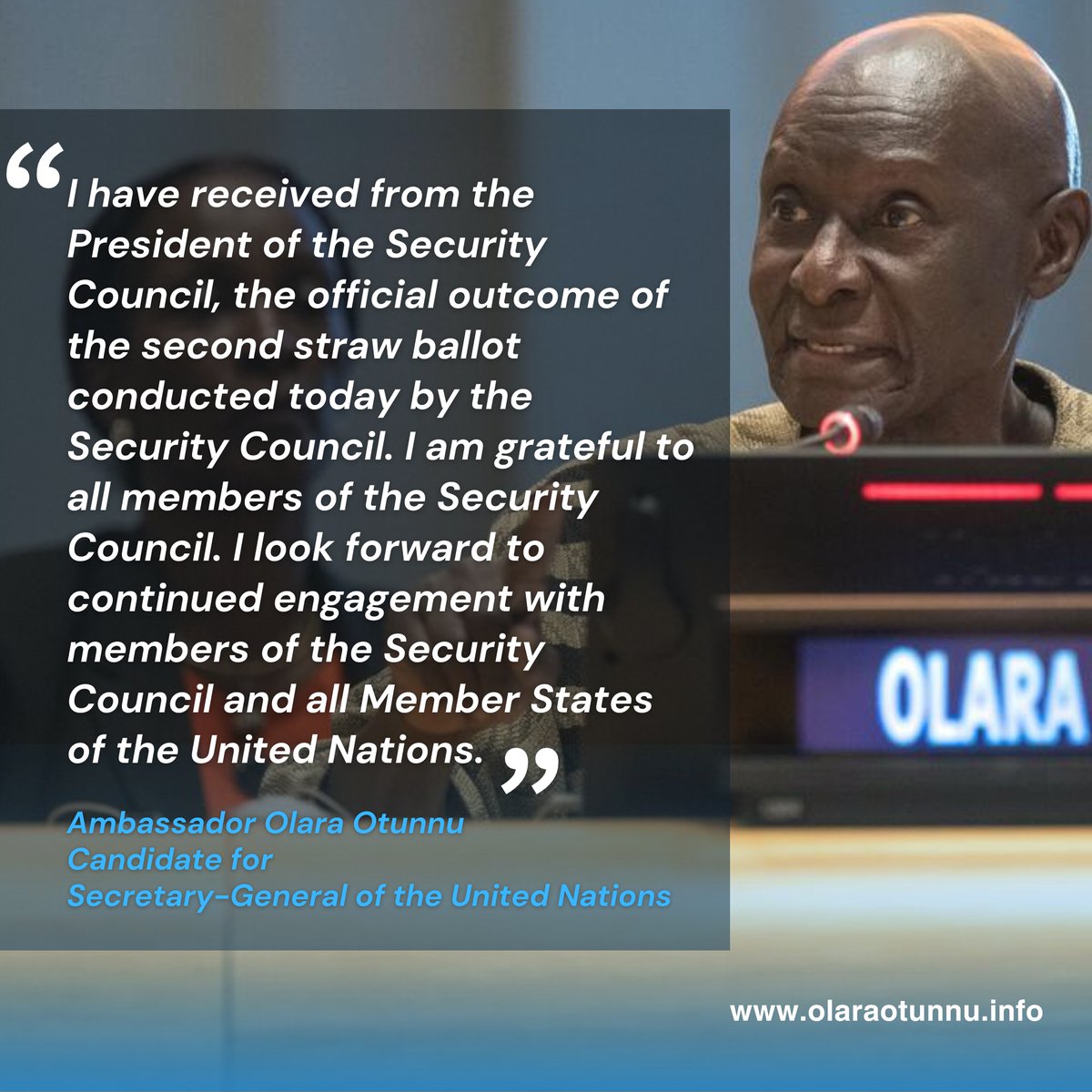
“I have received from the President of the Security Council, the official outcome of the second straw ballot conducted today by the Security Council. I am grateful to all members of the Security Council. I look forward to continued engagement with members of the Security Council
Aug 21, 2026523 likes128 reposts