

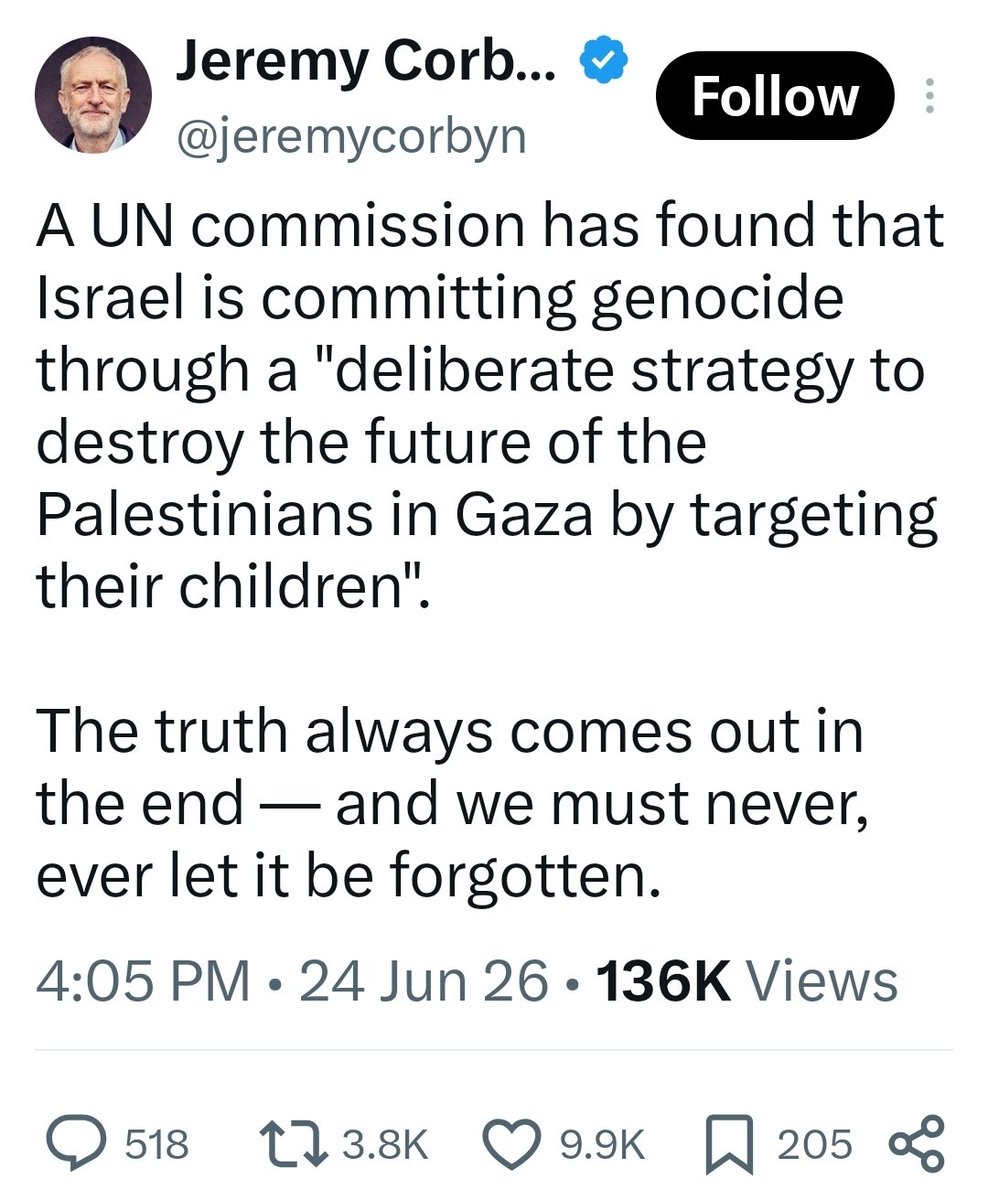
UN Commission Report Sparks Global Debate Over Claims of Deliberate Targeting of Palestinian Children
• From trending topic: UN report accuses Israel of deliberately targeting Palestinian children
Summary
A newly released report from a United Nations Commission of Inquiry has triggered intense international discussion after accusing Israeli forces of deliberately targeting Palestinian children in Gaza and the West Bank. The document, which has circulated widely on social media platforms in recent days, claims that thousands of minors have been killed or injured during ongoing military operations. Social media users are sharing conflicting narratives about the report's methodology, with some highlighting the commission's assertion that it withheld children's names to protect their families, while others question the sources used to compile casualty figures. The timing of the report's release coincides with renewed diplomatic tensions and has prompted immediate reactions from governments, advocacy groups, and commentators across multiple platforms.
Common Perspectives
Report Represents Documented Evidence of Systematic Violations
Supporters of the UN commission's findings argue that the report compiles extensive documentation showing a pattern of targeting minors, citing hospital records and witness accounts as evidence. They point to the commission's decision not to name individual children as a necessary protection measure rather than a weakness in methodology.
Report Relies on Unverified Sources and Lacks Credibility
Critics contend that the report draws heavily from unconfirmed hospital reports and statements that have not been independently verified on the ground. They argue that the absence of named victims and specific evidence undermines the document's reliability as an investigative finding.
Report Omits Context of Hamas Military Tactics
Some observers emphasize that the report fails to adequately address claims that Hamas uses civilian areas, including locations where children are present, for military operations. This perspective suggests the document presents an incomplete picture by not fully examining how militant groups' positioning affects civilian casualties.
Report Serves Political Agenda Rather Than Neutral Investigation
Another viewpoint holds that the commission's work is influenced by broader institutional biases within certain UN bodies, with critics pointing to previous reports they see as following similar patterns of selective focus on Israeli actions while giving less attention to actions by Palestinian armed groups.
A Different View
Rather than focusing solely on the report's conclusions or methodology, consider how the rapid circulation of specific casualty figures on social media creates feedback loops where unverified numbers gain authority through repetition across platforms. The discussion reveals less about verifying individual claims and more about how international institutions' outputs become tools in information ecosystems where context, sourcing, and counter-evidence compete for attention in real time, often detached from the original document's scope and limitations.
Conclusion
The release of this UN Commission of Inquiry report has intensified existing divisions over how civilian casualties, particularly those involving children, are documented and interpreted during active conflicts. The varied responses highlight ongoing challenges in establishing agreed-upon standards for investigating allegations in contested war zones where multiple parties operate with conflicting narratives about responsibility and intent.
Sources and discussion
These public posts were collected while researching this story. They provide context and reactions, but may not independently verify every claim.
View the original topic on XYosi Levi Sfari
@LeviSfari
The UN’s latest report accusing Israel 🇮🇱 of "deliberately targeting children" is a dangerous propaganda laundering operation completely devoid of actual evidence. By relying on hospital hearsay and completely erasing Hamas - who cynically exploit minors as combatants and hide
Jun 24, 2026Lynda Lee
@Leel06Lee
UN report finds Israel deliberately targets Palestinian children via @MichaelWestBiz
Jun 24, 2026Mark Brewer
@theapril29th
Israel has killed over 20,000 Palestinian children – UN report The UN Commission of Inquiry says Israeli forces have deliberately targeted minors in Gaza and the West Bank
Jun 24, 2026FLOR DO DESERTO
@FlorDeserto
Children were not named in the UN report out of fear that Israel would bomb their families. #UN: "The hardest decision we had to make in completing this report was.. not to name the #Palestinian children, whose deaths, injuries & suffering we describe..
Jun 24, 20261 likes1 repostsmr. drs. Peter Baars
@PeterBaars1111
Israel has killed over 20,000 Palestinian children – UN report
Jun 24, 2026CLH
@CLH111354
A new report from a United Nations @UN investigative commission has accused Israel of committing serious violations against Palestinian children during the conflict in Gaza and the Occupied Palestinian Territories. The commission alleges that thousands…
Jun 24, 2026