

Serbia’s Government Asks President to Dissolve Parliament for an October Snap Vote
• From trending topic: Serbia Government Requests Snap Elections Amid Protests
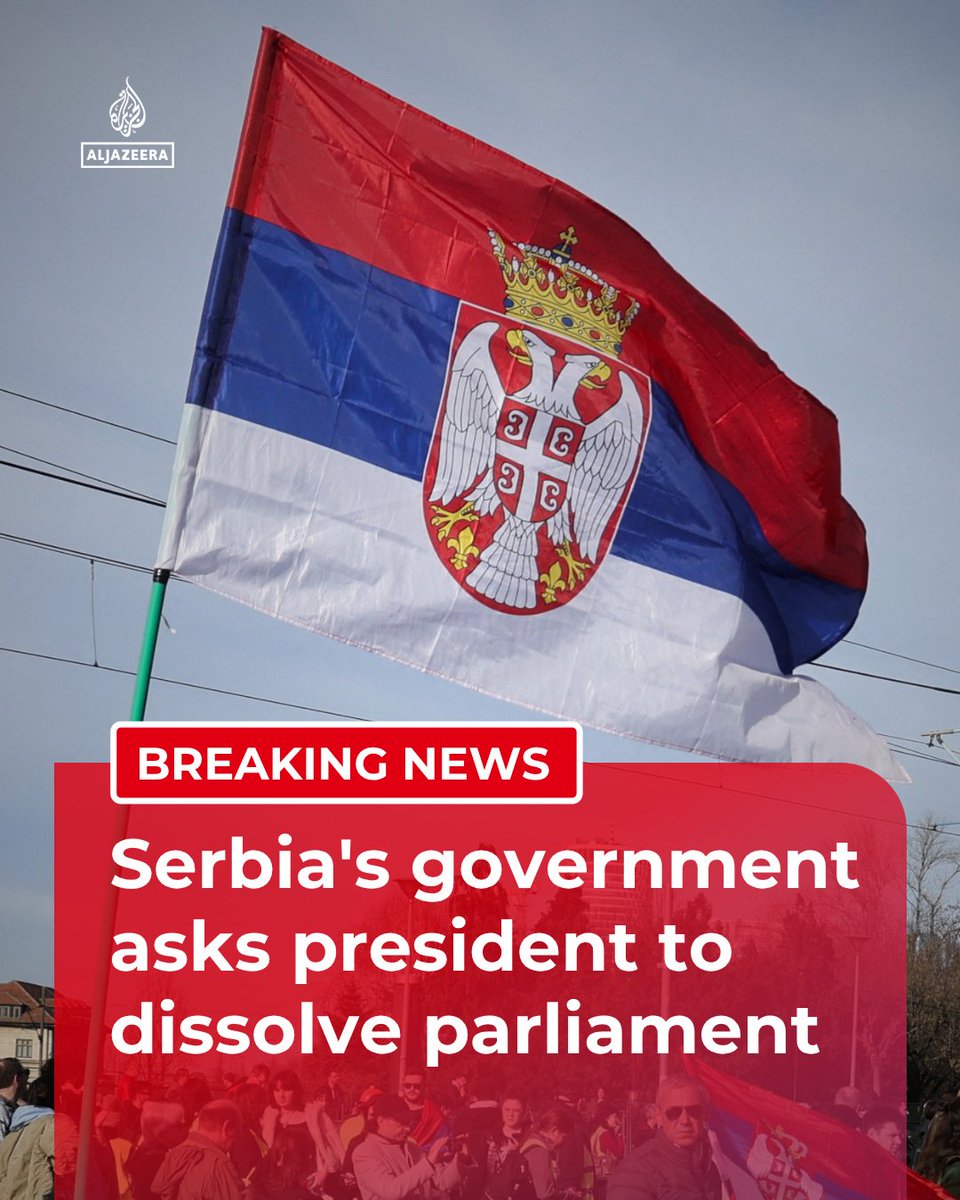
Summary
Serbia’s government has asked President Aleksandar Vucic to dissolve the National Assembly and call a snap parliamentary election, according to a statement attributed to Prime Minister Djuro Macut. Reporting tied to that announcement puts a possible voting day at October 25, 2026. Accounts of the process say the cabinet adopted a dissolution proposal and sent it to the president, with a formal election call described as imminent.
The story is traveling as a crisis measure “amid protests.” The clustered reports do not, by themselves, establish who is in the streets, what they are demanding, or how large or sustained the demonstrations are. Under the sequence described, the election is also not yet a completed legal fact: a government proposal still requires the president to dissolve parliament and set the date.
A thinner claim circulating with the news describes Vucic as embattled and says he wants to leave the presidency for the prime minister’s job in the coming contest. That is an inference about motive and role, not something established in the government’s described statement.
Common Perspectives
Renew the mandate at the ballot box
Allies of the government, and voters who still prefer the ruling camp to street vetoes, tend to treat a snap vote as the proper answer to unrest. An election, in this view, is a clearer verdict than an open-ended protest. The appeal is procedural legitimacy: if people are angry, let them count. The assumption is that the contest will be free enough to count as a reset. The trade-off is speed. A short run-up to late October favors whoever already has organization, media reach, and control of the state calendar.
A reset built to protect the incumbent
Opposition supporters and many protesters are likelier to read the request as a tactic. Dissolving parliament can interrupt momentum on the street; if the claim about a Vucic premiership is right, it also recasts his power instead of ending it. The appeal is pattern recognition—early elections as an incumbent’s tool. The assumption is intent: that the timing was chosen for advantage. The risk in that reading is symmetry. A national vote can also concentrate discontent if people who were protesting actually turn out.
Wait for the decree, not the rumor
A narrower institutional view insists that a cabinet proposal is not yet an election. The president still has to dissolve the assembly and name the day. This appeals to readers tired of treating every political signal as a finished outcome. Its assumption is that the presidency retains real discretion. The cost of that caution is political: insisting on formalities can look like denial if the result is already priced in by every actor who matters.
Use the vote to lower the temperature
Diplomats, business people, and exhausted swing voters often treat snap elections as a pressure valve. Campaigns absorb energy that would otherwise stay on the pavement, and a date on the calendar can look like an off-ramp. That appeal is stability. The assumption is that balloting substitutes for the grievance rather than merely postponing it. The trade-off is familiar: a winter of slogans can leave the original dispute untouched once the posters come down.
A Different View
The dominant fight is over who would win. A quieter effect is what disappearance of this parliament does in the weeks before any ballot. Once the assembly is gone, it cannot bargain, investigate, or pass the sorts of measures protesters might have extracted from a sitting legislature. Ministries keep operating; the street is left with campaigning or extra-parliamentary pressure. That can look like democracy while shrinking the number of rooms in which a compromise is even possible.
The weakly sourced idea of a presidential-to-prime-minister switch, if principals later confirm it, is also easy to misread as a personality story. The sharper question is institutional: whether executive power is being nudged back toward a government that must live with parliament, or whether the same personal dominance simply changes office.
Conclusion
The facts that would settle the story are still ahead of the request: a presidential decision on dissolution, a confirmed date, how protest groups answer an election calendar, and any on-the-record statement about who intends to lead the next government. Until those arrive, the cabinet’s move is a political signal; the election, and the motives hung on it, remain incomplete.
Sources and discussion
These public posts were collected while researching this story. They provide context and reactions, but may not independently verify every claim.
View the original topic on XAl Jazeera Breaking News
@AJENews
Serbia's government has asked President Aleksandar Vucic to dissolve parliament and call a snap election, Prime Minister Duro Macut said in a statement. 🔴 More on
Sep 7, 202663 likes29 repostsBloomberg
@business
Serbian Prime Minister Djuro Macut called for the dissolution of parliament, paving the way to snap elections in which embattled President Aleksandar Vucic wants to switch to the role of prime minister
Sep 7, 20268 likes2 repostsSERBIA ELECTS 🇷🇸
@serbia_elects
The process of dissolving the National Assembly was set in motion today after the Government adopted a proposal for its dissolution and submitted it to the President. The formal announcement of the election, scheduled for 25 October 2026, is now imminent.
Sep 7, 202618 likes