

Philippine Defense Chief Reads Chinese Note Aloud at Seoul Forum
• From trending topic: Philippine Defense Secretary Publicly Dismantles Chinese Note at Seoul Forum
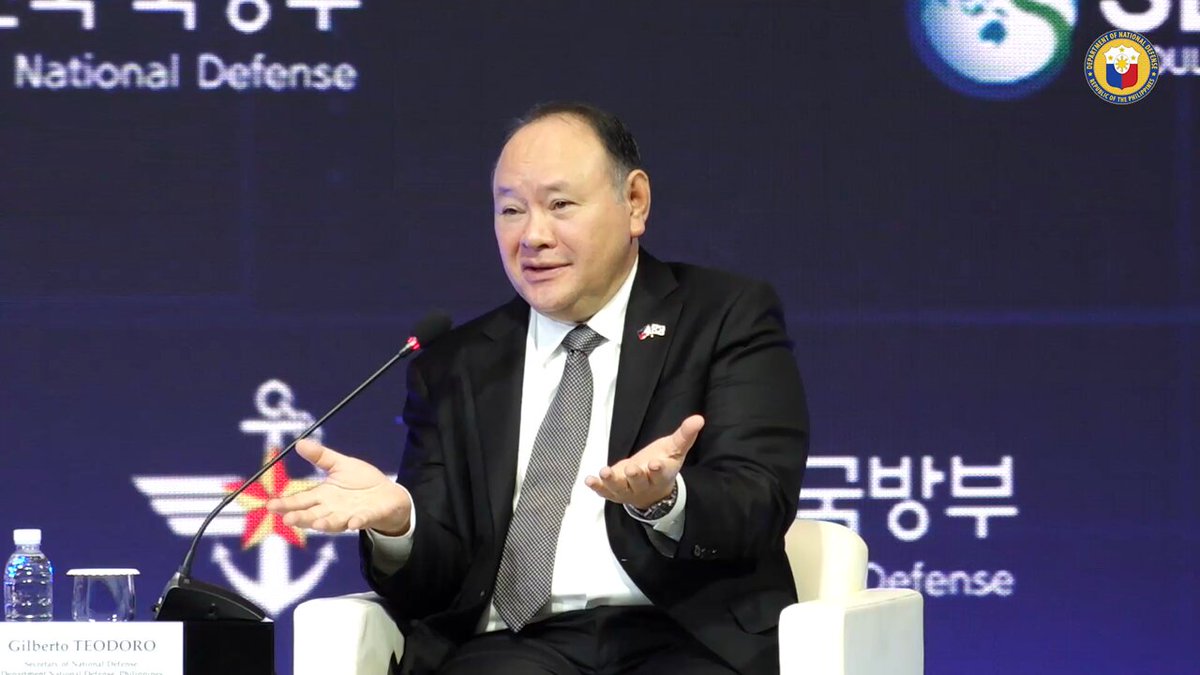
Summary
At the Seoul Defense Dialogue in South Korea, Philippine Defense Secretary Gilberto C. Teodoro Jr. was handed a note from the Chinese side while he was speaking. He read it to the room and answered it in public, focusing on the note’s treatment of the 2016 South China Sea arbitral award.
Accounts circulating on X, including a post from the Philippine Department of National Defense, describe the episode as a note passed during Teodoro’s remarks at SDD 2026. One widely shared version identifies the courier as a Chinese military attaché and says the message restated Beijing’s position that the 2016 ruling is “illegal, null and void.” Those accounts say Teodoro read the note aloud and replied to it point by point. The DND post confirms a public response to a Chinese-side note; it does not, by itself, independently verify every detail of the viral clips.
The underlying dispute is not new. In 2016 an arbitral tribunal constituted under the U.N. Convention on the Law of the Sea issued an award largely favoring the Philippines and rejecting China’s nine-dash line as a legal basis for historic rights inside the Philippines’ exclusive economic zone. China did not take part in the case and has consistently called the award null. Manila treats the ruling as a core legal foundation for its maritime claims. What was unusual in Seoul was the form: a written objection delivered mid-speech, then turned into an on-the-record rebuttal before other defense officials.
The clip spread quickly among Filipino users, often with language of national pride. Independent confirmation of the note’s full wording and of Teodoro’s complete reply still rests on the circulating video and official Philippine framing rather than a published transcript from the forum.
Common Perspectives
A necessary public stand
Many Filipinos who follow the West Philippine Sea, and officials aligned with a firmer Manila line, treat the moment as refusal to be corrected in silence. The appeal is straightforward: the 2016 award is, in this view, binding law, and reading a contrary note aloud denies China the last word in a multilateral room. It also plays to a domestic audience that has watched repeated encounters at sea. The assumption is that visible defiance has political and deterrent value. The trade-off is that a public dressing-down can make later military-to-military contact colder, even if both sides still need channels when ships get close.
A valid Chinese legal reservation
Beijing’s long-stated position—and that of commentators who accept it—is that the tribunal lacked jurisdiction, China never consented to the case, and the award has no legal effect. Passing a note is, in that reading, a formal way to put an objection on the record without seizing the microphone. People who hold this view tend to see Teodoro’s recitation as a theatrical breach of conference manners rather than a legal argument. The assumption is that historical claims and present naval presence outweigh a ruling China rejected from the start. The cost is continued isolation from governments that treat the award as settled international law.
Evidence of pressure at international meetings
Officials and analysts in the United States, Japan, Australia, and among Philippine hawks often fold the incident into a larger picture of Chinese coercion that does not stop at reefs and water cannon. A note handed to a speaking defense minister looks, to them, like an attempt to police another country’s talking points. That frame is appealing because it is simple and matches other public disputes over the South China Sea. The assumption is that calling out such tactics strengthens a “rules-based” coalition. The trade-off is that every forum incident becomes a loyalty test, shrinking the space for unscripted conversation that defense dialogues are supposed to provide.
Protect the room, not the clip
Some regional diplomats and officers who work incident-prevention and hotlines argue that both the note and the recitation broke the informal rules of a defense forum. Their concern is practical: once a meeting becomes content for home feeds, participants start performing. This view is common among people whose job is to keep talking after a collision or a blockade, not to win a news cycle. It assumes that quiet process prevents miscalculation better than viral clarity. The weakness is that quiet process can look, at home, like swallowing an insult.
A Different View
The South China Sea will not be redrawn by a piece of paper passed down a row of seats. Neither side lacked a position on the 2016 award before Seoul, and neither gained new legal force after it. What the episode did produce is a portable narrative: Manila as the party that would not pocket the note; Beijing as the party that would not let the award be mentioned unchallenged. Defense secretaries and attachés have incentives to generate that kind of record for audiences far from the hall—voters, party organs, allied capitals. The neglected question is whether working contacts among navies and coast guards continue off camera. If they do, the Seoul moment was messaging. If they freeze, the messaging will have been the policy.
Conclusion
The next signals worth watching are whether China issues a formal account of the note, whether Seoul’s hosts treat the exchange as a procedural problem, and whether Philippine-Chinese defense contacts proceed as scheduled after the clip fades.
Sources and discussion
These public posts were collected while researching this story. They provide context and reactions, but may not independently verify every claim.
View the original topic on XClash Report
@clashreport
WATCH: A Chinese military attaché passed a note to the Philippine Defense Secretary while he was speaking at a Seoul defense forum — restating that the 2016 South China Sea ruling is "illegal, null and void." Teodoro read it aloud to the room, then responded line by line. On
Sep 8, 202611.7K likes1.7K repostsDepartment of National Defense - Philippines
@dndphl
MAHIYA NAMAN KAYO | Secretary of National Defense Gilberto C. Teodoro, Jr. responded to a note from the Chinese side during the Seoul Defense Dialogue (SDD) 2026 in Seoul, Republic of Korea. #DNDPHL #DiKaPasisiil #SDD2026
Sep 8, 202631.6K likes5.8K reposts