

Nigerian Candidates Sign Peace Accord Ahead of 2027 Elections
• From trending topic: Nigerian Candidates Sign National Peace Accord for 2027 Elections
Summary
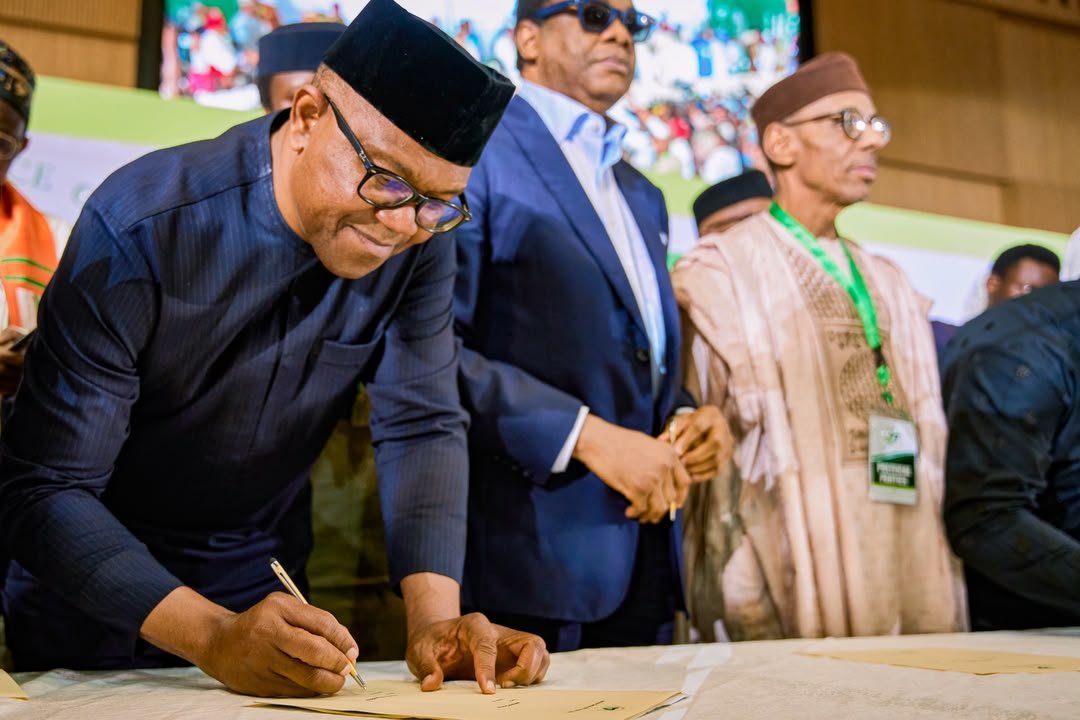
Presidential candidates including Peter Obi signed a National Peace Accord in Abuja, committing to issue-based campaigns for Nigeria’s 2027 elections. Participants said the signing took place at the Bola Ahmed Tinubu International Conference Centre. In a post on X, Obi wrote that he had joined other presidential candidates to sign what he called the first National Peace Accord for the 2027 presidential race, and that his signature reinforced a continued commitment to peaceful conduct. Another candidate described the document as a pledge for issue-based campaigns ahead of the official start of campaigning for the presidential and National Assembly elections. Obi also framed the moment around a demand that anyone seeking to be addressed as “His Excellency” behave excellently. The available reports and candidate posts establish that a multi-candidate signing occurred. They do not identify the full list of signatories, the organizing body, or any enforcement or monitoring mechanism attached to the accord. Those details are not confirmed here. Nigeria’s next general elections are due in 2027. Public peace pledges have been part of earlier cycles, usually as an attempt to lower the risk of violence and keep campaigns from sliding into personal or communal attack. This one arrives well before official campaigning, while the field is still taking shape.
Common Perspectives
A public brake on a dangerous season
Civil-society voices, voters in historically tense areas, and supporters of the candidates who signed tend to treat the accord as a useful restraint. A named, photographed commitment creates a record that can be cited later if rhetoric turns ugly. The appeal is straightforward: elite promises, once public, carry at least some reputational cost. The assumption is that candidate will and personal honor can influence party networks, local enforcers, and the security services. The trade-off is that this view locates the problem mainly in individual character rather than in party structures, patronage, and uneven policing.
Familiar theater that rarely binds anyone
Skeptical voters and people who have watched previous election seasons often read the ceremony as low-cost performance. Politicians sign, cameras click, and the incentives of a winner-take-all presidency remain. The view appeals because it matches a recurring pattern: pledges of restraint followed by inflammatory speech, disputed results, or clashes. The assumption is that the penalty for breaking the promise is close to zero. The trade-off is that writing the exercise off completely can miss whatever modest pressure public expectation still exerts on candidates who care about their image.
A hook for issue-based politics, if anyone uses it
Policy-focused voters and parts of Obi’s base hear something more specific in the language about issue-based campaigns and “excellent” conduct. For them the value is not the signature itself but the standard it hands to journalists, civic groups, and rival camps. The appeal is that it gives critics a text to measure speeches against. The assumption is that media and the public will actually reward substance and punish ethnic or personal attacks. The trade-off is that “issues” can still be framed in ways that inflame, and a pledge does not decide who sets the agenda.
Defensive signaling almost no one can refuse
Political operatives and some analysts of campaign incentives see the accord mainly as insurance. Refusing to sign would be framed immediately as planning trouble, so almost every serious contender has a reason to appear. The view appeals because it explains why such documents attract broad participation even among rivals who trust one another very little. The assumption is that the dominant motive is reputational self-protection, not a change in strategy. The trade-off is that if everyone signs for the same defensive reason, the accord distinguishes no one and constrains no one.
A Different View
The argument so far is about whether the candidates mean what they signed. A less examined question is what the ritual does for the system around them. Staging the first 2027 peace event at a major Abuja venue already named for the incumbent places the next contest inside the current administration’s physical landscape. Recurring accords can also become a substitute for harder work: insulating the electoral commission, professionalizing the police, and prosecuting past political violence. Elites get a document to point to; the underlying stakes of capturing the presidency stay the same. The signing does not settle whether this cycle will repeat that pattern. It simply does not address it.
Conclusion
The signatures are the easy part. The test is whether campaigns, once they formally open, stay inside the language the candidates just endorsed—and whether anyone with power invokes the accord when they do not.
Sources and discussion
These public posts were collected while researching this story. They provide context and reactions, but may not independently verify every claim.
View the original topic on XPeter Obi
@PeterObi
Those Seeking to be Addressed as “His Excellency” Must Behave Excellently Yesterday, I joined other presidential candidates to sign the first National Peace Accord for the 2027 Presidential Elections. My signing of the accord is a reinforcement of my continued commitment to
Aug 19, 20267.8K likes2.6K repostsBarau I. Jibrin
@barauijibrin
Signing of Peace Accord In Abuja Earlier today, I was at the Bola Ahmed Tinubu International Conference Centre (ICC), Abuja, to sign the Peace Accord for issue-based campaigns ahead of the commencement of campaigns for the 2027 presidential and National Assembly elections. The
Aug 18, 2026111 likes14 reposts