

UK Job Vacancies Fall to 707,000 as Payrolls Keep Shrinking
• From trending topic: UK Job Vacancies Hit Five-Year Low as Payrolls Decline
Summary
UK employers advertised 707,000 vacancies in the three months to July, the lowest figure since 2014 once the pandemic collapse is excluded. The same data showed payroll employment continuing to decline, a combination that has turned a routine labor-market release into a political flashpoint.
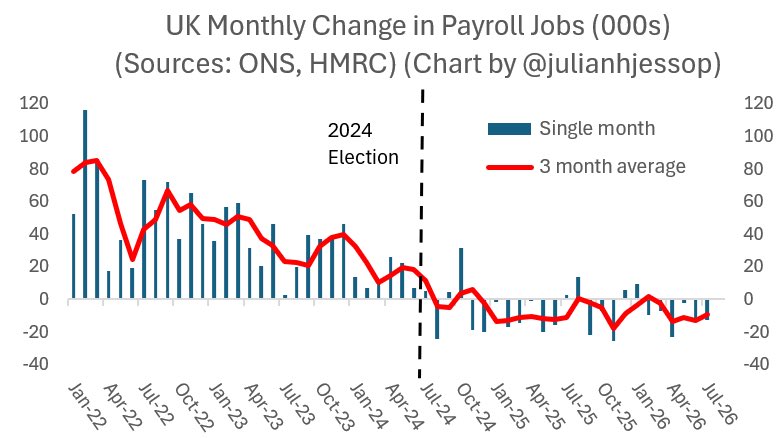
The numbers arrive two years after a change of government and after a Budget that raised business costs. Commentators on X have seized on the timing, contrasting earlier job growth with the current slide and citing additional figures—payrolls down tens of thousands over the year, unemployment at 4.9 percent—that are circulating in those discussions but are not independently confirmed here. What is established is the vacancies reading itself and the direction of payrolls. That is enough to reopen arguments about whether the labor market is merely normalizing or beginning to crack.
Common Perspectives
Government policy is the culprit
Business owners and critics of the current administration treat the drop as the predictable result of higher employer national-insurance contributions and other Budget measures. The appeal is straightforward: hiring was expanding before the election and has contracted since, so the policy change looks causal. The view assumes that firms’ decisions are driven mainly by the latest tax and regulatory shifts rather than by weaker demand, high interest rates, or global conditions that pre-date the Budget. The trade-off is that it can overstate the government’s short-run control over a labor market still digesting earlier shocks.
A necessary cooling after years of tightness
Some economists and those focused on inflation see fewer vacancies as overdue. The post-pandemic period produced chronic shortages and rapid wage growth; a return toward the 2014-era level of openings could ease price pressure without an immediate surge in unemployment. This reading appeals to anyone who regards the earlier tightness as unsustainable. It rests on the assumption that the economy can absorb slower hiring as a soft landing rather than a stall, and it downplays the risk that falling payrolls already signal something broader than a healthy adjustment.
Early warning of weaker demand
A third group—opposition politicians, some unions, and households feeling the squeeze—reads the same numbers as evidence that activity is fading. Vacancies are a leading indicator; when they fall alongside payrolls, job-seekers face longer searches and less bargaining power. The interpretation resonates because it matches lived experience of higher living costs and cautious employers. Its limitation is that it treats the national headline as uniformly grim, leaving little room for sector or regional variation that the published figures do not yet detail.
A Different View
The political argument treats the latest three-month reading as a verdict on one Budget. Labor-market series, however, move slowly and incorporate earlier forces—monetary tightening, energy-price spikes, and the unwinding of pandemic distortions—that began well before the current government. The “lowest since 2014 outside the pandemic” phrasing itself hints at a longer cycle: the extreme tightness of 2021–23 may have been the anomaly, and 707,000 openings could simply be the labor market reverting toward an older, less frantic equilibrium. If that is the case, the more useful questions are which sectors are still short of staff, whether lower vacancies will feed through to slower wage growth and earlier rate cuts, and how quickly unemployment actually rises—none of which is settled by the headline alone.
Conclusion
The next unemployment and earnings releases will show whether the vacancies decline is a controlled cooling or the start of a sharper softening. Until then the political contest over who “owns” the numbers is likely to outrun the data.
Sources and discussion
These public posts were collected while researching this story. They provide context and reactions, but may not independently verify every claim.
View the original topic on XAlexander Insley
@alexinsley
Look at that line @UKLabour Before the election: jobs growing, month after month. Since Labour's Budget: payrolls falling for a year straight, down around 90,000 over the past year, vacancies at their lowest since 2021, unemployment up to 4.9%. I've run businesses. I've
Aug 19, 202614 likes7 repostsAndrew Pierce
@andrewpierceexc
Inflation up, job vacancies sharply down, unemployment up. Welcome to Britain 2 years into a Labour govt
Aug 19, 2026954 likes153 reposts