

Fertility Has Fallen in 219 Countries, Entering Territory No Society Has Known
• From trending topic: Global Fertility Falls Below Replacement for First Time
Summary
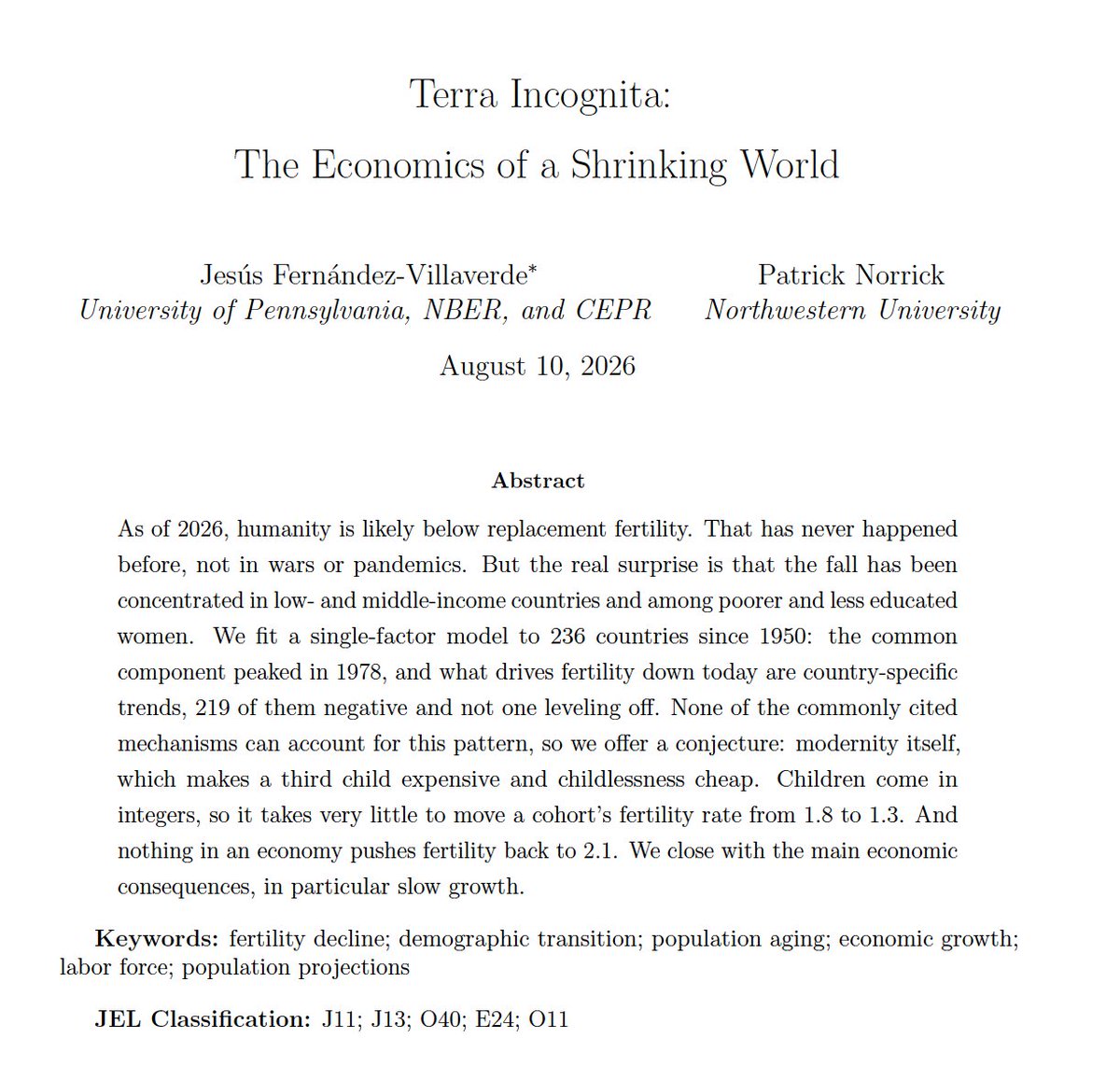
A new paper reviewing fertility records from 236 countries since 1950 finds declines in 219 of them and no evidence the trend is leveling off. Titled “Terra Incognita: The Economics of a Shrinking World” and co-authored by Patrick Norrick, the analysis was posted last week by one of its authors, who noted that no society in history has recorded the fertility levels now seen in South Korea, China, Thailand, Colombia, Chile and a lengthening list of others. The work has been clustered in coverage as the first time global fertility has dropped below replacement. Online reactions have stressed that Africa, long assumed to be the offsetting exception, is seeing fertility fall just as rapidly. Replacement fertility—about 2.1 births per woman in low-mortality settings—is the level at which a population neither grows nor shrinks in the absence of migration. The paper’s core empirical claim is that the post-1950 decline is both nearly universal and still underway, leaving large parts of the world in demographic conditions without precedent.
Common Perspectives
Labor Shortages and Fiscal Strain Are Inevitable
Economists focused on aging societies and officials in East Asia and southern Europe treat the numbers as a warning of shrinking workforces, rising old-age dependency and pressure on pensions and health systems. The view appeals because it matches visible problems already appearing in Japan, Italy and now China. Its assumption is that economic vitality still scales with the number of working-age people; the trade-off is that the usual remedies—large-scale immigration or expensive natalist subsidies—carry political costs and have so far produced only modest, temporary lifts in births.
Fewer People Ease Planetary Pressure
Environmental advocates and some development specialists welcome the decline as a brake on resource use and emissions. The appeal is straightforward: a smaller future population reduces the scale of climate and biodiversity challenges. The assumption is that headcount is the dominant driver of environmental harm. The trade-off is that older, richer societies can still generate high per-capita consumption, and slower growth may complicate the financing of a green transition.
Costs, Not Culture, Are Suppressing Births
Family-policy researchers and center-left commentators point to housing prices, education expenses, unstable work and the difficulty of combining careers with children. This framing is attractive because it suggests concrete, non-coercive fixes such as childcare, parental leave and housing reform. It assumes most people would have more children if the economic barriers fell. The trade-off is that similar policies in high-income countries have not restored replacement fertility, implying preferences themselves may have shifted.
Preferences Have Changed and Are Unlikely to Reverse
Social conservatives and some demographers argue that later marriage, higher female education and employment, and weaker religious or familial norms have altered what people want. The view resonates in places where generous subsidies have failed to produce a rebound. It assumes fertility is primarily a cultural outcome rather than a price problem. The trade-off is that it can sound like a critique of women’s autonomy and offers few politically palatable tools for change.
A Different View
Most arguments treat low fertility as a problem to solve or a benefit to accept. They largely skip the institutional mismatch: virtually every modern system—pay-as-you-go pensions, real-estate markets priced for growing demand, university expansion, even military manpower planning—was built for populations that increase. Historical population drops were usually sudden and followed by recovery. This one is gradual, chosen, and of unknown duration. The relevant question may not be whether governments can push the birth rate back up, but whether societies can redesign those systems for contraction without a long period of fiscal stress, asset deflation and intergenerational friction. That is the uncharted ground the paper’s title flags.
Conclusion
The immediate test will be whether any low-fertility country produces a sustained rebound and whether African rates continue their reported descent. Equally important is how quickly automation or other productivity gains can substitute for missing younger workers—an adaptation whose speed and distribution remain unknown.
Sources and discussion
These public posts were collected while researching this story. They provide context and reactions, but may not independently verify every claim.
View the original topic on XJesús Fernández-Villaverde
@JesusFerna7026
Last week I posted a new paper with Patrick Norrick: “Terra Incognita: The Economics of a Shrinking World.” We chose the title deliberately. No society in history has experienced the fertility levels now seen in South Korea, China, Thailand, Colombia, Chile, and many other
Aug 18, 20266.5K likes1.1K repostsNoah Smith 🐇🇺🇸🇺🇦🇹🇼
@Noahpinion
Africa will not save the human race. Its fertility is collapsing just as fast as everywhere else.
Aug 18, 2026147 likes9 reposts