

Preliminary Niño 3.4 Temperature Report Reaches 30.06°C
• From trending topic: Record El Niño Hits 30.06°C Milestone in Equatorial Pacific
Summary
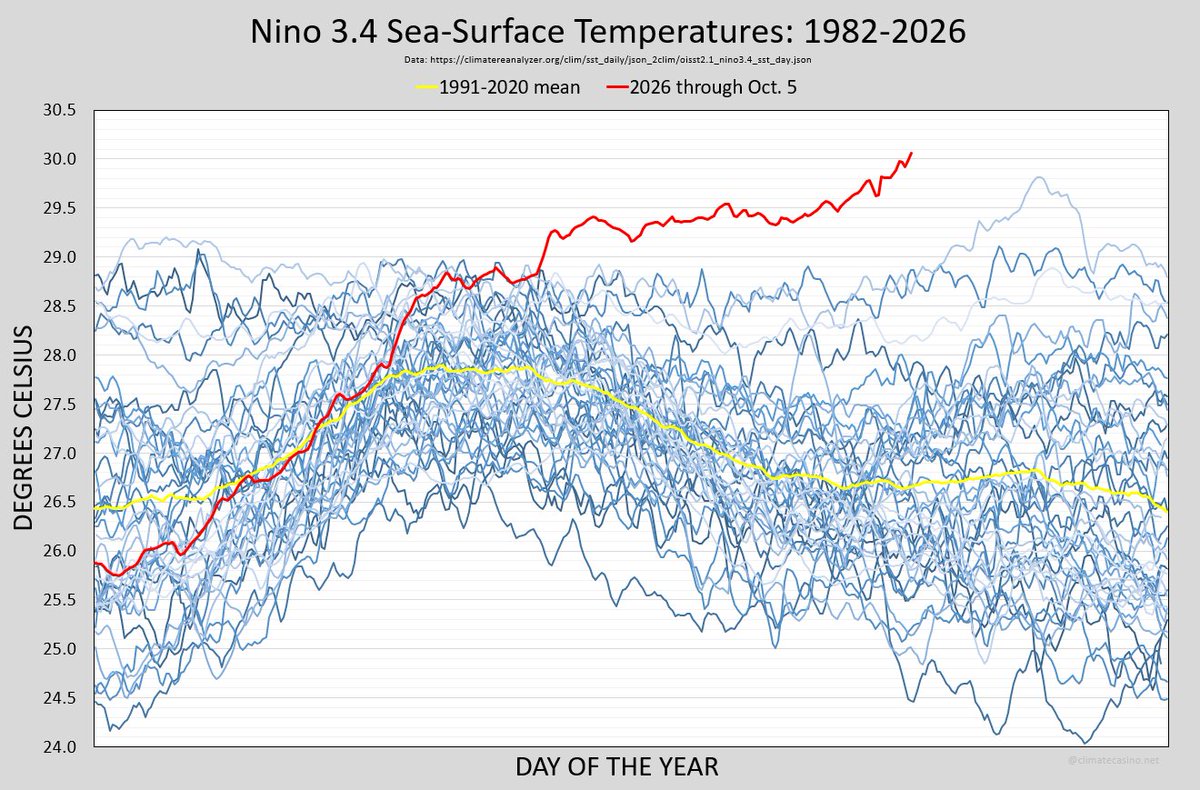
Eliot Jacobson reported a preliminary sea-surface temperature of 30.06°C for the Niño 3.4 region on October 5, with an anomaly of 3.41°C above the 1991–2020 baseline. Leon Simons separately described the reading as the first above 30°C in the NOAA sea-surface-temperature dataset for the main El Niño monitoring region. These claims concern a defined region of the equatorial Pacific, and the numerical reading remains preliminary.
Separate posts discussed seasonal forecasts. Daniel Swain described unusually high predictive confidence in a very wet California winter in the October 1 European Centre for Medium-Range Weather Forecasts guidance. Ben Noll reported forecasts of a peak anomaly above 4°C in December and possible influence extending into 2027. Those projections concern future conditions and remain subject to forecast uncertainty.
Common Perspectives
A regional temperature milestone
Jacobson and Simons emphasize the reported crossing of 30°C. As analysis, a record claim is most useful when accompanied by a clearly identified dataset, region and date. Confirmation and any subsequent revisions will matter for the final numerical record.
The anomaly alongside the temperature
The reported 3.41°C anomaly expresses the departure from the stated reference period. Considering it alongside the absolute temperature gives readers two distinct measures of the same reported conditions. A single regional reading has a limited scope for broader climate conclusions.
Forecasts and preparation
Swain and Noll draw attention to seasonal model guidance. A planning perspective would use those forecasts together with local information and later updates. Specific weather outcomes depend on how conditions develop over the coming months.
A Different View
Communication is part of the practical challenge. Readers need to distinguish the preliminary October 5 observation, a claim about the dataset’s historical record and forecasts for later months. Keeping their dates and uncertainty visible makes the information more useful for decisions.
Conclusion
Watch for confirmation of the preliminary reading and updated seasonal guidance. The reported regional milestone and the projected weather impacts require separate follow-up.
Sources and discussion
These public posts were collected while researching this story. They provide context and reactions, but may not independently verify every claim.
View the original topic on XProf. Eliot Jacobson
@EliotJacobson
Breaking News! Code UFB!!! For the first time in recorded history, the Niño 3.4 sea-surface temperature (SST) is above 30.0°C, reaching a preliminary SST of 30.06°C on October 5th. The Niño 3.4 SST anomaly is now 3.41°C above the 1991-2020 baseline. Everything is not fine.
Oct 6, 20262.4K likes924 repostsDaniel Swain
@Weather_West
Just did some number crunching using latest (Oct 1) ECMWF seasonal data, and I must say that I've never seen such high predictive confidence in a very wet California winter. This is a truly extraordinary forecast amid a record-strength El Niño event. [Thread: please read to end.]
Oct 6, 20261.1K likes214 repostsLeon Simons 🌍
@LeonSimons8
🚨 BREAKING Y-AXIS 🌊🌡📈 Record warm waters in the main El Niño region reached >30°C for the first time in the @noaa Sea Surface Temperature dataset. We've ain't seen nothing yet of the impacts this will have around the world.
Oct 6, 2026821 likes345 repostsBen Noll
@BenNollWeather
New ECMWF seasonal guidance shows *six straight months* of record-breaking El Niño conditions, with a peak above 4°C in December. This event is showing signs of potentially lingering longer into 2027, with El Niño's influence on the weather continuing through spring.
Oct 6, 2026490 likes120 reposts