

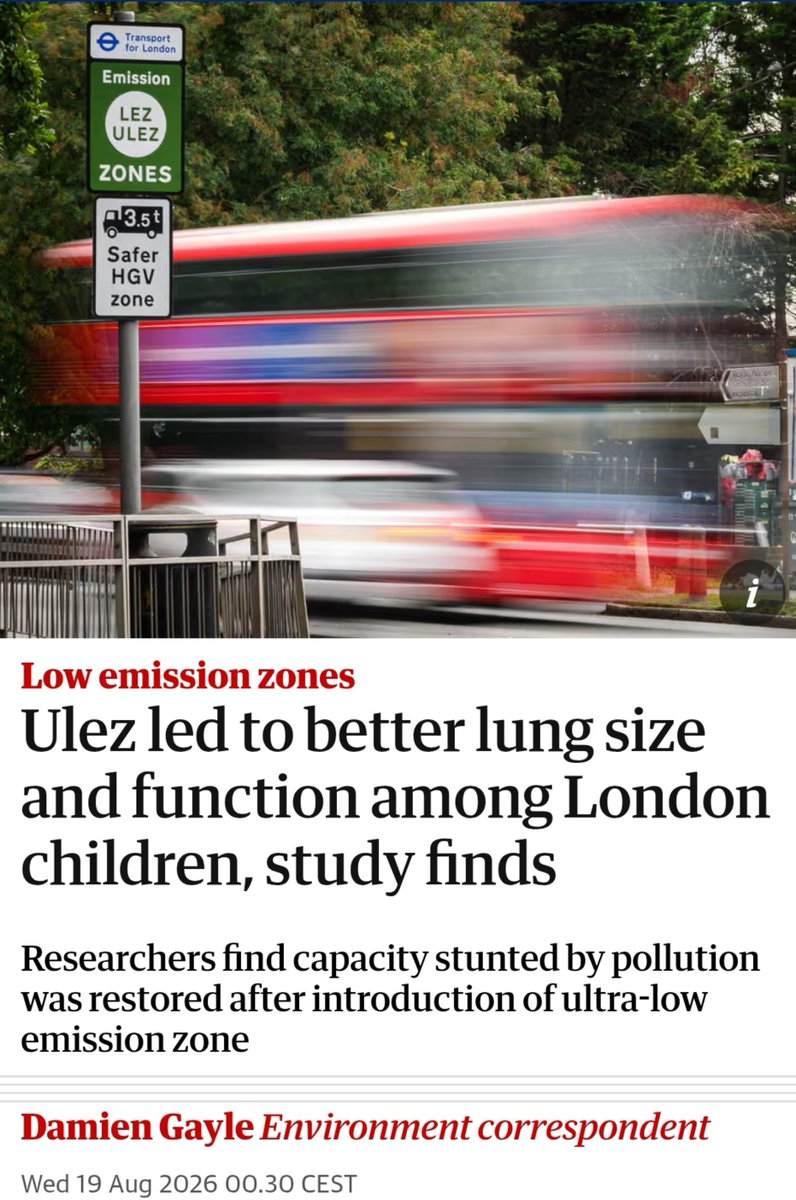
London Children's Lung Growth Caught Up After ULEZ, Queen Mary Study Finds
• From trending topic: London's ULEZ Linked to Children's Lung Growth Recovery
Summary
Children in central London showed faster lung growth after the Ultra Low Emission Zone was introduced, catching up with peers outside the capital as nitrogen dioxide levels declined, according to a Queen Mary University of London study. The result has circulated quickly on social media, where some posts have called the recovery striking and others have presented it as confirmation that the charging scheme produced a measurable health gain for young people. The research, described in circulating reports as independent, ties the change in lung development to the fall in NO2, a traffic-related pollutant. ULEZ requires drivers of higher-emitting vehicles to pay to enter the designated area. The findings arrive years after the zone's introduction and have been framed online as evidence of a policy effect on a vulnerable group.
Common Perspectives
Clean-air supporters treat it as policy validation
Environmental campaigners, public-health advocates and residents who backed ULEZ from the outset see the Queen Mary results as rare, concrete proof that restricting dirtier vehicles improves children's respiratory development. The appeal is the shift from emissions statistics to a physical outcome in growing lungs. This view assumes the study sufficiently isolated the zone's contribution from other simultaneous changes in traffic, vehicles or weather. The trade-off it accepts is the cost and inconvenience imposed on some drivers and businesses.
Opponents see correlation, not proof
Motorists, small-business owners and politicians who have long criticised ULEZ as a regressive charge tend to regard one study as insufficient to establish cause. They point to possible alternative explanations for both falling NO2 and improved lung growth. The stance resonates with those who paid the daily fee or changed their travel habits. It rests on the assumption that observational data cannot cleanly separate one policy from broader trends, and it carries the risk of discounting a genuine benefit if the link holds.
Independent researchers counsel caution
Epidemiologists and environmental-health scientists not involved in the work typically treat a single analysis as interesting but not definitive. They emphasise the difficulty of ruling out confounders in real-world air-quality studies. This perspective appeals to those who want replicated evidence before drawing strong causal conclusions. The implicit trade-off is slower or more limited policy adjustment while additional data accumulate.
London parents react to the personal implication
Families living inside the original zone often focus first on the suggestion that their children's lungs had been developing more slowly than those of children elsewhere. Relief that growth has now matched the rest of the country sits alongside questions about earlier years of higher exposure. The reaction is driven by everyday concern for kids rather than abstract debate. It assumes the catch-up is complete enough to close the gap, while leaving open the remaining urban health risks that a traffic charge does not address.
A Different View
The dominant discussion asks whether ULEZ "worked." A less examined question is what the catch-up itself says about both biology and geography. Developing lungs appear able to accelerate once a major pollutant drops, which could alter how delayed interventions are valued. At the same time, the need for London children to recover in order to match those outside the city highlights long-standing place-based differences in early-life health. Other urban areas with heavy traffic but no equivalent charging scheme may still have children whose lung trajectories lag, suggesting the relevant frame is national variation in child respiratory development rather than the success or failure of one city's zone.
Conclusion
How far the findings travel will depend on whether other researchers reach similar conclusions from the same or comparable data, and whether parallel patterns appear in cities that have introduced their own low-emission rules. Longer follow-up of the same children would also test whether the recovered growth trajectory persists.
Sources and discussion
These public posts were collected while researching this story. They provide context and reactions, but may not independently verify every claim.
View the original topic on XSky News
@SkyNews
London's ULEZ linked to improved lung growth in children, says study
Aug 18, 2026406 likes98 repostsBBC News (UK)
@BBCNews
Scientists stunned by children's lung recovery in ultra low emission zone
Aug 19, 2026271 likes108 repostsSadiq Khan
@SadiqKhan
NEW: An independent study by @QMUL has found that after the ULEZ was introduced, children’s lungs grew faster in central London, and have now caught up with children outside of the capital. Incredible news 💚
Aug 19, 2026459 likes144 reposts