

Falcon Heavy Sends NASA’s Roman Telescope Toward Its Destination
• From trending topic: SpaceX Launches NASA's Roman Space Telescope on Falcon Heavy
Summary
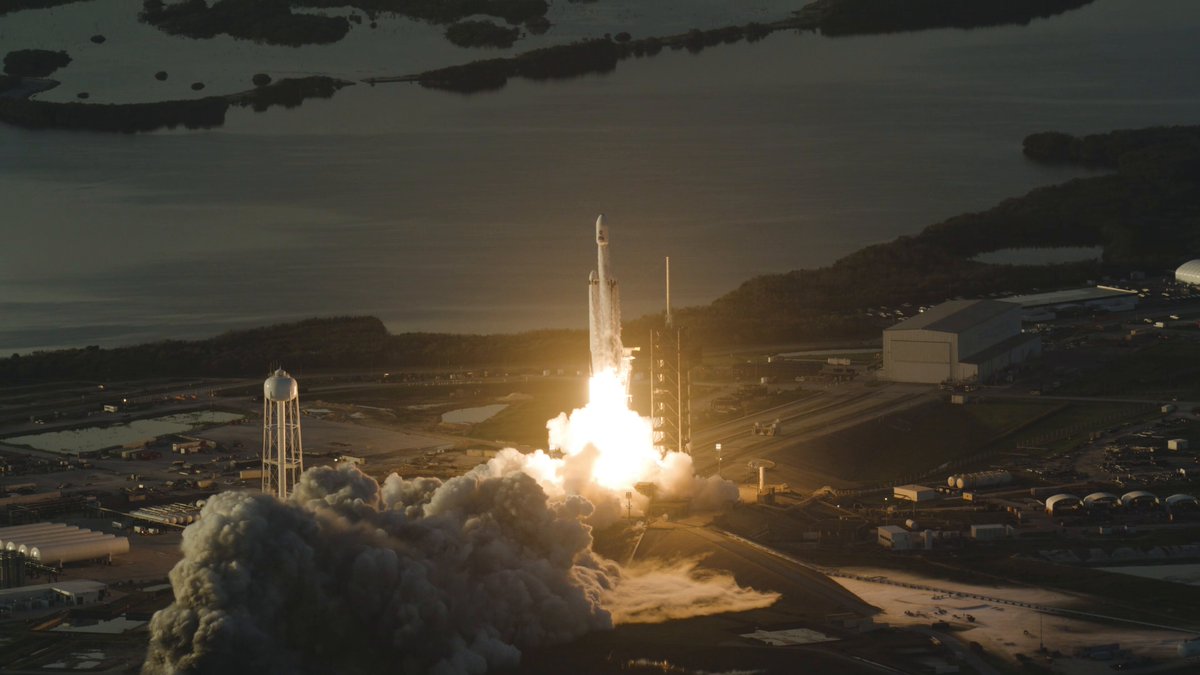
SpaceX launched NASA’s Nancy Grace Roman Space Telescope on a Falcon Heavy from pad 39A in Florida. The rocket’s two side boosters landed at LZ-2 and LZ-40. Deployment of the observatory was confirmed, and subsequent updates reported that its Solar Array Sun Shield and Lower Instrument Sun Shade had deployed, allowing the spacecraft to generate power and shade its instruments.
Social-media posts clustered around the event described a journey of more than three months to the telescope’s operating location and spoke of images of the universe that have not been possible before. Those characterizations come from public discussion of the launch, not from a detailed NASA commissioning report in the material reviewed here. What is established in the reporting is the launch itself, the booster recoveries, confirmed spacecraft deployment, and the early unfurling of the sun shield and solar arrays.
Roman is a NASA flagship astrophysics observatory. The launch places a high-value science payload on a commercially developed heavy-lift rocket and begins a long cruise before any science observations can start. Early hardware steps—power and thermal protection—now matter as much as the liftoff.
Common Perspectives
A new observatory is finally on its way
Astronomers, NASA supporters, and people who follow space science treat the launch as the start of a mission, not a spectacle. The appeal is straightforward: a large infrared survey telescope can, if it works, map the sky in ways Hubble and other predecessors could not. This view assumes the cruise, commissioning, and years of operations will succeed. The trade-off is patience. Pictures and catalogs arrive long after the rocket has been forgotten.
Reusability did the heavy lifting
Spaceflight watchers and commercial-space advocates focus on Falcon Heavy flying a NASA flagship and bringing both side boosters back. The appeal is proof that a reusable heavy-lift vehicle can carry national science payloads and still recover hardware. The assumption is that one company’s cadence and reliability are now sufficient for this class of mission. The trade-off is concentration of risk: a delay or failure on that vehicle affects more than a single launch.
The rocket was the story
A large share of the public conversation, judged by the posts that spread, centered on the liftoff, the landings, and the confirmation that “deployment” had occurred. For launch-watchers, that is the event. The telescope remains an abstraction until data appear. This view is not wrong about what people actually watched; it simply treats the payload as secondary. The cost is that attention collapses once the boosters are on the ground.
Flagship science versus other NASA work
Some engineers, budget-minded observers, and supporters of human exploration see another large observatory as a choice, not an inevitability. Money and management attention spent here are not spent on crewed systems, planetary probes, or many smaller missions. The appeal is opportunity cost. The assumption is that NASA’s portfolio is zero-sum in practice even when it is not on paper. Roman’s defenders answer that survey science of this scale is exactly what a flagship is for.
A Different View
The informal updates—“Shades on and batteries charging”—are as revealing as the trajectory. A flagship NASA observatory is now narrated to the public in near-real time, with the same cadence and tone used for booster landings. That collapses the old gap between mission control and the audience. It also trains people to treat early deployments as the drama. The harder, slower work—keeping a thermally sensitive observatory healthy through a months-long cruise, then turning it into a survey machine—will not produce the same feed. The launch succeeded. The communications style succeeded. Whether that style helps the public stay with the mission after the rocket is gone is a different question.
Conclusion
The next public milestones are not another launch. They are whether the spacecraft stays healthy on the way, whether further deployments and checkouts occur as planned, and whether the observatory arrives ready to work. Those updates will be quieter than Falcon Heavy leaving pad 39A.
Sources and discussion
These public posts were collected while researching this story. They provide context and reactions, but may not independently verify every claim.
View the original topic on XSpaceX
@SpaceX
Falcon Heavy launches @NASA’s Nancy Grace Roman Space Telescope from pad 39A in Florida, beginning its more than three-month journey to its destination where it will generate never-before-seen photos of the universe
Aug 30, 202624.3K likes3.5K repostsSpaceX
@SpaceX
Falcon Heavy's two side boosters land at LZ-2 and LZ-40
Aug 31, 202610.7K likes1.2K repostsSpaceX
@SpaceX
Deployment of Roman confirmed
Aug 30, 202623K likes2.7K repostsNancy Grace Roman Space Telescope
@NASARoman
Shades on and batteries charging! 😎 🔋 Roman’s Solar Array Sun Shield and Lower Instrument Sun Shade have successfully deployed, powering the observatory and shading its instruments!
Aug 30, 202613.3K likes1.7K reposts