

SonicWall Warns of Actively Exploited Zero-Days in SMA 1000 VPNs
• From trending topic: SonicWall Patches Zero-Day Flaws in SMA 1000 VPNs Under Active Attack
Summary
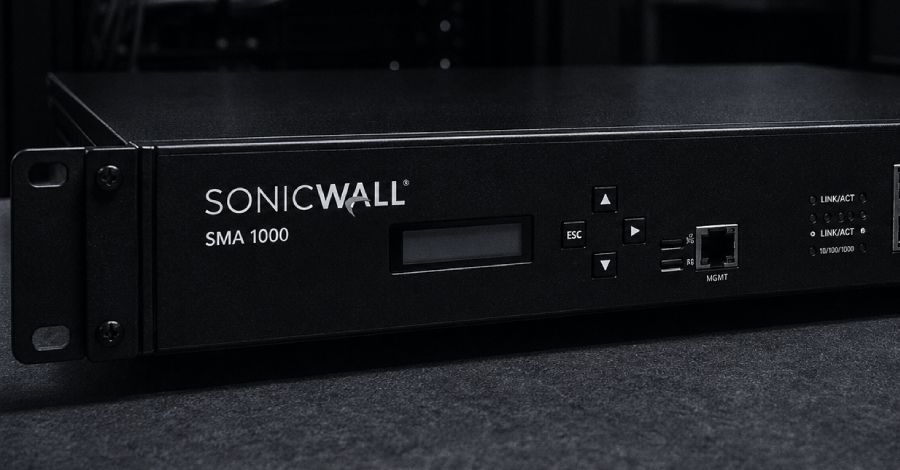
SonicWall has warned that two previously unknown flaws in its SMA 1000 series VPN appliances are being exploited in real attacks, and that customers need to upgrade immediately. The company’s alert is what pushed the story into circulation this week: not a theoretical advisory, but a claim that the bugs are already in use.
SMA 1000 devices sit at the network edge. They are built to handle remote access, which means they are often reachable from the internet and trusted once a session is established. That combination is why a vendor warning of this kind tends to move quickly among security teams even before every technical detail is public.
Accounts sharing the advisory described the pair of bugs in specific terms. One, they said, is a pre-authentication server-side request forgery (SSRF) issue, meaning it would not require a logged-in user. The other, according to the same circulating descriptions, would let an authenticated administrator inject operating-system commands under certain conditions. SonicWall, those reports said, indicated that attackers may have chained the two to run code. Those characterizations come from discussion of the warning, not from an independent public reconstruction of the exploits, and the company has not, in the material around this trend, laid out a full attack narrative with named intrusions, victim counts, or attribution.
What is established in the reporting brief is narrower and more operational: SonicWall says the flaws are zero-days, they are under active attack, they affect the SMA 1000 series, and the required response is an immediate upgrade. Unstated, at least in the information driving the trend, are the usual follow-on facts readers will want next—which software builds are vulnerable, whether any workaround exists short of upgrading, how widely the chaining is succeeding, and whether the activity is opportunistic scanning or a focused campaign.
That gap matters. “Actively exploited” is a high-urgency label. It is also a label that, without scope, leaves administrators to assume the worst about any SMA 1000 still on an older build.
Common Perspectives
This is an emergency patch, not a routine bulletin
Incident responders and security leads tend to treat a vendor’s “under active attack” notice as a stop-the-line event. The appeal is straightforward: once exploitation is claimed, waiting for a convenient maintenance window can mean handing an internet-facing concentrator to whoever got there first. That view assumes the upgrade is available for the builds actually in production, that it closes the chained path rather than one bug in isolation, and that the operational cost of rushing a VPN upgrade is lower than the cost of a foothold. The trade-off is real. Edge appliances are often the same systems people use to reach the network in order to patch everything else.
VPN appliances are a known hunting ground
A second reading, common among researchers and defenders who have watched years of incidents on remote-access gear, is that the product class is the story as much as SonicWall is. Internet-exposed VPN and secure-access devices have repeatedly been used as a first hop because they combine a large attack surface with privileged placement. This view is appealing because it places the SMA 1000 warning in a pattern rather than a one-off vendor failure. The assumption underneath it is that “another appliance zero-day” is the right frame. The trade-off is that pattern-matching can blur what is actually known here: two bugs, a possible chain, and a patch mandate—not a documented mass-exploitation wave, and not proof that every SMA 1000 on the internet is already compromised.
The people who run the boxes hear “upgrade now” as downtime
System administrators and managed-service providers often hold a more cramped view. SMA 1000 hardware is remote access. Taking it offline, or discovering that an upgrade breaks a client configuration, can lock staff and vendors out of the very network they are trying to defend. That perspective appeals because it matches how these devices are used: understaffed teams, brittle client software, and change windows that exist on a calendar, not in a security advisory. The assumption is that some compensating control—monitoring, restricting management interfaces, extra logging—can buy time. The trade-off is that those controls do not remove a pre-auth flaw on a device that is supposed to be reachable, and they do nothing if attackers have already chained to code execution.
Treat the technical claims as provisional until the advisory is read in full
A more cautious group, including some enterprise architects and legal/compliance readers, wants a hard line between SonicWall’s warning and the extra detail traveling with it on social media. They will patch because the vendor said to, while refusing to treat SSRF-plus-command-injection chaining as a fully specified incident report. That stance appeals as discipline: urgency without filling gaps with rumor. Its weakness is delay by another name. If the only confirmed instruction is “upgrade now,” waiting for a richer public write-up is not a mitigation.
A Different View
The argument unfolding around this warning is mostly about speed: how fast to patch, how loud to shout, how familiar the VPN-appliance plot has become. A less visited problem is placement. An SMA 1000 is not just another server with two new bugs. It is often the front door, the session broker, and a machine with a privileged view of internal networks. In that position, a pre-auth SSRF issue and an “authenticated admin” command-injection issue are not two separate risk tickets. They are adjacent privileges on the same internet-facing box.
Risk models still tend to downgrade anything that “requires authentication,” as if administrator access were a rare, well-guarded state. On a remote-access appliance, admin is a condition attackers work toward, and SSRF is a way to make the device talk to places its designers did not intend. Chaining, if SonicWall’s suggestion is right, is less a clever extra than the predictable result of stacking those bugs on a concentrator. The neglected question is not only whether customers applied this week’s upgrade. It is why so many organizations still terminate untrusted traffic on firmware appliances that are both exposed by design and trusted by default—then rediscover, each time a vendor says “zero-day,” that the patch treadmill is the substitute for changing that architecture.
Conclusion
The immediate fact to watch is whether SonicWall’s upgrade guidance is followed by a clearer public accounting: affected versions, any sign that the chain is widespread, and whether the activity stays confined to SMA 1000. Until that arrives, the responsible reading is the narrow one the company has already given—active exploitation, two flaws, patch now—without treating social-media reconstructions as a complete incident report.
Sources and discussion
These public posts were collected while researching this story. They provide context and reactions, but may not independently verify every claim.
View the original topic on XSecurityWeek
@SecurityWeek
SonicWall Warns of Two SMA1000 Zero-Days Exploited in Attacks
Sep 2, 20262 likes1 repostsThe Hacker News
@TheHackersNews
🚨 Attackers are exploiting two SonicWall SMA 1000 zero-days. One is a pre-auth SSRF flaw. The other allows an authenticated administrator to inject OS commands under specific conditions. SonicWall says attackers may have chained them to execute code. Find details here:
Sep 2, 202660 likes16 reposts