

UN Relief Chief and U.S. Press Council Over Arms as Sudan Crisis Is Called World's Worst
• From trending topic: UN Security Council Tackles Sudan's Humanitarian Crisis and Arms Debate
Summary
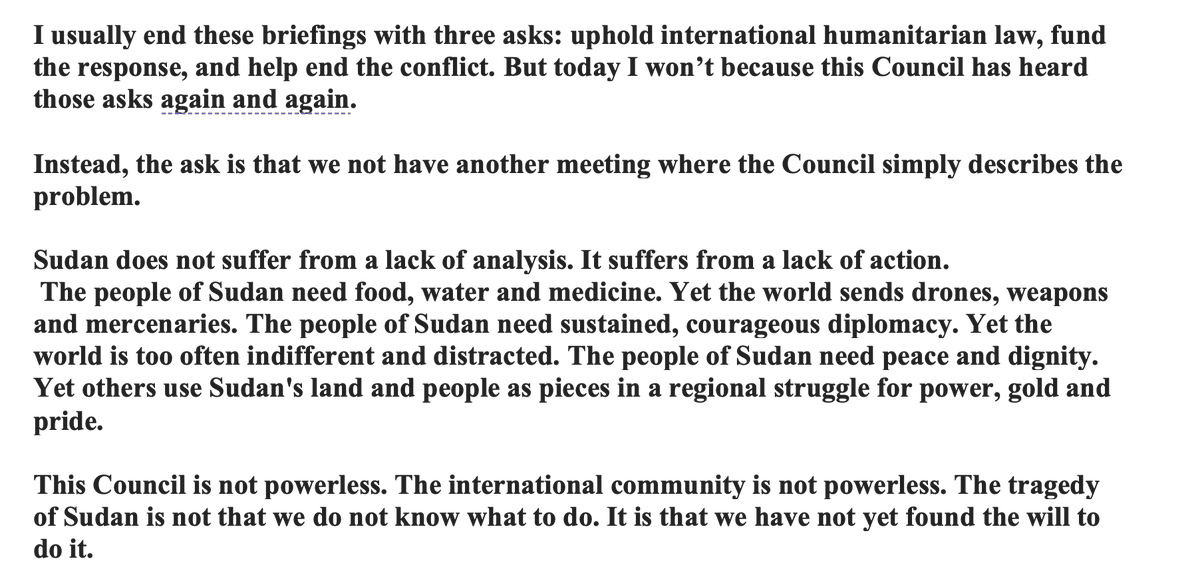
The UN Security Council took up Sudan's war this week, with the world body's relief chief arguing that countries keep sending weapons into what he called the planet's gravest humanitarian emergency while civilians go without food, water and medicine. In remarks that circulated widely after the session, he said Sudan does not lack analysis so much as action, and that the fighting is being fed by drones, mercenaries and a contest over power, gold and pride. A U.S. official, Senior Advisor for Arab and African Affairs Massad Boulos, separately urged the Council to expand the existing arms embargo on Darfur to the entire country, warning that outside military support risks widening the conflict and pulling in more regional actors. The posts and statements that followed treated the meeting as another moment of diagnosis rather than a turning point; whether any new restriction or diplomatic push follows remains unconfirmed.
Common Perspectives
Stop the weapons, deliver the basics
Humanitarian officials and advocates treat the session as evidence that the international community is choosing the wrong cargo. Their case, drawn from the relief chief's language, is that Sudanese civilians need medicine and water while the world supplies drones and fighters. The view appeals to people who track famine, displacement and aid blockages because it names a concrete mismatch. It assumes that cutting arms inflows would reduce violence enough for relief to move, and that public shaming can produce "courageous diplomacy." The trade-off is that it can understate how hard it is to police supply lines or to get a divided Council to act against members' partners.
Expand the embargo as a limited, practical step
U.S. officials, as represented by Boulos's reported remarks, present a nationwide embargo as a way to contain external fuel for the war without waiting for a full political settlement. The argument resonates with diplomats looking for an incremental tool already on the books in Darfur. It assumes the Council can agree to broaden the measure and that better coverage would actually constrain the flow of weapons and mercenaries. The risk, left largely unaddressed in the public comments, is that embargoes leak, that enforcement falls unevenly, and that some states will treat the proposal as theater rather than a constraint on their own clients.
The problem is will, not another briefing
A sharper version of the same frustration, voiced in one circulating statement, holds that Sudan has been studied enough. What is missing is political will to protect civilians and to stop treating the country as an arena for gold and prestige. This perspective appeals to Sudanese voices and long-time observers tired of sequential Council meetings that produce language but little change. It assumes "action" is identifiable and that the main obstacle is complacency rather than incompatible interests among the powers that would have to enforce it. That assumption can make the failure look like a moral lapse instead of a structural one.
A Different View
The arms debate frames Sudan mainly as a destination for other countries' recklessness. The references to gold, pride and regional draw-in point to something the session itself is less equipped to handle: a war that generates its own resources and patronage networks. External weapons matter, yet so do the local and regional markets that keep demand high and that can reroute around a paper embargo. Treating the Council meeting as the decisive arena may miss how those incentives operate whether or not a resolution is amended.
Conclusion
The immediate test is whether the U.S. proposal to widen the Darfur embargo gains any traction and whether aid access improves in the weeks after the session. The larger unknown is whether members who heard the relief chief's warning are among those whose partners keep the weapons moving.
Sources and discussion
These public posts were collected while researching this story. They provide context and reactions, but may not independently verify every claim.
View the original topic on XNicholas Kristof
@NickKristof
Sudan is the world's worst humanitarian crisis, fueled by the recklessness of countries sending in arms and by the complacency of the international community. @UNReliefChief @TFletcher speaks eloquently to the UN Security Council on Sudan.
Aug 24, 2026219 likes113 repostsUnited Nations
@UN
“The people of Sudan need food, water and medicine. Yet the world sends drones, weapons and mercenaries.” @UNReliefChief urges Security Council to protect civilians, stressing that Sudan’s crisis demands courageous diplomacy and greater political will.
Aug 24, 202691 likes32 repostsAl Arabiya English
@AlArabiya_Eng
US Senior Advisor for Arab and African Affairs Massad Boulos calls on the UN Security Council to expand the existing arms embargo on Sudan’s Darfur region to the entire country, warning that external military support risks deepening the conflict and drawing in more regional
Aug 24, 202612 likes7 repostsTom Fletcher
@UNReliefChief
Sudan does not suffer from lack of analysis, but lack of action. Sudanese people need diplomacy, water and medicine. Yet world sends drones, weapons and mercenaries in struggle for power, gold and pride. My Security Council statement:
Aug 24, 2026113 likes48 reposts