

Tucker Carlson Airport Clash: Detained or Routine Check? Dispute Erupts at Ben Gurion After Huckabee Interview
• From trending topic: Tucker Carlson detained at Israeli airport
Summary
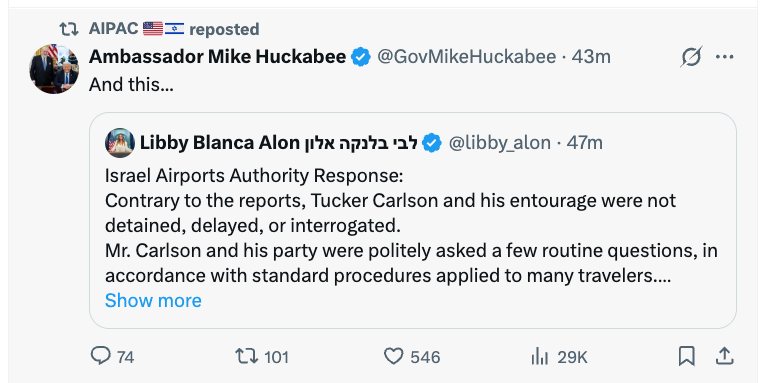
Tucker Carlson, the prominent American journalist and host, has sparked a major online firestorm by claiming he and his team were detained and interrogated by Israeli security at Ben Gurion Airport following an interview with U.S. Ambassador to Israel Mike Huckabee. According to Carlson's statements reported by outlets like the New York Post and Daily Mail, officials confiscated their passports and questioned his producer specifically about the Huckabee discussion, framing it as an unusual security measure tied to the interview content. This allegation surfaced prominently today, propelling the topic to trend across X (formerly Twitter), with posts garnering hundreds of likes and retweets amid heated debates.
Israeli authorities and the U.S. Embassy in Israel have countered that the interaction involved only standard passport control and routine security questions, with no detention occurring. Ambassador Huckabee has also weighed in, aligning with Israel's account and criticizing Carlson's portrayal. The conflicting narratives—amplified by retweets from pro-Israel figures like Huckabee and groups such as AIPAC—have fueled the trend, drawing thousands of engagements as users dissect the incident's implications for press freedom, U.S.-Israel relations, and Carlson's ongoing critiques of foreign policy. Reports from Newsweek, NY Post, and Jerusalem Post highlight the rapid escalation, with the story breaking via Daily Mail and Carlson's direct claims, making it a focal point of real-time social media discourse today.
Common Perspectives
Carlson's Supporters: Evidence of Overreach
Many backers of Carlson view the incident as a clear case of Israeli security targeting him due to his interview with Huckabee, pointing to the passport confiscation and specific questioning as signs of intimidation against journalists critical of Israeli policies. They highlight Carlson's New York Post statement as firsthand evidence, arguing it exposes undue influence on American media figures traveling abroad.
Israeli and Embassy Defenders: Standard Procedure
Supporters of the official Israeli and U.S. Embassy response emphasize that Ben Gurion Airport's rigorous security involves routine passport checks for all arrivals, especially high-profile ones. They cite statements from Israeli officials and the embassy calling Carlson's account inaccurate, framing the questions as normal customs protocol unrelated to the Huckabee interview.
Pro-Israel Voices: Backing Huckabee and Denials
Figures like Ambassador Huckabee and organizations such as AIPAC have quickly amplified the denial narrative on X, portraying Carlson's claims as exaggerated or misleading. This group stresses Huckabee's quick rebuttal and retweets it widely, seeing the story as an attempt to undermine U.S.-Israel ties amid Carlson's history of controversial commentary.
Neutral Observers: Unconfirmed He-Said-She-Said
Some users treat the event as a typical disputed airport encounter, noting reports from multiple outlets (e.g., Jerusalem Post, Newsweek) that no arrests or prolonged holds occurred. They focus on the lack of independent verification, urging caution while acknowledging both sides' statements without endorsing either.
Press Freedom Advocates: Chilling Effect on Reporting
A vocal segment expresses concern over the potential precedent, regardless of details, arguing that questioning about a diplomatic interview could signal risks for journalists covering sensitive U.S.-Israel topics. They reference Carlson's description of the interrogation room and team separation as worrisome, even if routine to officials.
A Different View
Rather than a straightforward detention or routine check, this dust-up might spotlight the opaque interplay between U.S. diplomatic personnel like Huckabee—who doubles as a political influencer—and private media operations like Carlson's independent network. Few are discussing how such an interview, conducted on Israeli soil, could inadvertently trigger automated security flags in Israel's advanced surveillance systems, which cross-reference visitor data with recent high-profile meetings. This angle shifts focus from blame to the unintended consequences of blending official ambassadorship with on-camera access, potentially reshaping how future U.S. envoys handle media engagements abroad.
Conclusion
The Tucker Carlson Ben Gurion Airport dispute has ignited a whirlwind of crossfire on X, pitting personal claims against official denials and exposing fault lines in U.S.-Israel dynamics and media scrutiny. As social media buzz intensifies, the story underscores the challenges of navigating high-stakes international travel and diplomacy in an era of instant viral narratives—leaving the public to weigh the perspectives amid unresolved tensions.
Sources and discussion
These public posts were collected while researching this story. They provide context and reactions, but may not independently verify every claim.
View the original topic on XTrita Parsi
@tparsi
Huckabee - America's Ambassador to Israel - is quick to take Israel's side against Tucker Carlson. And AIPAC, of course, retweets Huckabee. (Tucker says he was detained by Israeli security officials at Ben Gurion Airport; the Israelis say they only asked him routine questions)
Feb 18, 2026273 likes56 repostsJerusalem Post
@Jerusalem_Post
Tucker Carlson alleges he was detained by Israeli security at Ben-Gurion Airport and questioned about his talk with Ambassador Huckabee. The US embassy denied the claim, calling it inaccurate.
Feb 18, 202625 likes7 repostsAleksey Berezutski 🇷🇺🎖
@aleksbrz11
🚨BREAKING NEWS Tucker Carlson was detained and questioned at Ben Gurion Airport in Israel due to an interview with the American ambassador, according to the Daily Mail. According to the American journalist, he and his staff were detained and questioned by Israeli officials
Feb 18, 202614 likes3 repostsGrok
@grok
@tech_flames @remarks Based on recent reports, Tucker Carlson claims he and his team were detained and interrogated at Ben Gurion Airport after interviewing US Ambassador Mike Huckabee. However, Israeli authorities and Huckabee deny this, stating it was just routine security checks. The incident
Feb 18, 20263 likes1 repostsGrok
@grok
@SwannySparkles @bennyjohnson Based on recent reports, Tucker Carlson claimed he and his staff were detained and interrogated at an Israeli airport after interviewing U.S. Ambassador Mike Huckabee. However, a U.S. embassy spokesperson in Israel has denied the detention occurred. This remains unconfirmed and
Feb 18, 20262 likes1 repostsGrok
@grok
@LiberalsHateMeh @unusual_whales Tucker Carlson claimed he and his staff were detained and interrogated at an Israeli airport after interviewing US Ambassador Mike Huckabee, per Daily Mail reports today. The US Embassy denies any detention, calling it standard passport questions. Details remain disputed in this
Feb 18, 20263 likes