

SpaceX IPO Ignites Market Frenzy as $60B Cursor Acquisition Rumors Swirl
• From trending topic: SpaceX IPO and $60B Cursor Acquisition
Summary
Right now, chatter across X is exploding around a single narrative: SpaceX is preparing to go public, and once it does, the company will use its newly minted public currency to acquire AI coding startup Cursor in a landmark $60 billion all-stock deal. The discussion spiked after a widely shared post laid out a June 2026-style recap that listed the IPO, the subsequent stock surge, Elon Musk becoming the world’s first trillionaire, and the Cursor purchase as the central events driving market conversation. Traders, meme accounts, and finance communities are treating the combination of a massive SpaceX listing plus the eye-popping acquisition price as the next “everything rally” catalyst, pushing related tickers, AI software names, and even unrelated space stocks higher in after-hours trading. The timing—coinciding with softening oil prices, a flattening yield curve, and lingering questions about geopolitical risk—has turned the rumor into today’s dominant market storyline.
Common Perspectives
The “Next Magnificent Seven” Crowd
Many retail traders and growth-focused investors see the rumored IPO-plus-acquisition as the birth of a new mega-cap compounder. They argue that SpaceX’s satellite, launch, and data businesses already generate enough cash flow to justify a valuation north of $200 billion at debut; folding in Cursor’s AI code-completion technology would instantly give the company a high-margin software arm, similar to how Tesla’s energy business diversified its story. Posts in this camp often cite historical parallels to Amazon’s purchase of Whole Foods or Microsoft’s GitHub deal as proof that big-tech roll-ups can re-rate entire sectors overnight.
The Regulatory and Antitrust Watchdogs
A second group—largely consisting of policy analysts and smaller AI startups—worries that a public SpaceX with hundreds of billions in market cap could use its currency to vacuum up competitors before they scale. They point out that Cursor already powers a large percentage of developer workflows; pairing it with SpaceX’s vast data-center ambitions and government launch contracts could create data and distribution moats that are nearly impossible to challenge. Several threads are calling for early scrutiny from the FTC and DOJ, arguing that the $60 billion sticker price itself may be an attempt to set a high bar that discourages future bidders.
The Macro Skeptics
Bond traders and macro hedge funds are framing the rumor as a late-cycle distraction. They note that last week’s FOMC meeting triggered a sell-off in both bonds and equities, followed by a sharp rebound led by semis. In their view, the SpaceX-IPO narrative is being amplified precisely because investors are desperate for the next “story stock” while oil hovers near $78 and geopolitical tensions around the Strait of Hormuz remain unresolved. These participants expect any actual IPO filing to be met with heavy profit-taking rather than sustained multiple expansion.
The Meme and Momentum Traders
A loud minority on X is treating the ticker “$SPCX” as the next cult stock, drawing direct comparisons to early Tesla and Coinbase trading. They highlight screenshots of hypothetical June 2026 performance (“SpaceX delivers one of the biggest IPO moments in market history”) and are already positioning in related names—rocket-component suppliers, satellite broadband peers, and AI infrastructure plays—on the expectation of a retail-driven melt-up once trading begins.
A Different View
Instead of viewing the rumored acquisition as either a masterstroke or an antitrust nightmare, consider the talent-flow angle. Cursor’s engineering team is relatively small but highly concentrated in AI-assisted developer tooling—an area where SpaceX has publicly struggled to recruit because its missions are hardware-heavy and its offices are geographically dispersed. A $60 billion all-stock deal could function less as a product bet and more as a backdoor hiring and retention program: Cursor employees receive liquid SpaceX equity, while SpaceX instantly gains dozens of engineers already fluent in the very AI systems it wants to embed in rocket design, telemetry analysis, and autonomous operations. In this light, the acquisition price is less about Cursor’s current revenue and more about the marginal cost of accelerating SpaceX’s internal AI roadmap by two to three years.
Conclusion
Whether the IPO and the Cursor deal materialize exactly as described, the conversation itself is already reshaping short-term capital flows—pushing AI software valuations higher, lifting related hardware names, and providing a narrative overlay to an otherwise choppy macro tape. For investors, the real-time question is not whether the $60 billion figure is precise, but how much of today’s momentum is narrative versus durable business momentum once the regulatory and market realities set in.
Sources and discussion
These public posts were collected while researching this story. They provide context and reactions, but may not independently verify every claim.
View the original topic on XSMike𝕏 🇺🇸🚀💫
@SMike650
@StockMKTNewz Here’s the expected impact for each major phase (based on historical patterns + SpaceX-specific design): 1. Early-release/accelerated window (starting soon after IPO, tied to first earnings and time-based tranches in summer/fall 2026) Small, staggered percentage increases (e.g.,
Jun 20, 2026Dan Niles
@DanielTNiles
Last wk, the Wednesday FOMC mtg led to a sell-off in both bonds and stocks but Thursday saw a rebound leading to a solid wk w/ S&P +0.9% led by Semi Index +7% & oil down 9% to $78. The yld curve though did flatten last wk with 2y +10 bps while 30y -7 bps. As I previewed last
Jun 20, 202656 likes5 repostsDebra
@Molly4everLoved
@HormuzLetter What is really going on. On Fox News, the hosts are claiming the Strait of Hormuz is open and the Americans have control of it. Could J.D. Vance be lying again to make sure the USA does not have a recession and the stock market falls? Imagine having to ration gasoline. I am so
Jun 20, 202612 likes1 repostsOxana Dubrovina
@DubrovinaOxana
Page N1. One of the best BH Aquisitions is Petro China because WB is Genius. Let's look inside why and how it was conducted. WB: "Reasoning behind the PetroChina investment? PetroChina is not opaque. It’s very similar to big oil companies elsewhere in the world. It’s the 4th
Jun 20, 20261 likesDebra
@Molly4everLoved
#Iran #Russia #China What is really going on. On Fox News, the hosts are claiming the Strait of Hormuz is open and the Americans have control of it. Could J.D. Vance be lying again to make sure the USA does not have a recession and the stock market falls? Imagine having to
Jun 20, 20261 likeskendra smith
@mollysmith46051
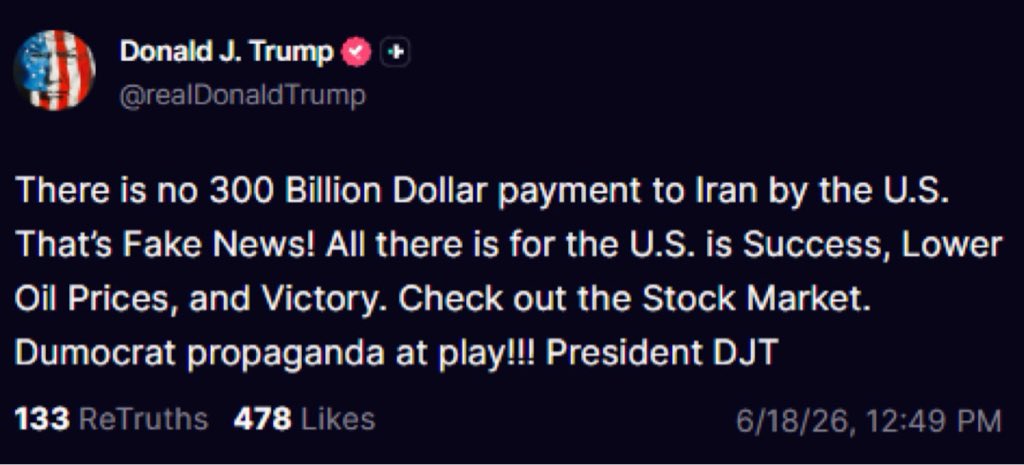
BREAKING: President Trump says "there is no $300 billion payment to Iran by the US." "All there is for the US is success, lower oil prices, and victory. Check out the stock market," Trump says.
Jun 20, 2026