

Services Surge Lifts US Activity Gauge to Fastest Pace Since 2022
• From trending topic: US Business Activity Hits Fastest Pace Since 2022 in August
Summary
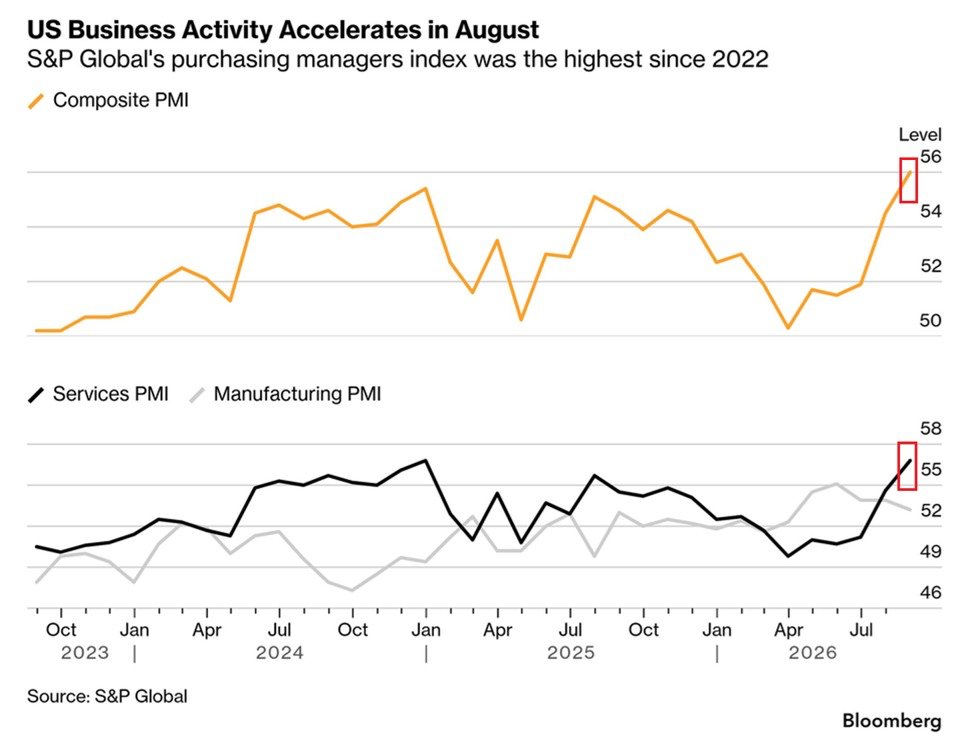
S&P Global’s flash US composite PMI rose to 56.0 in August, the strongest reading since April 2022, according to figures circulating in market reports and an evidence brief on the clustered story. That is a 1.5-point increase from 54.5 in July and the third consecutive monthly improvement. Any print above 50 signals expansion; 56 is a brisk one.
The move was not even. The flash services PMI jumped 2.2 points to 56.8, well above a 54.0 forecast cited in those same recaps. The manufacturing PMI came in at 53.2, still expanding but short of a 53.9 forecast. In other words, the headline “fastest pace since 2022” is largely a services story.
These are flash estimates, compiled from early survey responses rather than the full month-end sample, and they measure purchasing managers’ reports of output and related conditions—not GDP, jobs, or inflation directly. On X, the print was quickly framed as proof that “US economic momentum is accelerating.” That is an interpretation of a survey, not a completed picture of August.
Common Perspectives
The expansion is gathering speed
Investors, corporate managers, and commentators who treat PMI as a timely activity gauge see a third straight rise to a multi-year high as confirmation that demand is firming, not fading. The appeal is simplicity: one widely watched number, above 50 and rising, after years of arguments about a stall. The assumption is that what purchasing managers report this month will show up in spending, hiring, and profits. The trade-off is that flash PMIs are revised, cover larger firms more cleanly than the rest of the economy, and can look strong while households or particular regions feel no such lift.
Strong activity argues against easy money
People who watch the Federal Reserve more than the survey itself read a 56.8 services print as a reason to delay or scale back rate cuts. Services strength has, in recent cycles, coincided with stickier prices, and a surprise this large relative to the cited forecast feeds that habit of mind. It appeals to anyone who thinks 2021–22 taught that “hot” activity is not free. The assumption is that this burst of reported activity will translate into pricing power rather than higher real volume with slack. The trade-off is that activity and inflation can decouple when supply is adequate; a strong PMI is not itself a consumer-price print.
This is a two-speed report, not a boom
Factory-watchers and anyone who follows goods, freight, or industrial production point to the manufacturing miss. Services smashed expectations; factories did not. That pattern has been familiar in the United States for years, and it appeals because it refuses to let a services-heavy composite stand in for the whole economy. The assumption is that the split is meaningful—either a warning that goods demand is softer, or evidence that manufacturing will catch up. The trade-off is compositional: services dominate US output, so a composite that looks like services is, in a narrow sense, doing its job.
A flash survey is a clue, not a verdict
Economists and reporters who prefer payrolls, retail sales, industrial production, and inflation data treat the August flash as one early reading from one private survey. That skepticism appeals after previous PMI spikes and drops that did not match the hard data that arrived later. The assumption is that lagged official statistics are a better measure of what actually happened. The trade-off is timing: those statistics will not describe August for weeks, which is why a 56.0 flash moves markets and headlines first.
A Different View
The neglected question is not whether 56.0 is “good” or “bad,” but whose activity the number is capturing and what kind of strength it is. S&P Global’s PMI is built from firms organized enough to have purchasing managers; a services-led jump can reflect larger companies in health care, travel, finance, and business services booking more work, while factories, smaller operators, and goods supply chains tell a flatter story—the manufacturing undershoot already hints at that split.
“Fastest since April 2022” also imports a loaded comparison. That earlier period mixed genuine demand with reopening, strained supply, and rapid price increases. Matching the composite level years later does not say whether August’s rise is more output from spare capacity or more orders piled onto already busy service desks. The survey can register “faster activity” either way. The next useful details are the ones this flash headline does not provide: whether employment, backlogs, and prices paid moved with output, and whether the final August PMI still looks like 56 once the full sample is in.
Conclusion
The figure to test is not the composite trophy reading but the split beneath it: whether services stay this firm in the final PMI and in official data, and whether manufacturing’s miss was noise or the start of a flatter goods track.
Sources and discussion
These public posts were collected while researching this story. They provide context and reactions, but may not independently verify every claim.
View the original topic on XKaroline Leavitt
@PressSec
US Business Activity Expands at the Fastest Pace Since 2022
Aug 21, 20261.2K likes263 repostsThe Kobeissi Letter
@KobeissiLetter
US economic momentum is accelerating: The S&P Global US Composite PMI index surged +1.5 points in August, to 56.0, the highest since April 2022. This marks the 3rd consecutive monthly improvement. This comes as the Services PMI index jumped +2.2 points, to 56.8, the highest
Aug 22, 20261.8K likes247 reposts*Walter Bloomberg
@DeItaone
U.S. S&P GLOBAL AUGUST FLASH COMPOSITE PMI AT 56.0 (VS 54.5 IN JULY) U.S. S&P GLOBAL AUGUST FLASH SERVICES PMI AT 56.8 (FORECAST 54.0) U.S. S&P GLOBAL AUGUST FLASH MANUFACTURING PMI AT 53.2 (FORECAST 53.9)
Aug 21, 2026225 likes20 reposts