

Philippine Supreme Court Tells Congress It Must Ban Political Dynasties
• From trending topic: Philippine Supreme Court Orders Law Banning Political Dynasties
Summary
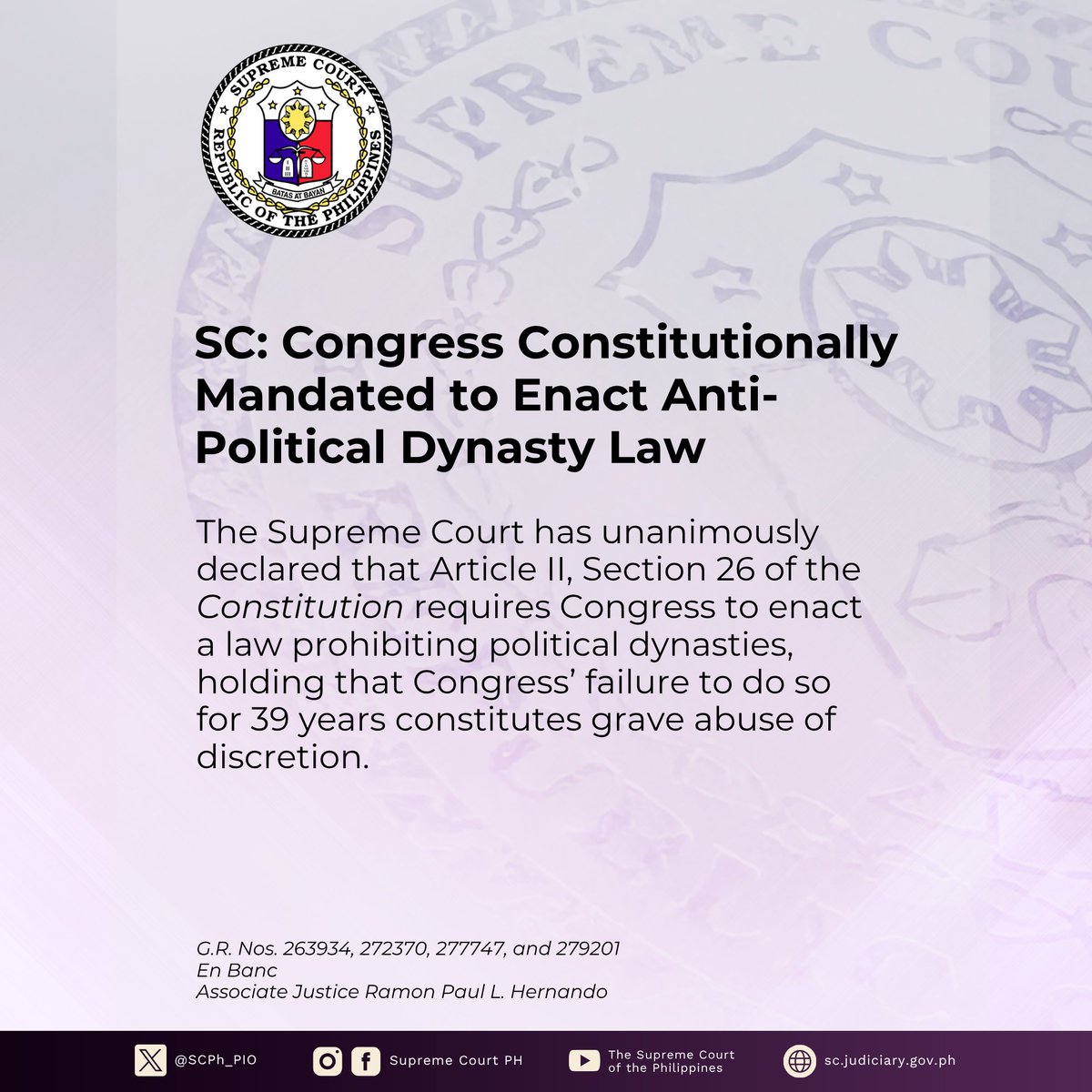
The Philippine Supreme Court unanimously declared that Congress must enact a law prohibiting political dynasties, according to its public information office. The office dates the decision to the Court's August 26, 2026 session and identifies Article II, Section 26 of the Constitution as the basis for the duty.
News5 reports that the Court ordered legislation after granting consolidated petitions. Leila de Lima quoted the ruling's finding that Congress's failure to act for 39 years constitutes grave abuse of discretion. ABS-CBN News reports that Senator Risa Hontiveros subsequently called for renewed consideration of an anti-political-dynasty bill. This is a direction to legislate, not evidence that a new statutory ban is already in force. The analysis below examines legislative choices rather than attribute unreported opinions to lawmakers or voters.
Common Perspectives
Give effect to the constitutional duty
The ruling makes legislative action the central issue. Hontiveros's reported request to resume consideration of the bill is one concrete response. Moving from that request to enacted text will matter more than treating the Court's decision as if it had already supplied the law.
The definition will determine the reach
A prohibition needs workable rules identifying the relationships and offices it covers. Different definitions could produce substantially different restrictions. The retained posts do not establish the final wording, so they cannot show who would become ineligible under a future law.
Implementation needs to be understandable
Candidates, election administrators and voters would need clear instructions about any new restrictions and their application. Ambiguous boundaries could produce disputes even after legislation passes. That is an implementation risk to examine, not evidence that a particular dispute or deadline has already arisen.
A Different View
A ban's practical effect depends on both its scope and how compliance can be checked. A broad principle may attract agreement while leaving difficult questions about evidence, enforcement and timing unresolved. Evaluating the eventual bill on those details would be more informative than judging compliance by its title alone.
Conclusion
The next substantive development will be the text Congress considers and the steps it takes toward enactment.
Sources and discussion
These public posts were collected while researching this story. They provide context and reactions, but may not independently verify every claim.
View the original topic on XLeila de Lima
@manayleila
The Supreme Court, in its ruling granting the petitions seeking to compel Congress to pass a law on political dynasties, stated: “Congress’ failure to do so for 39 years constitutes grave abuse of discretion.” Further delaying the passage of a genuine anti-dynasty law, or
Sep 16, 2026337 likes84 repostsABS-CBN News
@ABSCBNNews
Senator Risa Hontiveros, in today's plenary session, appeals to her colleagues to resume consideration of the Anti-Political Dynasty Bill. This, after the Supreme Court directed Congress to enact an anti-political dynasty law. | via @victoriatulad
Sep 16, 202668 likes4 repostsPhilippine Supreme Court Public Information Office
@SCPh_PIO
The #SupremeCourtPH 𝘌𝘯 𝘉𝘢𝘯𝘤, during its session on August 26, 2026, unanimously declared that Article II, Section 26 of the Constitution requires Congress to enact a law prohibiting political dynasties, holding that Congress’ failure to do so for 39 years constitutes grave
Sep 16, 2026861 likes361 repostsNews5
@News5PH
PAGBABAWAL SA POLITICAL DYNASTIES Inutusan ng Korte Suprema ang Kongreso na magpasa ng batas para ipagbawal ang political dynasties sa bansa. Ito’y matapos aprubahan ng korte ang consolidated petitions na inihain ng 1Sambayan Coalition sa pangunguna nina retired Supreme
Sep 16, 2026478 likes145 reposts