

NASA Seals Roman Telescope in Falcon Heavy Fairing Ahead of Florida Launch
• From trending topic: NASA's Roman Telescope Encapsulated for Falcon Heavy Launch
Summary
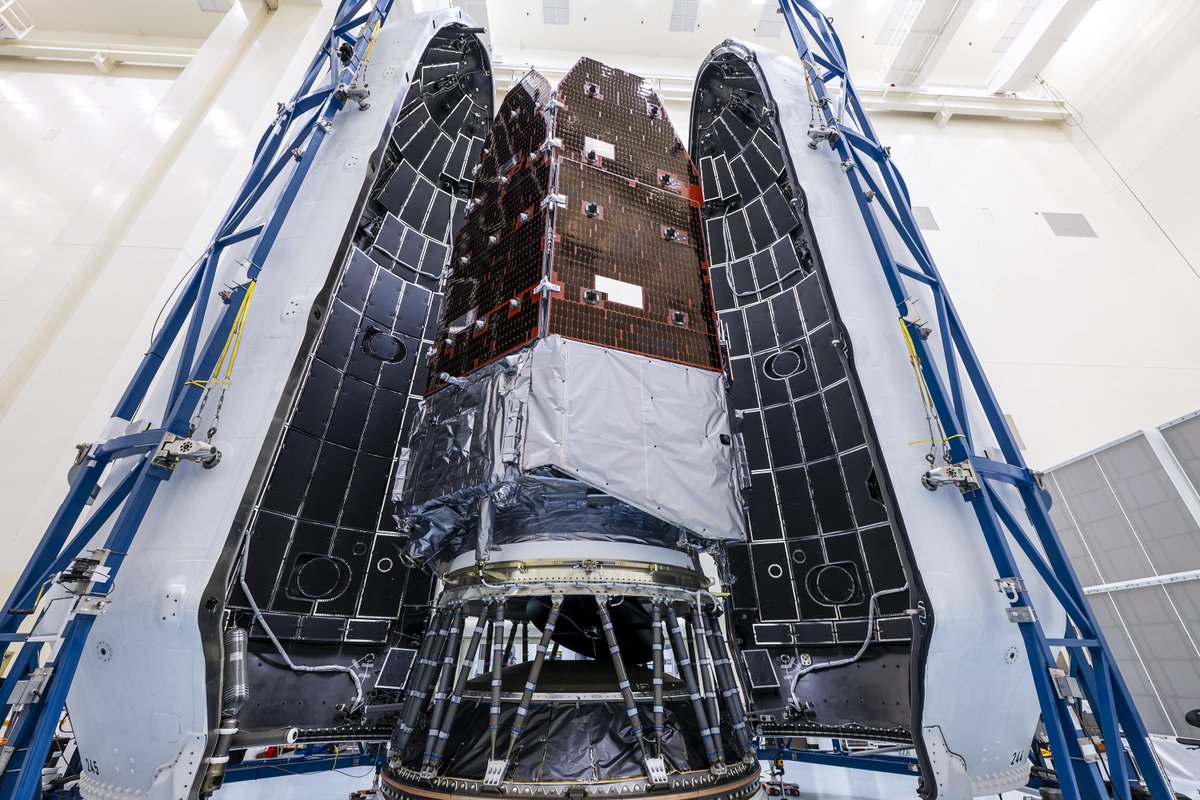
NASA has closed the payload fairing around the Roman Space Telescope, locking the observatory into a SpaceX Falcon Heavy for a launch now aimed at Sunday, August 30, from pad 39A at Kennedy Space Center.
Agency updates circulated this week said the spacecraft is encapsulated and due next at the hangar at Launch Complex 39A. NASA also said it will carry the attempt live beginning at 6:20 a.m. Eastern (10:20 UTC). If the flight holds to the present plan, Roman is to travel about a million miles from Earth to the Sun-Earth L2 point, a gravitationally useful station already occupied by the James Webb Space Telescope.
Encapsulation is a late, unglamorous threshold. The observatory is no longer hardware that technicians can walk up to on the ground; it is a payload, boxed for ascent. Roman is a wide-field infrared survey telescope, built to map large stretches of sky rather than stare at a few famous targets. Its intended work includes measuring how the expansion of the universe has changed and finding exoplanets through gravitational microlensing. The posts that pushed the story this week treated the fairing closeout as the start of launch week. That is fair as far as it goes. It is also incomplete: August 30 is a target, and late-summer weather, range timing, and last checks on the rocket can still move it.
Common Perspectives
The missing wide-field machine is finally leaving the ground
Professional astronomers, especially in cosmology and exoplanet demographics, tend to read the encapsulation as the end of a long wait for a survey companion to Webb. Webb is deep and narrow; Roman is meant to be fast and wide. The appeal is practical: some questions about dark energy and the frequency of worlds around other stars are statistical, and they need huge, uniform maps. The assumption underneath is that the instruments will perform as designed after launch and months of commissioning. The trade-off is patience. Catalogs and constraints arrive slowly, and a clean fairing photo is not evidence that the detectors, pointing, or survey strategy will deliver.
Flagship science now leaves Earth on a commercial heavy-lift rocket
Industry watchers and commercial-space advocates see a different milestone: a premier NASA observatory riding Falcon Heavy from the same pad complex that once served Apollo and the shuttle. The appeal is institutional. It suggests NASA’s most expensive science can use a rocket built for a mixed market rather than a purpose-built government launcher. The assumption is that a commercial heavy-lift vehicle is now mature enough for a unique, unrepeatable payload. The trade-off is heritage. Falcon Heavy has flown far less often than Falcon 9, and an anomaly on this flight would not be just another lost satellite.
Another large observatory absorbing money and attention
Budget skeptics, some congressional staff, and scientists in fields that live on smaller grants often greet news like this with fatigue rather than awe. Flagship telescopes concentrate funding, management attention, and public credit. The appeal of that critique is arithmetic and experience: big missions slip, grow, and then become too important to reshape. The assumption is that comparable knowledge could be bought in pieces, or that other disciplines are paying the opportunity cost. The trade-off is capability. A stable, wide-field infrared survey from L2 is not something a rideshare cubesat can imitate, even if the politics of one large project are ugly.
A launch people can set an alarm for
Casual space followers and NASA’s own communications audience have treated the week as a countdown story: packed, sealed, rolling toward 39A, cameras on at dawn. That view is not foolish. Encapsulation is one of the last concrete images before a rocket either leaves or sits. The appeal is human. Most of astronomy is invisible labor; a Sunday morning launch is not. The trade-off is expectation. Getting off the pad is the visible part. The mission’s value, if it has any, will be decided later, farther away, and in data products that do not look like a liftoff.
A Different View
The dominant conversation is still launch-week theater: a telescope in a fairing, a heavy rocket, a Florida pad. A quieter fact is that Roman is being committed to a place no crew can visit. Once it leaves for L2, there is no Hubble-style repair. Encapsulation is therefore less a ribbon-cutting than the end of physical access. That changes the meaning of “ready.” The remaining risks belong to the vehicle, the Cape’s August weather, and a long, unserviceable cruise.
There is a second mismatch. Roman is being discussed in the language of famous observatories, but it is closer to a census bureau than to a portrait studio. Agencies have a standing incentive to harvest attention when there is a rocket to film. Survey science does not return the favor on the same schedule. If the public is sold a spectacle, it will judge a catalog. That is not a reason to cancel the flight. It is a reason to notice that the story trending this week and the work the spacecraft was built to do are not the same story.
Conclusion
The next facts are mundane and decisive: whether the encapsulated observatory actually moves to the 39A hangar on the present timeline, whether August 30 survives weather and range constraints, and whether the departure toward L2 is clean. Those will matter more than the fairing photos.
Sources and discussion
These public posts were collected while researching this story. They provide context and reactions, but may not independently verify every claim.
View the original topic on XSpaceX
@SpaceX
NASA’s Roman Space Telescope was encapsulated into Falcon Heavy’s fairing this past week ahead of launch on Sunday, August 30 from pad 39A in Florida →
Aug 24, 20264.9K likes772 repostsNASA's Kennedy Space Center
@NASAKennedy
Roman is packed up and ready to roll! 🚀 NASA's @NASARoman is now encapsulated in the Falcon Heavy fairing ahead of a targeted launch on Aug. 30 from Kennedy. Next stop, the hangar at Launch Complex 39A.
Aug 24, 20261.1K likes162 repostsNASA
@NASA
In under a week, @NASARoman is scheduled to launch 1 million miles away to help us see the big picture of the cosmos. We’ll be broadcasting Roman’s launch live starting at 6:20am ET (1020 UTC) on Aug. 30. Save the date and set your alarm to join us here!
Aug 24, 20261K likes182 reposts