

Millions of City Voters Face Removal from India's Draft Electoral Rolls
• From trending topic: Millions of Urban Voters at Risk of Exclusion from India's Draft Electoral Rolls
Summary
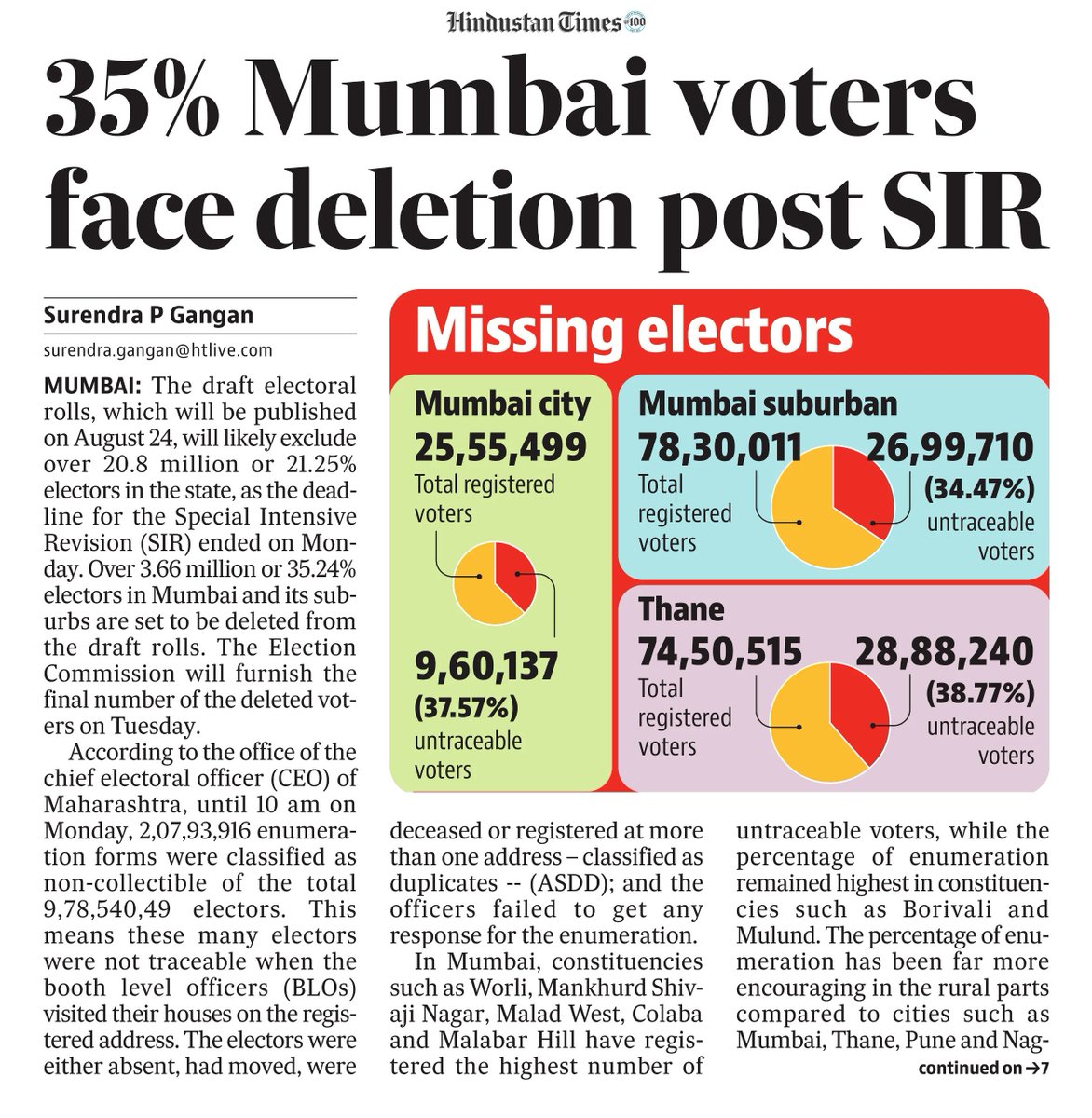
The Special Intensive Revision of voter lists has flagged millions of names for possible deletion, with urban centres absorbing the heaviest impact ahead of the draft rolls due on 24 August. Coverage of the just-closed exercise has centred on Maharashtra, where circulating figures put more than 20.8 million electors — roughly 21 percent of the state total — at risk of exclusion. Mumbai alone accounts for a large portion: reports cite 3.66 million voters, or about 35 percent of the city’s electorate. In Delhi the numbers cited exceed 4.7 million, including nearly 700,000 in the South East district, an area with sizable low-income and Muslim populations. The Election Commission of India uses the intensive revision to identify deceased, migrated or duplicate entries. Because Indian cities experience constant movement — people arriving, shifting neighbourhoods or leaving without updating records — the process naturally surfaces high volumes of unconfirmed addresses. The draft publication is not the final list; a claims-and-objections window follows. Still, the scale in Mumbai and Delhi has turned a routine administrative step into a live political and civic issue.
Common Perspectives
Cleaning the rolls is overdue and essential
Election officials and analysts who emphasise institutional integrity argue that inflated or outdated lists undermine every subsequent poll. Ghost voters, multiple entries and names of people who have long since moved or died distort constituency sizes and invite fraud. The high urban figures, in this view, simply quantify a known problem of mobility rather than reveal a new crisis. The appeal lies in the straightforward logic that accurate rolls are a precondition of fair elections. The trade-off accepted is that some genuine voters will have to re-register; the assumption is that the subsequent claims process will be sufficiently accessible and that the Commission’s field staff applied consistent criteria.
The numbers amount to large-scale disenfranchisement
Opposition voices, urban civil-society groups and residents of the affected neighbourhoods treat the same statistics as evidence that the exercise has swept up large numbers of eligible citizens. Renters, recent migrants, daily-wage workers and people living in informal settlements often lack the paperwork or the time to respond to verification notices. The concentration of potential deletions in South East Delhi has sharpened this reading among minority-rights advocates. The perspective resonates because it foregrounds inclusion and the practical barriers faced by the least documented urban residents. Its assumption is that notice-serving and house-to-house verification were incomplete; the trade-off it downplays is the possible retention of ineligible names if the bar for deletion is set too high.
This is simply what high mobility looks like
A more observational strand, visible in commentary about Mumbai’s “city of movement,” treats the figures as a demographic fact rather than a scandal. People arrive, change addresses, leave for other cities and rarely bother to update the electoral roll. Putting a number on that churn, these voices say, is useful but not inherently sinister. The view appeals to those who live the transience and see bureaucratic processes as chronically lagging behind reality. It assumes the deletions largely track actual relocation rather than administrative failure or targeting, and it accepts a permanently leaky urban roll as the price of a dynamic labour market.
Implementation looks uneven and therefore suspect
A fourth cluster of reactions focuses less on the overall totals than on their distribution. When a single district with a particular demographic profile accounts for a disproportionate share of Delhi’s potential deletions, questions arise about whether verification teams applied the same diligence everywhere. This reading is common among parties and activists already sceptical of the current Commission’s independence. It draws force from India’s history of contested roll revisions. The assumption is that patterns in the data reflect choices rather than coincidence; the corresponding risk is that legitimate variation in mobility or documentation rates is recast as proof of motive.
A Different View
The dominant argument treats the revision as a one-time event whose fairness can be judged by the raw deletion numbers. A less examined angle is that the entire architecture — residence-based, document-heavy, periodically “intensively” revised — was designed for a far more sedentary society. Megacities now contain millions of people whose housing is informal, whose work is itinerant and whose paper trail is thin. Each SIR therefore becomes a recurring collision between an old administrative logic and a new social fact. The overlooked question is not only who gets deleted this August, but whether India will keep running the same labour-intensive, error-prone exercise every few years or will move toward a more portable, digitally verified form of voter identity that travels with the citizen rather than remaining pinned to a last-known address.
Conclusion
The draft rolls themselves will appear on 24 August. What follows — how clearly reasons for deletion are communicated, how easily claims can be filed in dense slums and rental blocks, and whether the Commission releases any demographic or geographic breakdown — will determine whether the current numbers remain a snapshot of urban flux or become a lasting reduction in the urban electorate.
Sources and discussion
These public posts were collected while researching this story. They provide context and reactions, but may not independently verify every claim.
View the original topic on XJeet Mashru
@mashrujeet
35% Mumbai Voters face deletion post SIR. The draft electoral rolls, which will be published on August 24, will likely exclude over 20.8 million or 21.25% electors in the state, as the deadline for the Special Intensive Revision (SIR) ended on Monday. Over 3.66 million or
Aug 18, 2026335 likes111 repostsMumbai Heritage
@mumbaiheritage
Mumbai has always been a city of movement. People arrive here. Move from one neighbourhood to another. Leave for other cities. And sometimes, never update their old address. The latest electoral roll revision puts a number to that churn. 36.6 lakh voters in Mumbai and its
Aug 18, 2026143 likes23 repostsMaktoob
@MaktoobMedia
More than 47 lakh Delhi voters, including nearly seven lakh in Muslim-populated and low-income South East Delhi, face exclusion from the draft electoral roll under the ongoing SIR exercise.
Aug 18, 2026128 likes76 reposts