

July CPI Cooling Lifts S&P 500 Above 7,800
• From trending topic: July CPI Disinflation Sends S&P 500 to Record Highs
Summary
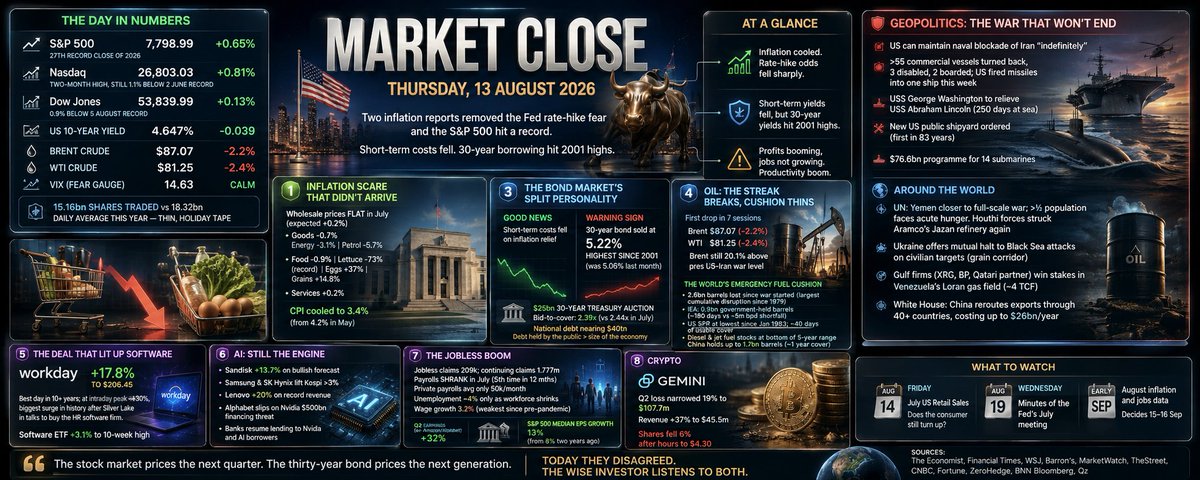
The S&P 500 closed above 7,800 for the first time after July consumer-price data showed further cooling in inflation. Market recaps described two inflation reports in two days as having quietly removed the prospect of a near-term Federal Reserve rate increase, the outcome many traders had feared most.
Equities posted their strongest week since April. Recaps circulating after Thursday’s close put the S&P 500 gain at 3.6 percent to a new high, the Dow Jones Industrial Average up 3 percent, and the Nasdaq Composite up 5.2 percent. The same week, a government jobs report indicated the U.S. economy lost 23,000 positions in July. Gold moved above $4,400. Bitcoin fell 2.8 percent, and some artificial-intelligence hardware shares encountered selling that participants labeled a “sell-the-news” reaction. One recap noted that the U.S. government continued to borrow at almost the same moment the stock index set its record.
The combination of a record equity close, a negative jobs print, a strong gold move, and ongoing Treasury issuance has produced sharply different readings of what the data actually mean.
Common Perspectives
Soft-landing confirmation for equity holders
Investors already positioned in growth stocks and broad indexes treat the July CPI reading, especially when paired with job losses, as evidence that inflation can recede without a deep downturn. Lower policy-rate odds support higher valuations, particularly in technology. The view appeals because it validates existing holdings and the narrative that has driven much of the year’s advance. Its central assumption is that the July employment decline will stay contained and that one or two inflation prints are enough to lock in easier financial conditions.
Labor-market caution among employment watchers
Economists and analysts who prioritize household and hiring data see a net job loss alongside cooling prices as a possible sign of softening demand rather than a tidy rebalancing. This reading is common among those who track real-time consumer health more closely than index levels. It appeals because it keeps the focus on whether weaker labor income will eventually feed back into spending and prices. The trade-off is that it can underweight the market’s forward-looking nature; the assumption is that inflation progress remains fragile if energy or shelter costs reverse.
Cross-asset skepticism from metals and crypto traders
Holders of gold and some digital assets highlight the metal’s move above $4,400 as evidence that not every participant accepts a straightforward disinflation-plus-growth story. Bitcoin’s decline and the selling in AI hardware names suggest the equity rally is narrower than headline indexes imply. This perspective appeals to those who view persistent government borrowing as a reason to keep inflation hedges even while stocks rise. It assumes older correlations still operate and that fiscal deficits will eventually reassert themselves in asset prices.
A Different View
The week’s price action may reflect the sudden removal of one discrete policy risk more than a fresh assessment of economic strength. Once two inflation reports took a rate hike off the table, systematic strategies and leveraged positions that had been defending against tighter policy could unwind quickly, amplifying the S&P 500’s move through 7,800. The simultaneous Treasury borrowing noted in the same recaps underscores that fiscal policy has not tightened. In that setting the dual record in stocks and gold looks less like a verdict on productivity or earnings and more like a liquidity-and-positioning event whose durability will depend on whether August labor data confirm July’s job loss as noise or the start of a trend.
Conclusion
The next employment report and the Federal Reserve’s characterization of the inflation progress will show whether markets continue to treat cooling prices and weaker hiring as complementary or as conflicting signals. Gold’s ability to hold its gains while equities extend theirs will test whether the two markets are describing the same economy.
Sources and discussion
These public posts were collected while researching this story. They provide context and reactions, but may not independently verify every claim.
View the original topic on XIRSProb.com
@irsprob
Stocks just had their best week since April. The Dow rose 3 percent, the S&P 500 gained 3.6 percent to a new closing high, and the Nasdaq climbed 5.2 percent. Also this week: the U.S. economy lost 23,000 jobs in July.
Aug 12, 2026YUBIT
@YUBIT_Exchange
July CPI confirmed disinflation, sending the S&P 500 to a new record and Gold above $4,400. Yet Bitcoin slipped 2.8% while AI hardware faced a “sell-the-news” test. Explore the week’s key cross-asset signals. 📊
Aug 16, 20268 likes1 repostsMansa Tesla
@MansaTesla
MARKET CLOSE — THURSDAY, 13 AUGUST 2026 Two inflation reports in two days quietly removed the thing markets feared most — a Federal Reserve rate rise — and the S&P 500 cleared 7,800 for the first time in history. At almost the same moment, the US government borrowed money for
Aug 13, 20261 likes