

Courts Sealed Across Zambia on the Last Day to Challenge the Election
• From trending topic: Zambia Closes Courts on Opposition's Final Election Petition Day
Summary
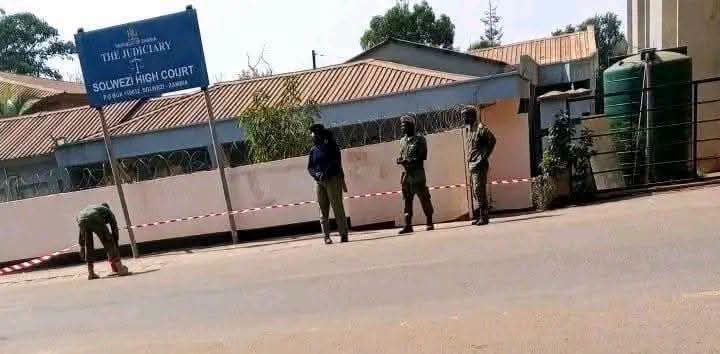
High Court premises in Lusaka and other parts of Zambia were closed and barricaded on August 24, the final day for filing presidential election petitions. Reports circulating with the story described the sites as crime scenes. Local courts were said to be affected as well. One widely shared account showed the High Court in Solwezi, the capital of North-Western Province, among the buildings shut.
That combination — a statutory deadline and physical closure of the buildings where petitions are filed — is why the episode moved so quickly. Posts clustered around the story said judges and court staff had been told not to report for work, that hearings were adjourned, and that President Hakainde Hichilema’s government had closed the High Courts. Those claims about instruction, nationwide policy, and presidential direction are circulating as allegations. The material driving the trend does not include an official circular, a police docket, or a ministry explanation that would settle whether this was a coordinated shutdown, a security response to a specific incident, or a patchwork of local closures.
What is consistently described is simpler and still serious: courthouse gates that would not open on the last day the opposition could take the election to court. Ordinary matters in local courts appear to have been interrupted at the same time. How many petitions, if any, were accepted, rejected, or left unfiled is not established in the available reporting.
Common Perspectives
The courthouse door was the last remaining check
Opposition supporters and critics of the government read the closures as a political act. If the last legal day to contest the presidency is also the day the High Court is taped off, the right to petition exists only on paper. The view appeals to people who already distrust the official result and who treat access to a judge as the difference between a hard loss and a managed one. It assumes the shutdown was directed rather than incidental. The trade-off is that once every closed gate is framed as proof of a stolen process, a real security incident or a local administrative failure becomes almost impossible to acknowledge without sounding like surrender.
A messy security day, inflated into a coup narrative
Government supporters and voters who prize order after years of turbulent politics argue that a courthouse can be sealed for reasons that have nothing to do with silencing petitions: a threat, an investigation, a facilities emergency. In this reading, social posts collapsed an ugly operational morning into a story about Hichilema padlocking the judiciary. The appeal is stability, and skepticism toward an opposition that benefits if the courts look captured. It assumes a mundane explanation exists and will be produced. The cost of that assumption is time. On a filing deadline, silence is not neutral; by the time an official account arrives, the window it was meant to explain may already have closed.
Procedure is the story, not the tally
Lawyers, rights monitors, and some international observers set the vote count aside and look at the institution. Local courts were reportedly closed too, which would mean tenants, accused persons, and civil litigants lost a day of justice that had nothing to do with the presidency. This view appeals to people who think a disputed election is survivable, while a habit of treating courthouses as disposable is not. It assumes that physical access and filing procedure are themselves a form of legitimacy. The weakness is tone: a procedural critique can sound bloodless to those who believe the election was taken, and credulous to those who think open courts would only have been used to inflame the street.
The record is still too thin for the certainty on offer
A fourth group treats the virality itself as the problem. Barricades and empty benches are visible. A nationwide order from the presidency, a staff lockout, and a coordinated crime-scene designation across Lusaka and Solwezi are inferences. This caution appeals to readers who have watched incomplete posts harden into settled history. It assumes that waiting for primary documents is still possible. The trade-off is practical: election-petition law is built on calendars, not on the pace of verification. Restraint after the deadline can look like wisdom and still leave the losing side without a file stamp.
A Different View
The neglected fact is how brittle the petition system was before anyone hung a lock on a gate. A constitution that funnels the most explosive litigation in the country onto a single calendar day turns the courthouse entrance into a single point of failure. A power cut, a strike, a genuine crime, a rumor of a crime, or a police tape used as an administrative tool can all produce the same political result. That design gives a government an enormous incentive to keep the building closed and an opposition an enormous incentive to treat any disruption as proof. It also hides a quieter cost. If local courts were sealed with the High Courts, Zambia did not only argue about the presidency on August 24. It paused ordinary justice for people who were not on any ballot. The “crime scene” language matters for the same reason. Either something extraordinary happened at multiple courthouses on the same morning and has not been explained, or civic buildings can be removed from public use by a designation that is hard to appeal and easy to repeat.
Conclusion
What to watch is not another round of posts about locked gates. It is whether any petition was accepted after hours or on a later day, whether an official account names a specific incident at specific courts, and whether the local-court backlog is treated as collateral or as someone else’s problem. Those details will decide if August 24 is remembered as a security scare that collided with a deadline, or as the day the filing window and the courthouse failed at the same time.
Sources and discussion
These public posts were collected while researching this story. They provide context and reactions, but may not independently verify every claim.
View the original topic on XDingindaba Jonah Buyoya
@BuyoyaJonah
High Court premises in Lusaka and other parts of Zambia have been closed off and barricaded as “crime scenes”, with Local Courts also affected. The shutdown comes on the final day for filing presidential petitions, forcing adjournments and raising concern over access to justice.
Aug 24, 2026673 likes128 repostsBBC News (World)
@BBCWorld
Zambia courts sealed off as election petition deadline looms
Aug 24, 2026629 likes199 repostsHopewell Chin’ono
@daddyhope
Hakainde Hichilema has now closed all High Courts across Zambia. This is the Solwezi High Court in Solwezi, the capital of Zambia’s North-Western Province. It, too, has been shut down. Judges and court staff have reportedly been instructed not to report for work, ensuring that
Aug 24, 2026651 likes228 reposts