

ATF Confirms Isolated Cyber Incident After Qilin Claims a Breach
• From trending topic: Ransomware Group Claims Hack of ATF Investigation System
Summary
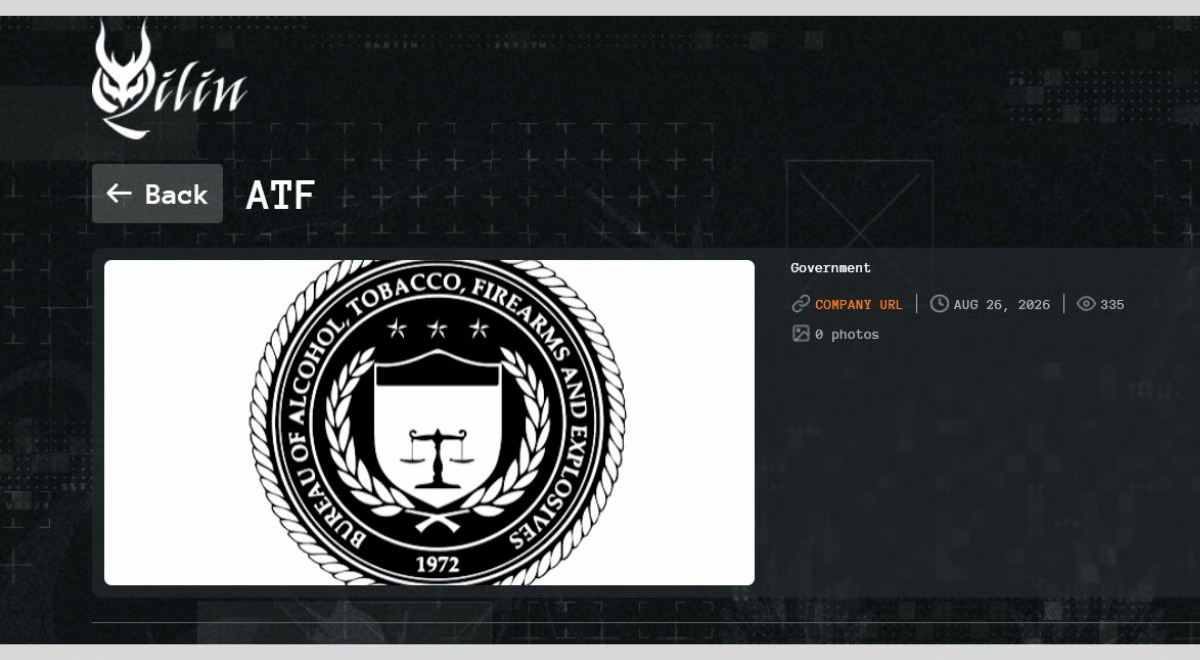
The Bureau of Alcohol, Tobacco, Firearms and Explosives said it is responding to a cybersecurity incident on a standalone system after the ransomware group Qilin claimed to have hacked the agency. ATF stated the affected system was not connected to its enterprise network, the eForms system, or any other ATF systems, and that it was shut down quickly once the breach was discovered. The investigation remains ongoing.
Qilin’s claim circulated widely, but it is unclear what data, if any, was taken. ATF has not described the contents of the standalone system or confirmed that Qilin obtained records. Online discussion quickly focused on ATF’s firearms-related files, with some posts asserting the agency maintains a registry covering more than a billion guns and gun owners. That figure and the implication that such a registry was involved have not been established in ATF’s public account of the incident.
The gap between a high-profile claim and a tightly worded agency statement has driven the story: a ransomware group associating itself with a politically charged federal bureau, while officials describe a contained event on an isolated machine.
Common Perspectives
Fear that gun-owner records were exposed
Firearms owners and Second Amendment advocacy groups treat any ATF incident as a potential leak of lawful purchasers’ information. The view draws on long-standing distrust of the bureau’s record-keeping and the political value of gun-owner lists. It assumes the standalone system held the kind of registry data discussed online—an assumption ATF has neither confirmed nor denied in its statement that the system sat apart from eForms and other networks.
Contained event, limited operational damage
Readers who give weight to ATF’s wording see a successful isolation: a non-enterprise system identified and taken offline before it could reach core investigative or licensing platforms. This reading appeals to those who want evidence that segmentation works. The trade-off is that it treats Qilin’s claim as possibly inflated and treats “standalone” as equivalent to “low-value,” which cannot be verified until more is known about what the machine actually stored.
Another government cybersecurity failure
Critics of federal IT practices view the episode as proof that even isolated law-enforcement systems remain reachable. The appeal is straightforward: agencies that handle sensitive investigations should not be in this position. The assumption is that a ransomware claim plus an official “incident” equals a serious compromise, regardless of the network architecture ATF described.
Ransomware groups chase headlines
Some cybersecurity observers treat Qilin’s announcement as a publicity move common in the ransomware ecosystem. Naming a controversial agency generates coverage even if the actual access was narrow. This view notes that groups often post claims before, or instead of, proof. It can underweight the possibility that limited systems still hold investigative material worth stealing.
A Different View
The more durable issue may not be whether this particular machine was fully air-gapped, but why a politically radioactive dataset—or even the rumor of one—makes ATF an attractive name to attach to a leak site. Ransomware operators do not need a complete copy of every ATF file to extract value; they need a story that forces officials to respond and that inflames an already polarized gun debate. Isolation reduces some technical risk while concentrating political risk: a single offline box, if it ever held case files or traces of owner data, becomes a perfect target for a group that profits from controversy as much as from encryption. The next useful signal is not another round of “standalone versus enterprise” language, but whether Qilin produces samples that match anything ATF actually stored.
Conclusion
Watch for whether Qilin publishes files that can be tied to ATF systems and whether the bureau expands its description of the standalone machine. Until then, the confirmed facts remain narrow: an isolated system was hit, taken down, and is under investigation.
Sources and discussion
These public posts were collected while researching this story. They provide context and reactions, but may not independently verify every claim.
View the original topic on XGun Owners of America
@GunOwners
🚨BREAKING🚨 Ransomware gang Qilin claims to have hacked ATF. It’s unclear what data, if any, was stolen. But @ATFHQ maintains a registry of more than 1 BILLION guns and gun owners.
Aug 26, 20263.2K likes534 repostsATF HQ
@ATFHQ
ATF is responding to a cybersecurity incident affecting a standalone system not connected to the ATF enterprise network, ATF eForms system, or any other ATF system. The system was quickly shut down when the breach was discovered. This is an ongoing investigation. Press release:
Aug 26, 2026238 likes72 reposts