

Amusan Tosin Tops FUNAAB Class With 4.99 CGPA
• From trending topic: Amusan Tosin Graduates Top of FUNAAB with Near-Perfect 4.99 CGPA
Summary
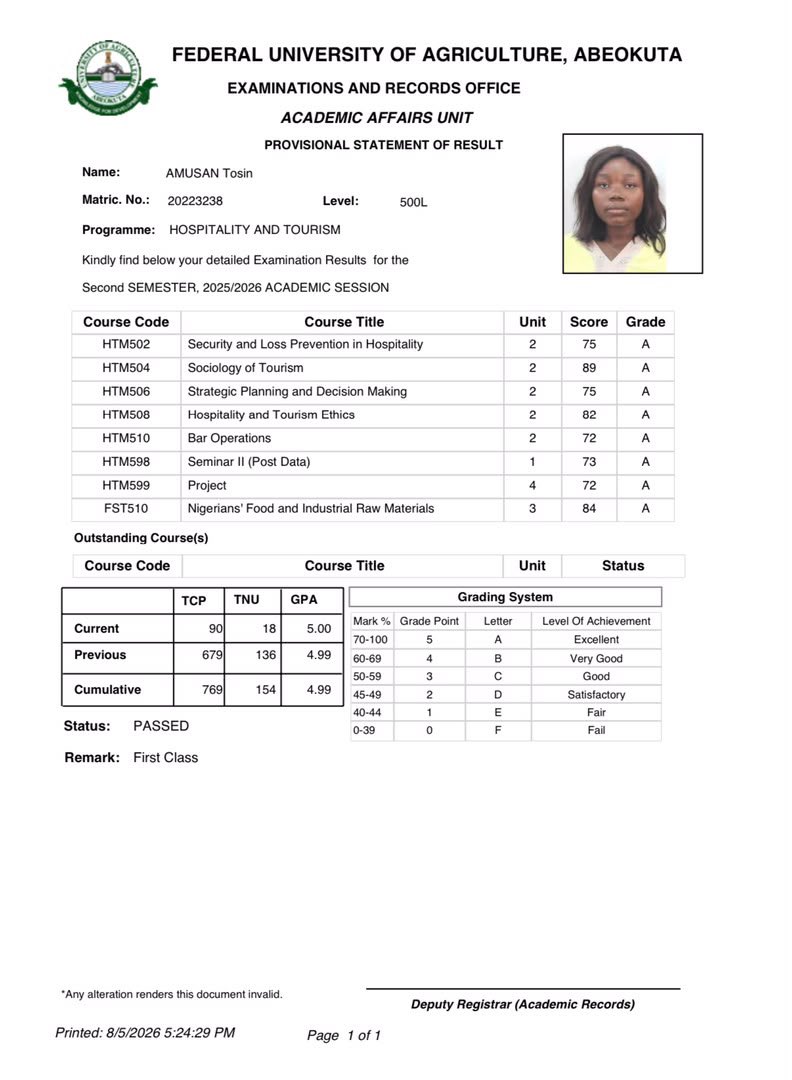
Amusan Tosin has graduated from the Federal University of Agriculture, Abeokuta with a 4.99 CGPA out of 5.00 in Hospitality and Tourism, the highest result in her department, college and the university, according to an X News summary of the story now circulating widely. Posts on X add that she received A's in every course except one B. One first-person post that has drawn more than 13,000 likes states that the score set a new record as the first such performance across those three levels of the institution. FUNAAB is a federal university whose core mandate is agriculture; the Hospitality and Tourism program therefore sits somewhat outside that original identity. The combination of the near-perfect transcript and the student's own announcement has turned a personal academic result into a national talking point on X.
Common Perspectives
Celebration of documented effort
Students, parents and many ordinary Nigerians treat the 4.99 as welcome proof that outstanding results remain possible inside the public-university system. The view appeals because consistently positive education stories are uncommon and because it supplies a concrete counter-example to complaints about declining standards. It rests on the assumption that a CGPA this high is a trustworthy measure of ability and that comparable outcomes are available to others who apply similar discipline.
Skepticism about what the number measures
Some education commentators and people who work in hospitality and tourism question whether a transcript containing only a single B accurately captures the practical demands of the field. They see the result as possible evidence of assessment methods that reward examination performance more than applied skill. This perspective is common among those who hire graduates or who have long argued that Nigerian universities suffer from grade inflation. Its trade-off is that it can appear to diminish a student's recorded work.
Visibility for an under-noticed program
People connected to tourism and hospitality regard the achievement as useful publicity for a department that is not central to FUNAAB's agricultural reputation. They hope the attention will draw more applicants and perhaps industry interest. The assumption is that a record academic ranking will convert into better opportunities for both the graduate and the program itself.
Representation for female students
Young women and advocates for girls' education present Tosin as a visible example of high achievement inside a federal university. The appeal is representational: one documented success is taken as encouragement that similar results are attainable. It assumes that the circulation of a single high-profile case will have a measurable effect on the choices or performance of others.
A Different View
The conversation has focused on one student's grades, yet the episode also illustrates how specialized federal universities have quietly widened their offerings. An institution founded for agriculture now produces a record graduate in hospitality and tourism; that expansion itself, rather than the CGPA, may be the more lasting institutional fact. Social-media amplification then turns the personal result into a public benchmark, which can raise expectations for every subsequent cohort even when university resources remain constrained.
Conclusion
Official confirmation from FUNAAB and any statement about Tosin's next steps will show whether the story stays a social-media moment or becomes a longer reference point for the university's academic standing.
Sources and discussion
These public posts were collected while researching this story. They provide context and reactions, but may not independently verify every claim.
View the original topic on XFederal University of Agriculture, Abeokuta
@FunaabCable
Meet Amusan Tosin, The Best Graduating Student with a 4.99/ 5.00 CGPA in Hospitality and Tourism from the Federal University of Agriculture, Abeokuta (FUNAAB). She had just a single B and A all through her academic career.
Aug 20, 2026662 likes91 repostsAmusan Tosin Chukwunonso
@tosincamusan
I graduated with a 4.99/ 5.00 CGPA in Hospitality and Tourism from Federal University of Agriculture (FUNAAB), setting a new record as the first in my department, college and the University. Had A's all through with a single B .🏆
Aug 19, 202613.2K likes1.9K reposts