

President Murmu Presents 72nd National Film Awards at Statue of Unity
• From trending topic: President Murmu Presents 72nd National Film Awards at Statue of Unity
Summary
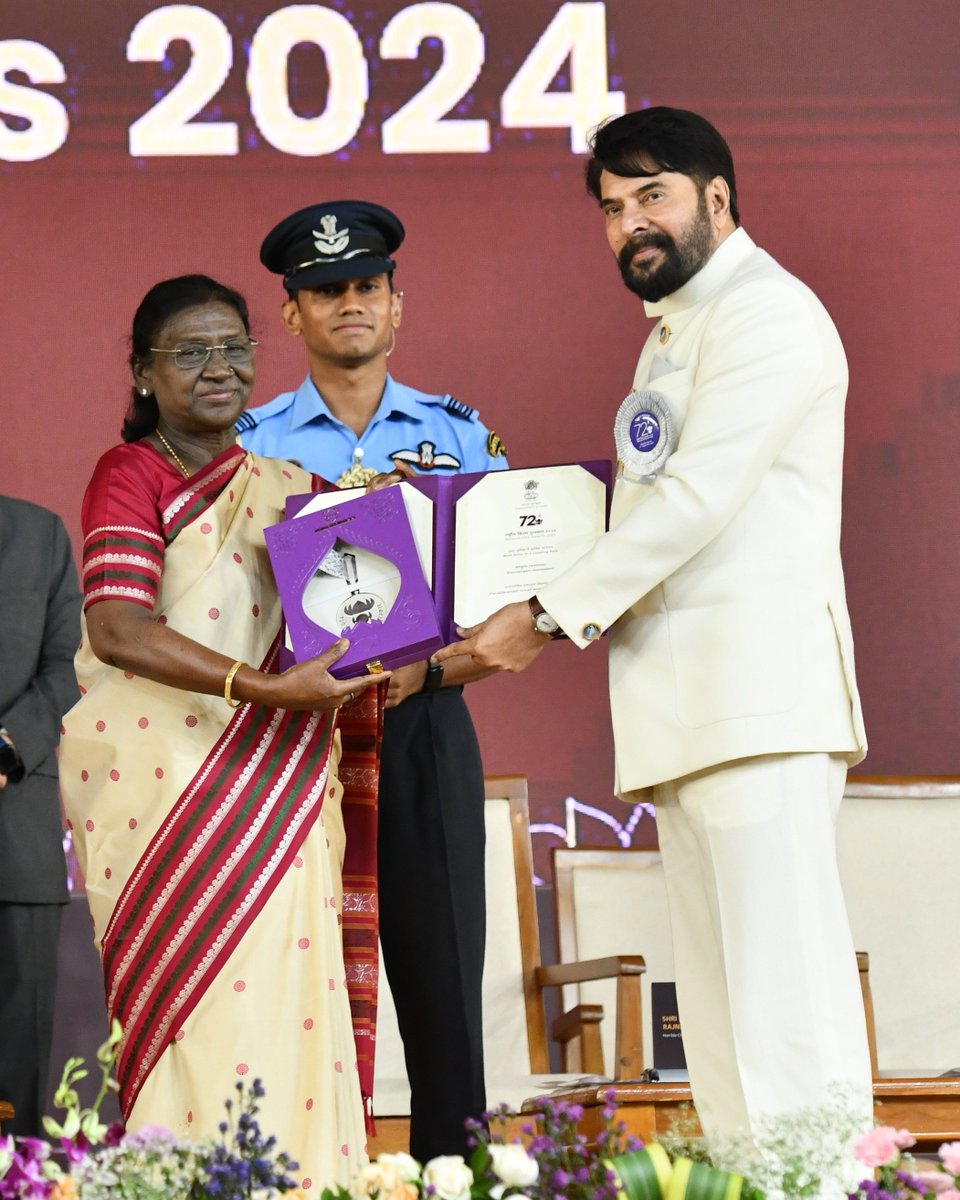
President Droupadi Murmu presented the 72nd National Film Awards at the Statue of Unity, naming Article 370 Best Feature Film. Kartik Aaryan and Mammootty shared Best Actor. Anant Nag received the Dadasaheb Phalke Award for 2024.
The ceremony in Gujarat recognized work across Indian cinema according to the official national honors. Social-media posts from around the event included a Best Actor recipient calling the award an honour to cherish for a lifetime and saying the moment belonged as much to supporters as to the actor. Separate posts on the Phalke award described Anant Nag’s five-decade career as having enriched India’s cultural landscape.
These details come from the clustered reporting of the presentation and circulating statements; fuller jury citations and complete winner lists were not part of the immediate public recap.
Common Perspectives
Balanced honoring of commercial and regional work
Industry figures, fans of the named actors, and viewers who follow both Hindi mainstream films and South Indian cinema often treat the results as a welcome spread of recognition. Kartik Aaryan’s shared Best Actor prize satisfies those who argue mass-appeal Hindi work has been undervalued; Mammootty’s share and Anant Nag’s lifetime award please those who want veteran regional craft given national standing. The view assumes juries can weigh popularity, craft, and longevity on artistic terms. Its trade-off is that it can treat the slate as self-evidently meritorious and set aside questions about how themes or institutional timing shape outcomes.
Article 370’s win as cultural alignment with policy
Commentators focused on Kashmir and on the independence of state cultural bodies frequently read the Best Feature choice as more than a film prize. They note the movie’s subject—the 2019 changes to Jammu and Kashmir’s status—and see the award as the government lending prestige to one account of that history. The perspective appeals to those already skeptical of official arts institutions. It rests on the assumption that jury decisions track political narrative at least as much as cinematic quality; the corresponding risk is reducing the film to its topic and discounting whatever technical or narrative case the jury may have made.
Prestige for a contemporary Hindi star
Kartik Aaryan’s large audience and parts of the Hindi commercial industry tend to frame his award as proof that box-office connection and national honor can coincide. It appeals to people who feel earlier National Awards favored art-house or non-Hindi work. The assumption is that wide popularity itself signals excellence worth state recognition. The trade-off is a possible lowering of the distinctiveness of a “national” award if commercial success becomes a stronger implicit criterion.
Lifetime honor as overdue South Indian spotlight
Kannada- and Malayalam-cinema communities, along with advocates for non-Hindi industries, often greet Anant Nag’s Phalke award and Mammootty’s acting prize as correction of long under-representation at the national level. The appeal is straightforward cultural pride and a sense that decades of work are finally counted. It assumes the awards machinery can still function as a genuine pan-Indian ledger. The limitation is that a single ceremony cannot by itself change the structural Hindi-language tilt of much national media attention.
A Different View
The dominant talk sorts winners into political, commercial, and regional boxes. A less examined angle is the venue itself. Staging the presentation at the Statue of Unity, a large Gujarat tourist monument rather than a conventional Delhi hall, places the state’s highest film honors inside a site already used to project national integration. That choice can serve local visibility and visitor traffic as much as cinematic judgment. It also quietly recasts the awards as a unity ritual: a politically charged feature film, a young Hindi star, and an elder South Indian actor all appearing under the same patriotic landmark. Whether or not that was the intent, it supplies an extra incentive for future filmmakers—produce work that can travel commercially, satisfy a national-theme brief, and still look at home in a monument setting.
Conclusion
Jury remarks, if released, and reactions from Kashmir-focused voices versus the Hindi and South Indian industries will show whether the conversation stays on the films or settles on the symbolism of both the Best Feature winner and the Gujarat location.
Sources and discussion
These public posts were collected while researching this story. They provide context and reactions, but may not independently verify every claim.
View the original topic on XMammootty
@mammukka
Receiving the National Award for Best Actor at the 72nd #NationalFilmAwards is an honour I will cherish for a lifetime. To everyone who has watched, supported, celebrated and connected with my work over the years, this moment belongs to you as much as it belongs to me. Thank
Sep 22, 202614.9K likes1.3K repostsPresident of India
@rashtrapatibhvn
President Droupadi Murmu conferred the Dadasaheb Phalke Award for the year 2024 on Shri Anant Nag, recognising his exceptional contribution to Indian cinema. The creative journey of Shri Anant Nag spanning over five decades has enriched India’s cultural landscape. His style of
Sep 22, 20263.4K likes433 reposts