

Micron's Record Earnings Ignite Wall Street Frenzy as AI Chip Demand Explodes
• From trending topic: Micron Technology posts record earnings, stock surges
Summary
Right now, Micron Technology is dominating financial conversations after posting fiscal third-quarter results that shattered every Wall Street benchmark. The Boise-based memory-chip giant reported adjusted earnings of $25.11 per share on $41.46 billion in revenue—nearly doubling analyst expectations of $20.49 per share—triggering an immediate stock surge and pushing MU into trending status across trading platforms and social media. The catalyst appears to be explosive demand for high-bandwidth memory chips used in AI training clusters, with the company noting that data-center revenue more than quadrupled year-over-year. Within minutes of the release, automated trading algorithms and retail investors piled into the stock, lifting shares more than 8 percent in after-hours action and keeping MU at the center of market chatter even as the broader Nasdaq posted its fifth consecutive down day. The earnings beat has also sparked a wave of online debate comparing human versus AI-driven stock analysis, with traders testing proprietary models against conventional forecasts to see who correctly called the magnitude of the upside surprise.
Common Perspectives
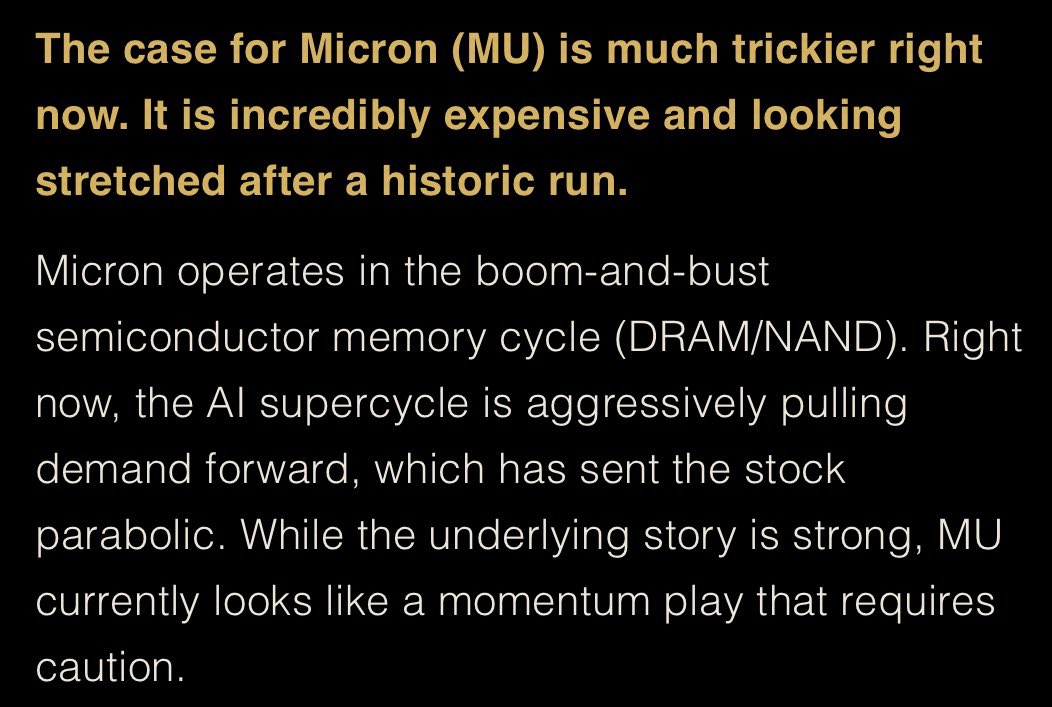
This Is the AI Trade's First Real Proof Point
Many market participants view Micron's blowout quarter as the first concrete evidence that generative-AI spending is translating into tangible, accelerating chip demand rather than remaining a narrative-driven rally. Commentators on X highlighted that the company’s data-center segment alone contributed tens of billions in incremental revenue, arguing the print validates aggressive capex plans by hyperscalers and positions memory makers as direct AI beneficiaries alongside GPU designers.
Short-Term Momentum May Outrun Fundamentals
A second group cautions that the magnitude of the beat—more than 20 percent above consensus—could set an unsustainably high bar for future quarters. Posts circulating on trading forums warn that investors may be pricing in multiple years of AI-driven growth in a single session, leaving the stock vulnerable if enterprise budgets tighten or if memory ASP (average selling price) growth moderates once new supply ramps later this year.
Retail Traders Are Using AI Tools to Outsmart Wall Street
A third strand of conversation centers on the rise of DIY stock-picking bots. Users shared side-by-side comparisons showing how custom AI assistants flagged MU as a strong buy ahead of the print, contrasting that with more cautious mainstream models. The narrative gaining traction is that individual investors armed with real-time data scrapers and sentiment analyzers can now surface inflection points faster than traditional sell-side research desks.
Memory Makers Are the “Picks and Shovels” of the AI Gold Rush
Others frame Micron less as a direct AI winner and more as critical infrastructure—an enabler whose products sit inside every AI server. This perspective emphasizes that while headlines focus on GPU designers, the physical memory capacity required to train trillion-parameter models is expanding at an even faster rate, positioning companies like Micron as under-the-radar compounders.
A Different View
Rather than treating Micron’s surge as another chapter in the AI investment cycle, consider it a stress test for market-structure resilience. The same automated systems and social-media amplification that propelled the stock higher within seconds also exacerbated the Nasdaq’s broader selloff earlier in the week. In other words, the speed at which positive earnings news now ricochets through algorithmic order books and influencer feeds may be compressing both upside and downside moves, raising questions about whether traditional sector rotation patterns still apply when capital can pivot from “AI leaders” to defensives in a single session.
Conclusion
Micron’s record quarter has become more than a single-company catalyst; it is serving as a real-time referendum on how AI spending is rippling through supply chains, how quickly sentiment can swing on social platforms, and whether retail traders armed with custom algorithms can consistently front-run institutional research. As the after-hours tape continues to digest the numbers, the coming sessions will reveal whether this momentum marks the start of a durable re-rating for memory stocks or simply another rapid rotation in an increasingly reflexive market.
Sources and discussion
These public posts were collected while researching this story. They provide context and reactions, but may not independently verify every claim.
View the original topic on XNoLimit
@NoLimitGains
I built my own AI assistant that scans any stock and tells you if it is a good buy or not. Much more than that too. I ran a test on $MU and compared it against Grok and my own AI. Here are the results. Grok: Yes, MU (Micron Technology) looks like a strong buy for many
Jun 27, 202672 likes12 repostsDaniDin
@BBZIOT
📈 Market News $MU MU: Micron Technology Soars on Explosive Earnings, But Can the Momentum Last? Micron Technology's latest earnings report has sent shockwaves through the tech industry, with revenue beating expectations and solidifying its position as a leader in the AI
Jun 27, 2026MCO News
@MCO_News
The Nasdaq Just Fell for a Fifth Straight Day as Money Flees Tech It was an ugly week for the AI trade. The Nasdaq slipped again on Friday, its fifth straight losing session, and finished the week down 4.6 percent as investors rotated out of crowded technology stocks into safer
Jun 27, 20262 likesAlexander Hayes
@hsaraeya
🚨 BREAKING: I believe these stocks could deliver 40%-80% gains over the next few months. $ALAB — Astera Labs $LITE — Lumentum Holdings $AAOI — Applied Optoelectronics $HIMS — Hims & Hers Health $INOD — Innodata $LUNR — Intuitive Machines $BKSY — BlackSky Technology $OUST —
Jun 27, 20261 likesTicker Report
@ticker_report
Shares shifted sharply after Micron Technology posted a fiscal third quarter that obliterated every benchmark on the board — then kept climbing. The memory-chip maker reported adjusted earnings of $25.11 per share on revenue of $41.46 billion, versus analyst estimates of $20.49
Jun 27, 2026Quinn政经瞭望
@quinnoutlook
Based on this news, here are my predictions for $QS and Honda. This plant was originally a joint venture between Honda and LG, with Honda 49% and LG 51%. LG provided the battery technology, while Honda was responsible for integration and adaptation to its own vehicles. The
Jun 27, 20262 likes