

Kenya’s electoral body says no degree needed to run in 2027
• From trending topic: No University Degree Needed for Kenya's 2027 Top Elections
Summary
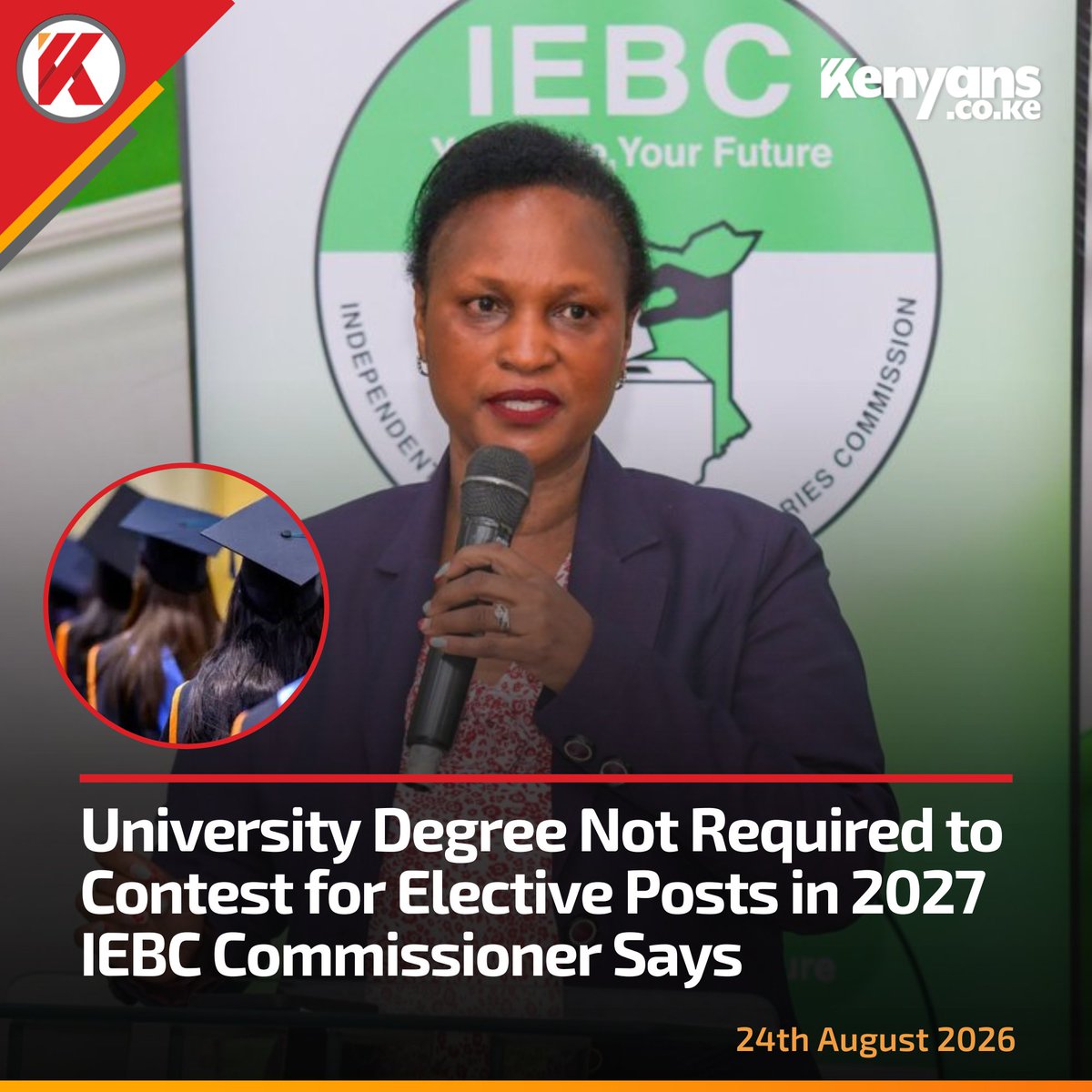
Kenyans without a university degree will be allowed to seek the presidency, a governorship, or a parliamentary seat in the 2027 general election, Kenya’s Independent Electoral and Boundaries Commission (IEBC) has said, citing court rulings that removed the academic qualification.
The commission’s confirmation, amplified this week in Kenyan discussion online, is not a new statute from Parliament. It is an electoral body stating that existing court decisions now govern who may be cleared to contest those offices. Posts summarizing the remarks circulated widely, including claims that candidates without degrees may run for president, governor, or MP. Those posts describe the IEBC’s position; they are not themselves the legal rulings.
Kenya had, for years, treated a degree as a gate for several high offices, a rule defenders cast as a competence floor and critics as a barrier that favored a narrow, credentialed class. The courts’ intervention—and the IEBC’s reading of it—means the 2027 nomination and clearance process will, if the commission holds this line, no longer use a university certificate as a disqualifier for those posts. How parties write their own nomination rules, and whether Parliament or further litigation tries to restore a qualification, remains outside what the commission has settled in public remarks reported so far.
Common Perspectives
Open the field
Many Kenyans who lack degrees, and allies who see formal schooling as a poor proxy for public service, treat the change as overdue. The appeal is straightforward: millions of voters and local leaders never sat a university exam, yet they already organize communities, businesses, and party machines. A legal bar that ignored that experience looked, to this group, like elite self-protection. The assumption is that a wider candidate pool produces fairer representation. The trade-off is that voters lose a simple, if crude, screening device and must judge competence some other way.
Keep a floor for high office
Professionals, some civil-society voices, and voters who backed the old rule argue that the presidency, a county, or a legislature is not an entry-level job. Budgets, statutes, and foreign relations are complex; a degree was never a guarantee of honesty, but it was a minimum signal of sustained academic work. This view appeals to people who distrust populism and who invested in education as a path into public life. Its assumption is that university training correlates with the skills those offices demand. Its cost is exclusion of experienced non-graduates and a politics that can look closed even when it is not.
Courts rewrote the ballot, not voters
A third cluster cares less about degrees than about who decides eligibility. If Parliament or the Constitution’s implementing laws set qualifications, and judges then strip them, the fight becomes institutional: judicial review versus the elected branches. Lawyers, opposition strategists, and constitution-watchers tend to occupy this ground. It appeals because it treats 2027 as a test of legal finality, not of campus prestige. The hidden wager is that “what the courts said” is clearer and more stable than it often is in Kenyan public law, where follow-on cases and regulations can reopen the same fight.
Parties and money still pick the winners
Political operators and skeptical voters argue that clearing non-graduates changes the brochure more than the race. Nomination still runs through parties, campaigns still cost large sums, and name recognition still dominates. On this reading, a famous organizer or businessman without a degree gains more than an unknown graduate does, and ordinary citizens remain spectators. The assumption is that structural barriers—finance, ethnicity, incumbency—swamp academic ones. The risk is cynicism: if the legal change is mostly symbolic, celebrating it as democratization overstates what the IEBC can deliver.
A Different View
The degree rule may have mattered less as a filter of talent than as a market. It pushed ambitious politicians toward last-minute certificates, parallel programs, and paper qualifications whose quality the public could not easily check. Removing the requirement could shrink that particular form of credential theater without making the typical officeholder less schooled—parties may still prefer graduates—while shifting the remaining filters toward wealth, media, and ethnic arithmetic. That is a different distribution of advantage, not automatically a more meritocratic one. What to watch is not only who files papers in 2027, but whether parties quietly reimpose education tests in their own constitutions, and whether the IEBC’s clearance forms match the court holdings the commission now cites.
Sources and discussion
These public posts were collected while researching this story. They provide context and reactions, but may not independently verify every claim.
View the original topic on XMoe
@moneyacademyKE
Kenyans without university degrees can contest for President, Governor or MP in the 2027 General Election, IEBC says.
Aug 25, 20264.4K likes695 repostsKenyans.co.ke
@Kenyans
University degree not required to contest for elective posts in 2027 IEBC commissioner says
Aug 24, 20262.3K likes363 reposts