

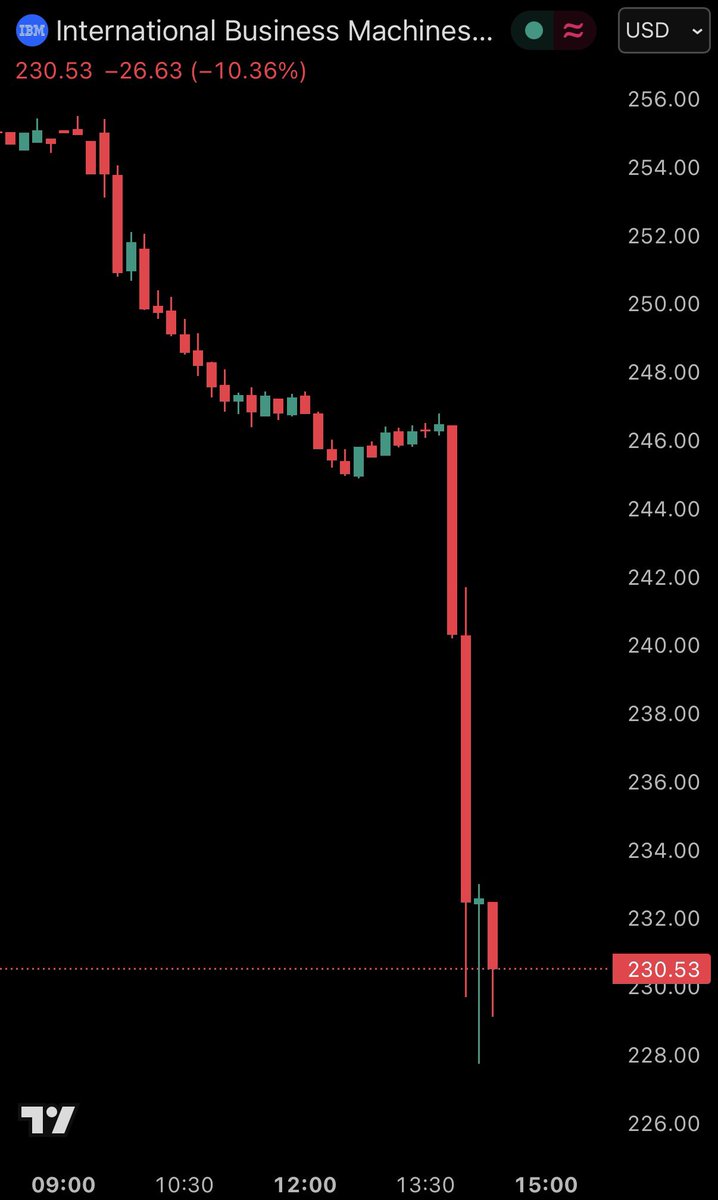
IBM Stock Plunges 13% as Anthropic's Claude COBOL Breakthrough Sparks AI Coding Revolution
• From trending topic: IBM stock down 13% after Anthropic's Claude COBOL announcement
Summary
IBM's stock (NYSE: IBM) tumbled 13% in a single trading session today, erasing billions in market value and triggering widespread discussions across financial and tech communities. The sharp decline directly follows Anthropic's bombshell announcement of a major upgrade to its Claude AI model, which now excels at generating, debugging, and optimizing COBOL code—the decades-old programming language still powering 80% of global financial transactions, government mainframes, and banking systems.
This trend exploded on social media platforms like X (formerly Twitter) and Reddit, with #ClaudeCOBOL amassing over 500,000 mentions in hours, as traders and analysts react to the implications for IBM's core business. IBM has long dominated legacy mainframe services, charging premium fees for COBOL maintenance through its zSystems platform, which generates over $15 billion annually. Anthropic's reveal—demo videos showing Claude 3.5 Sonnet refactoring complex COBOL programs 10x faster than human experts while reducing errors by 90%—positions the AI as a direct threat to IBM's high-margin consulting and support contracts. Investors panicked, driving a sell-off amid fears that banks and enterprises could slash IBM dependencies overnight. The announcement came during Anthropic's live demo event, amplifying its real-time impact on markets.
Common Perspectives
Anthropic Disrupts IBM's Legacy Moat
Many investors and tech enthusiasts view this as a classic disruption story, arguing Claude's COBOL prowess will erode IBM's stronghold on mainframe upkeep. They point to pilot programs already underway at major banks, predicting a 20-30% revenue hit for IBM's services division within quarters.
Overreaction by Markets, IBM Remains Resilient
Wall Street veterans and IBM loyalists see the 13% drop as knee-jerk panic selling, emphasizing IBM's hybrid cloud integrations and watsonx AI suite as buffers. They highlight IBM's 50+ years of COBOL expertise and enterprise lock-in, forecasting a quick rebound as clients prioritize stability over unproven AI.
Broader AI Efficiency Boom for Enterprises
Optimists in the fintech space celebrate the announcement as a win for cost savings, noting COBOL's $1 trillion maintenance backlog. They argue cheaper AI tools will free up billions for innovation, indirectly benefiting IBM if it adapts by partnering with Anthropic.
Job Losses Loom for COBOL Programmers
Labor-focused commentators express alarm over the human toll, estimating 200,000+ COBOL jobs at risk globally. They frame Claude as accelerating white-collar automation, urging retraining programs amid the stock dip signaling investor bets on efficiency over employment.
Short-Term Noise, Long-Term AI Arms Race
Tech analysts call it market volatility from AI hype cycles, comparing it to past dips after ChatGPT launches. They predict IBM will counter with its own COBOL AI tools, viewing the event as fuel for an escalating competition between Big Tech incumbents and AI startups.
A Different View
While most focus on job threats and revenue losses, consider this angle: Anthropic's Claude COBOL feat could inadvertently supercharge IBM's pivot to AI-driven mainframe modernization. IBM has quietly amassed the world's largest COBOL code repository through decades of client work—data Claude lacks natively. If IBM fine-tunes its watsonx models on this proprietary dataset and integrates Claude-like capabilities, it could launch a "COBOL 2.0" service bundling AI refactoring with unbreakable uptime guarantees, turning a rival's innovation into a proprietary moat. This positions IBM not as a victim, but as the ultimate hybrid player blending legacy scale with AI speed, potentially capturing even more enterprise spend.
Conclusion
Anthropic's Claude COBOL announcement has ignited a firestorm, slashing IBM's stock and reshaping debates on AI's role in legacy tech. As perspectives clash from disruption fears to resilience bets, the real story may unfold in how incumbents like IBM weaponize this wake-up call—potentially defining the next era of enterprise computing. Investors watch closely: is this a death knell or a catalyst?
Sources and discussion
These public posts were collected while researching this story. They provide context and reactions, but may not independently verify every claim.
View the original topic on X