

NVIDIA CEO Jensen Huang's Bold Prediction: Why SpaceX, Anthropic, and OpenAI Could Match Early Amazon, Google, and Meta Returns
• From trending topic: NVIDIA CEO Jensen Huang compares investing in SpaceX, Anthropic, and OpenAI to early Amazon/Google/Meta
Summary
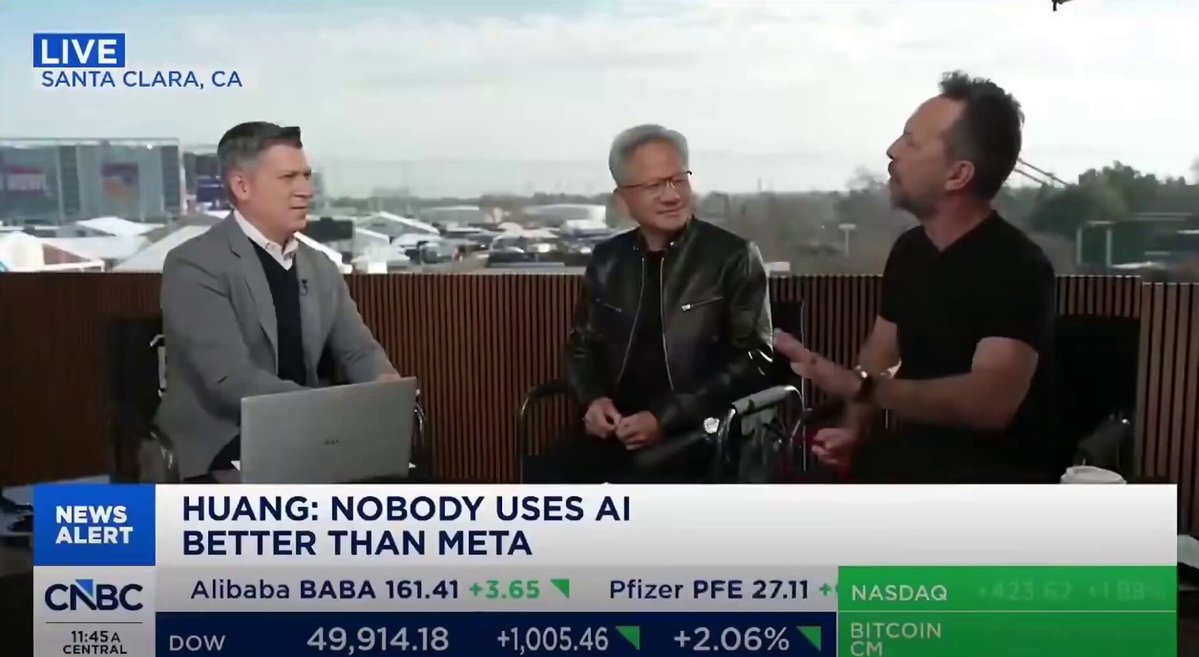
NVIDIA CEO Jensen Huang made headlines during a live CNBC appearance when he drew a direct comparison between today's investments in SpaceX, Anthropic, and OpenAI and the earliest opportunities to buy shares in Amazon, Google, and Meta. Huang, who leads the world's most valuable company by market capitalization at $5.43 trillion, stated that backing these three frontier companies now carries similar upside potential to purchasing those tech giants in their nascent stages. The remarks immediately ignited widespread discussion across financial social media, with investors and analysts parsing whether Huang's comparison signals a generational wealth-creation moment or reflects over-optimism in an already frothy AI market. The statement's timing—amid record valuations for AI startups and heightened scrutiny of NVIDIA's own role in powering the AI boom—amplified its reach, turning a single interview clip into a trending topic on X as traders and commentators weighed the implications for both public and private markets.
Common Perspectives
The "Next Magnificent Seven" Thesis
Many market participants view Huang's analogy as validation that SpaceX, Anthropic, and OpenAI represent the foundational infrastructure layer of the coming decade, much like Amazon's e-commerce platform, Google's search dominance, and Meta's social graph became indispensable. Proponents argue that early stakes in these entities could deliver outsized returns as they expand into adjacent verticals—robotics and satellite internet for SpaceX, enterprise AI platforms for Anthropic and OpenAI—creating new trillion-dollar ecosystems.
The Valuation and Access Reality Check
A counter-view circulating on trading forums emphasizes the structural differences between 1998-era Amazon and today's AI leaders: private-market valuations already price in massive future growth, and most retail investors lack meaningful access to these rounds. Critics note that while Huang's comparison is directionally compelling, the risk-reward profile differs sharply from the dot-com era because entry prices are higher and liquidity pathways narrower.
The NVIDIA Ecosystem Ripple Effect
Another strand of commentary focuses less on the startups themselves and more on what Huang's endorsement signals for NVIDIA's positioning. Observers suggest the comments reinforce NVIDIA's role as the "picks and shovels" supplier to whichever AI or space ventures ultimately win, potentially sustaining demand for its chips even if individual startup bets face winner-take-most outcomes.
The Regulatory and Competitive Uncertainty Angle
Some analysts highlight that Huang's optimism comes against a backdrop of intensifying regulatory scrutiny on AI safety, export controls on advanced chips, and competition from well-capitalized rivals. This perspective frames the comparison to early Amazon or Google as incomplete without accounting for policy risks that could reshape market access and valuation multiples faster than in previous tech cycles.
A Different View
Rather than treating Huang's statement as a simple endorsement of outsized returns, consider it as an implicit forecast about capital allocation inside NVIDIA itself. The comparison may be less about cheering external venture bets and more about signaling that NVIDIA's own massive cash generation—fueled by AI demand—will increasingly flow into strategic minority positions across the very ecosystem it powers. In this reading, Huang is describing a flywheel in which NVIDIA's hardware dominance funds software and infrastructure bets that, in turn, lock in future hardware demand, creating a self-reinforcing loop distinct from the more arm's-length relationships Amazon, Google, or Meta maintained with their early investors.
Conclusion
Huang's CNBC remarks have crystallized a broader debate about whether the current wave of AI and space companies will deliver Amazon-like compounding or whether elevated entry prices and new systemic risks will produce more tempered outcomes. The conversation now extends beyond individual stock picks to questions of market structure, regulatory posture, and the evolving role of the world's largest company in shaping the next era of technological infrastructure.
Sources and discussion
These public posts were collected while researching this story. They provide context and reactions, but may not independently verify every claim.
View the original topic on Xᴛʀᴀᴄᴇʀ
@DeFiTracer
🚨 BREAKING: NVIDIA CEO JENSEN HUANG JUST SAID LIVE ON CNBC: "INVESTING IN SPACEX, ANTHROPIC AND OPENAI WILL BE SIMILAR TO BUYING $AMZN, $GOOGL, OR $META IN THE EARLIEST DAYS." THIS GUY RUNS THE WORLD’S LARGEST COMPANY WITH $5.43 TRILLION CAPITALIZATION HE DEFINITELY KNOWS
Jun 1, 202652 likes10 repostsXylosynTrades
@XyloCyp
BREAKING: NVIDIA CEO JENSEN HUANG JUST SAID LIVE ON CNBC: "INVESTING IN SPACEX, ANTHROPIC AND OPENAI WILL BE SIMILAR TO BUYING $AMZN, $GOOGL, OR $META IN THE EARLIEST DAYS." THIS GUY RUNS THE WORLD’S LARGEST COMPANY WITH $5.43 TRILLION CAPITALIZATION HE DEFINITELY KNOWS
Jun 1, 2026AllSharkQueen
@AllCristina2
Dude... that's not what sega said in their report... at all. And if anything the reason you have is even more of a reason they'll bulk up 2026 with announcements. This is even counting the fact that sega said their investing in longer marketing cycles.
Jun 1, 2026170 likes19 repostsKenny Zufall
@KennyZufall
@TheRayMyers Think the opportunity cost is in $IREN right now. We'll see though $NBIS pumps +15% on no material news other than Jensen mentioning them or Leopold investing in them. Pretty clear that $NBIS is the market favorite right now though. Not going to FOMO here🤷♂️
Jun 1, 20265 likesMinistry of Health
@MOH_Kenya
Dr. Ouma Oluga, PS Medical Services: Let us treat patients the way we would like to be treated. We are also investing in training health workers to improve the quality of care. Patients and families can report any concerns or complaints through the available feedback and
Jun 1, 20262 likes3 reposts🙂↔️🫶🏼
@pancakehandler
Never miss an earnings report again 📅📈 My favourite feature on #moomoo is the Earnings Calendar. Upcoming earnings dates and market insights are all in one place, making it easy to stay informed without juggling multiple apps, come join the bull run!!🐂 #stocks #investing
Jun 1, 20262 likes1 reposts