

U.S. Agencies Warn Chinese AI Firms Are Distilling American Frontier Models
• From trending topic: U.S. Agencies Accuse Chinese AI Firms of Stealing Tech from American Models
Summary
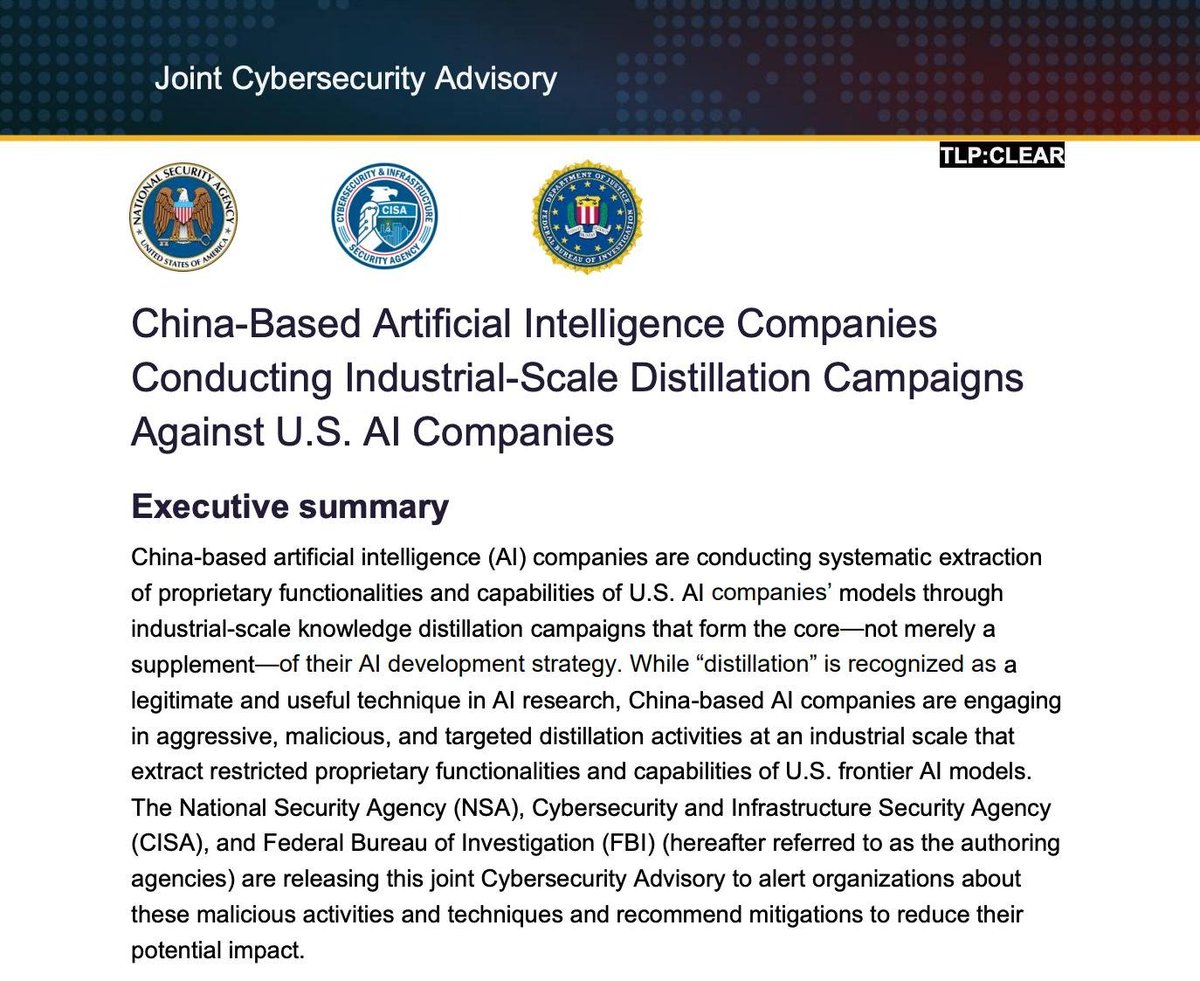
The NSA, FBI, and CISA have issued a joint advisory stating that China-based AI companies are illicitly extracting capabilities from leading U.S. frontier models through knowledge distillation. The document, as described in circulating accounts of the report, outlines tactics, techniques, and procedures used in those campaigns and recommends mitigations for American model developers.
Knowledge distillation typically trains a smaller “student” model on the outputs or internal signals of a larger “teacher” model, transferring performance without a full copy of weights. U.S. agencies frame the China-based activity as unauthorized extraction of proprietary abilities. Social-media discussion of the advisory has gone further, describing industrial-scale campaigns and suggesting Chinese government awareness; those characterizations come from posts about the report rather than independently confirmed details in the public summary. No specific Chinese firms or U.S. models are named in the material circulating with the story.
The warning sits inside a larger contest over who can train, serve, and protect the most capable systems. U.S. labs have spent heavily on closed models sold through APIs; Chinese firms, facing chip-export limits and intense domestic competition, have strong incentives to close capability gaps quickly. Distillation is a documented machine-learning method. Whether large-scale, possibly ToS-violating use of it against U.S. APIs constitutes “stealing tech” is the point now in dispute.
Common Perspectives
National-security threat requiring tighter controls
Intelligence officials, China-focused lawmakers, and some U.S. lab executives treat the advisory as evidence of systematic intellectual-property theft with military and economic stakes. The appeal is straightforward: China has a documented pattern of acquiring foreign technology by means other than pure domestic invention, and generative AI is dual-use. The assumption is that model capabilities are protectable American property and that API access can be meaningfully restricted. The trade-off is that heavier monitoring, query limits, or model-export rules could slow legitimate research, push activity onto less visible channels, and accelerate Chinese efforts to train without U.S. teachers.
Distillation as ordinary machine learning, not theft
Researchers who work on compression, transfer learning, and open models argue that distillation is a standard, published technique. If U.S. companies expose powerful models through APIs, high-volume querying to train student systems is an expected consequence, even when it breaches terms of service. This view appeals to people who see digital capabilities as inherently leaky and who worry that “stealing” language will be used to over-securitize a scientific method. The assumption is that scale and covert tradecraft do not change the underlying technique. The trade-off is that it underweights commercial harm, possible unauthorized access methods, and the difference between academic distillation and industrial campaigns aimed at frontier systems.
Closed-model economics under pressure
Investors and proponents of proprietary labs see the campaigns as an attack on the moat they paid billions to build. Watermarking, fingerprinting, rate limits, and output filters become necessary product features rather than optional research. This perspective appeals to those who treat frontier AI as a platform business whose returns depend on exclusive capability. The assumption is that technical mitigations can preserve a meaningful lead. The trade-off is extra friction for paying customers and the risk that the largest U.S. labs become even more gated while smaller American researchers lose access.
Another round of U.S.–China tech decoupling
Geopolitical and supply-chain analysts read the advisory as the software counterpart to chip export controls and telecom restrictions. Both governments are pursuing technological self-sufficiency; commercial AI activity is treated as an extension of state strategy. The frame appeals to people tracking strategic competition rather than individual firms. The assumption is that the Chinese companies involved are acting with at least tacit state alignment. The trade-off is that it can flatten commercial motives—Chinese labs competing with one another inside China—and ignore how much U.S. models themselves were trained on globally scraped data.
A Different View
The argument usually starts from the premise that American models are discrete national assets being siphoned. A more structural reading starts from the business model that produced the leak. U.S. labs trained on vast public and semi-public text from everywhere, then monetized the result by selling query access. Every useful API response is a training signal. Distillation is downstream of that design, not an exotic intrusion. Chip export controls may have strengthened the incentive: if advanced GPUs are harder to obtain, extracting software capability from the models that already run on those GPUs becomes a substitute path. The mitigations the agencies recommend—tighter access, more monitoring—could further concentrate power in the few U.S. labs large enough to absorb the cost, while the same labs continue to depend on global data and global talent. The neglected question is not only whether China is “stealing,” but whether the current way of selling intelligence as a service was ever compatible with keeping that intelligence inside one country’s commercial perimeter.
Conclusion
Watch whether U.S. labs actually implement the recommended defenses, whether later versions of the advisory name firms or models, and how Chinese officials and companies characterize the same activity. The technical facts of distillation are not in serious dispute; the political and commercial meaning of those facts is.
Sources and discussion
These public posts were collected while researching this story. They provide context and reactions, but may not independently verify every claim.
View the original topic on XMichael Lucci
@Michael7ucci
🚨 U.S. intelligence and security authorities reveal China-based AI companies, likely with Chinese government awareness, have carried out industrial-scale campaigns to extract proprietary capabilities from leading U.S. AI models. Full report:
Sep 8, 2026295 likes124 repostsNSA Cyber
@NSACyber
China-based AI companies are illicitly distilling U.S. frontier AI capabilities. Read NSA’s new report, co-sealed with @FBI, @CISAgov, highlighting AI knowledge distillation, TTPs used, and recommended mitigations:
Sep 8, 2026492 likes163 reposts