

SEC Proposes Regulation Crypto Assets for Token Fundraising
• From trending topic: SEC Proposes Crypto Asset Rules for Clearer Fundraising
Summary
The Securities and Exchange Commission has proposed Regulation Crypto Assets, a dedicated framework for certain investment contracts that involve crypto assets. The plan, outlined in an agency announcement, would create exemptions allowing some offerings to raise as much as $75 million annually without full registration. Social-media reports of the proposal added that it would also permit smaller raises of up to $5 million over four years and establish a conditional safe harbor. One widely circulated statement presented the rules as the most significant modernization of federal securities law for crypto to date and cast the United States as the industry’s natural home. Those extra details and the precise wording of any official remarks have not been independently verified beyond the circulating accounts and the core $75 million figure in the agency’s summary. The proposal now heads into the standard notice-and-comment process. Its final form, the exact conditions attached to any exemptions, and whether it survives legal or political challenge remain open.
Common Perspectives
Crypto founders and investors welcome defined lanes
Entrepreneurs, token issuers, and venture funds that have operated under years of enforcement-only oversight tend to treat the proposal as overdue permission to raise capital onshore. Clear dollar thresholds and a named safe harbor reduce the fear that any public sale will later be labeled an unregistered security. The appeal is practical: projects can plan around known limits instead of guessing at the Howey test. The assumption is that bright-line exemptions will draw more legitimate activity into the United States; the trade-off is that the caps themselves may still feel arbitrary and that the comment period could shrink or complicate them.
Investor-protection groups see loosened guardrails
Consumer advocates and some securities lawyers view any expansion of unregistered offerings as a step backward in a market already marked by volatility and past failures. A $75 million annual exemption, they argue, is large enough to expose ordinary buyers to significant risk with lighter disclosure. This stance rests on the premise that crypto assets are inherently harder for retail participants to evaluate than traditional stocks or bonds. The cost is that overly cautious rules could simply push the same activity to less transparent venues.
Competitiveness hawks treat it as industrial policy
Commentators and officials who emphasize American leadership in finance and technology frame the proposal as a necessary response to other jurisdictions that already offer clearer crypto regimes. Language describing the United States as the “Crypto Capital of the World” resonates with this group because it recasts regulation as a tool for retaining talent and capital rather than merely policing it. The bet is that the United States can write rules attractive enough to keep the industry while still claiming to protect investors; if the balance is judged too industry-friendly or too timid, activity may continue to migrate.
Traditionalists prefer adapting existing law
Practitioners steeped in the current registration regime and the Howey investment-contract test often resist creating a parallel crypto track. They worry that special exemptions will produce inconsistent standards and invite regulatory arbitrage. Uniformity, in this view, is a feature, not a bug. The limitation is that it may understate how poorly some token structures map onto statutes written decades before blockchains existed.
A Different View
Most argument has centered on whether the dollar limits are too high or too low. A less examined effect is how the mere existence of those limits will shape token design itself. Issuers have a strong incentive to structure raises, vesting schedules, and community distributions so they stay under the annual or multi-year caps or fit neatly inside the safe harbor. Over time that could produce more frequent, smaller offerings, novel lock-up mechanics, or tokens whose economic rights are deliberately muted to avoid “investment contract” status. Those second-order changes in how projects organize and how liquidity forms are not the main subject of the current debate, yet they may prove more lasting than the precise exemption numbers that emerge from the comment period.
Conclusion
The proposal’s next test is the public-comment window and any subsequent revisions. Watch whether the $75 million figure and the reported safe-harbor conditions survive intact, and whether courts or Congress treat the package as legitimate rulemaking or as the agency writing its own statute.
Sources and discussion
These public posts were collected while researching this story. They provide context and reactions, but may not independently verify every claim.
View the original topic on XWatcher.Guru
@WatcherGuru
JUST IN: 🇺🇸 SEC officially proposes new rules to create clear regulatory framework for crypto.
Aug 18, 20267.5K likes895 repostsU.S. Securities and Exchange Commission
@SECGov
🚨 TODAY: The SEC proposed new rules, “Regulation Crypto Assets,” that would create a clear and fit-for-purpose framework for certain investment contracts involving crypto assets.
Aug 18, 20265K likes1.5K repostsAsh Crypto
@AshCrypto
BREAKING: 🇺🇸 SEC just proposed its first-ever crypto rules “Regulation Crypto Assets” to create a clear framework for crypto. The SEC is launching its own Clarity Act.
Aug 18, 20265.6K likes805 repostsEleanor Terrett
@EleanorTerrett
🚨NEW: The @SECGov has just formally proposed Regulation Crypto Assets, a new framework for crypto fundraising in the U.S. The proposal would: 📌Allow certain offerings of up to $5M over four years or $75M annually without SEC registration 📌Create a conditional safe harbor
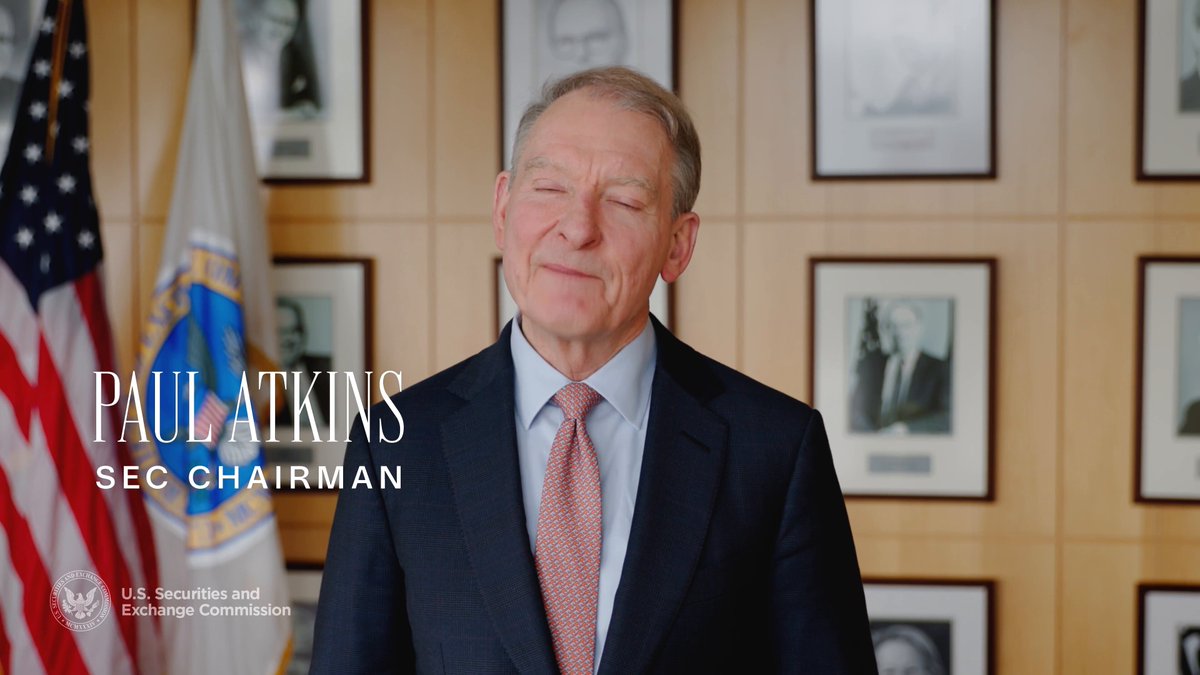
Aug 18, 20263.5K likes835 repostsPaul Atkins
@SECPaulSAtkins
With our new proposal, the SEC is taking the most historic step yet to modernize federal securities regulations for crypto assets. As the Crypto Capital of the World, the U.S. must and will lead. Regulation Crypto Assets will ensure that we do. 🇺🇸
Aug 18, 20269.3K likes2.1K reposts