

Nvidia Superchip Accelerates AI Integration Across Consumer PCs and Laptops
• From trending topic: Nvidia launches ‘superchip’ putting AI power into laptops and PCs
Summary
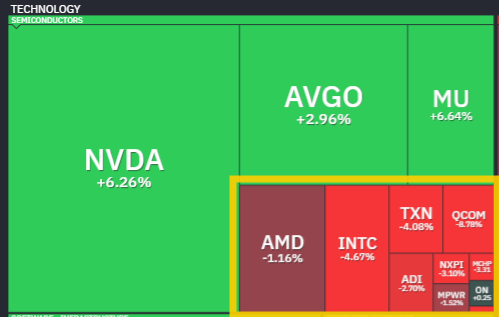
Nvidia’s latest announcement centers on a new “superchip” architecture designed to bring advanced AI processing directly to everyday laptops and desktop PCs. The move is being discussed widely on social platforms because it shifts AI acceleration from data-center servers to mainstream consumer devices, with immediate market consequences. Tech investors reacted within hours: Nvidia’s share price rose more than 6 percent, Microsoft gained 2.3 percent, and Dell—already positioned in both AI-enabled PCs and servers—surged, while several other semiconductor makers posted notable losses. The sudden rotation of capital toward companies seen as direct beneficiaries of on-device AI has turned the launch into one of Monday night’s dominant trending topics.
Common Perspectives
Market Winners and Losers Signal a New Supply-Chain Map
Observers note that Nvidia’s entry into PC silicon is reshaping competitive dynamics. Shares of companies with exposure to AI PCs—Dell, certain cloud-software names, and Nvidia itself—moved sharply higher, while firms perceived as lacking a comparable on-device offering saw selling pressure. The intraday divergence is being read as an early indication of how design wins could redistribute revenue across the semiconductor ecosystem.
AI Workloads Move from Cloud to Local Hardware
A second viewpoint focuses on the user experience. With AI inference now running locally on laptops and desktops, tasks such as real-time image generation, voice assistants, and on-device data analysis can operate without constant internet connectivity or cloud latency. Commenters highlight potential privacy gains and lower operating costs for both consumers and enterprises that currently pay for remote compute.
Regulatory and Political Responses Surface Quickly
The news coincides with Sen. Bernie Sanders’ introduction of the “American AI Sovereign Wealth Fund Act,” which proposes a one-time 50 percent tax on stock holdings of major AI companies to fund public dividends and services. Some analysts argue the timing could intensify scrutiny of Nvidia’s expanding market power, while others see the legislation as an attempt to address wealth concentration accelerated by the very hardware advances now reaching consumers.
A Different View
Rather than framing the superchip solely as a performance upgrade, consider its role in redefining what counts as “personal computing.” If AI accelerators become a baseline feature in nearly every new PC, the devices themselves start to function less like general-purpose tools and more like always-on inference engines. In that light, the launch is less about faster graphics or smoother gameplay and more about embedding a persistent, invisible layer of algorithmic decision-making into ordinary workflows—altering not just speed, but the nature of the computer’s relationship to its user.
Conclusion
Nvidia’s superchip announcement has compressed a multi-year industry shift into a single trading session, producing immediate stock-price movements and prompting fresh policy debate. The episode underscores how quickly hardware decisions at the chip level can ripple outward to markets, regulation, and the everyday experience of computing.
Sources and discussion
These public posts were collected while researching this story. They provide context and reactions, but may not independently verify every claim.
View the original topic on XTop News with Data
@TopNewsWithData
Top News for Monday night: - Tech: Nvidia launches ‘superchip’ putting AI power into laptops and PCs - Gaming: Baldur's Gate 2 Is Reportedly Getting The One Of The Original BioWare Lead Designers Returning - NBA: No article found And check out these analytics!
Jun 1, 2026STOCK TRAIN
@stocktrain2
AI ecosystem gets another boost. Anthropic’s surprise filing and Nvidia’s move into the PC market proved good news for a host of tech names exposed to AI. Nvidia’s share price jumped more than 6% while Microsoftgained 2.3%. Dell, a maker of both AI-enabled PCs and servers, surged
Jun 1, 20261 likesNeil Sethi
@neilksethi
Nvidia pushing into PC semiconductors wasn't all good news for the tech sector with most of the other makers seeing notable losses.
Jun 1, 20263 likes2 repostsMEDBED
@MEDBED01
🚨BREAKING NEWS🚨 MedBed Treatment Process Revealed! For the first time, we unveil the revolutionary MedBed technology! How it works: 1. Crystal Chamber Entry: Patients step into a high-tech chamber. 2. Quantum Scan: @MEDBED01
Jun 1, 20263 likesBillBoard
@myBillBoard_
BREAKING: Sen. Bernie Sanders has introduced the 'American AI Sovereign Wealth Fund Act.' The legislation proposes a one-time 50% tax on the stock of major AI companies, aiming to redistribute tech wealth through direct public dividends and funding for public services. Sanders
Jun 1, 20262 likesDreamonology
@Dreamonology
@kinocasinoclips Rumble has the same garbage censorship tools as Youtube and other big tech sites, no different than reddit, stuff gets hidden if people spam report your replies. Thought it was a champion of free speech platform lol. The rate limits for activity on it is awful as well.
Jun 1, 20262 likes