

Nigerian Stock Market Accelerates to T+1 Settlement: Faster Trades Set to Transform Investor Experience
• From trending topic: Nigerian stock market moves to T+1 settlement from May 29, 2026
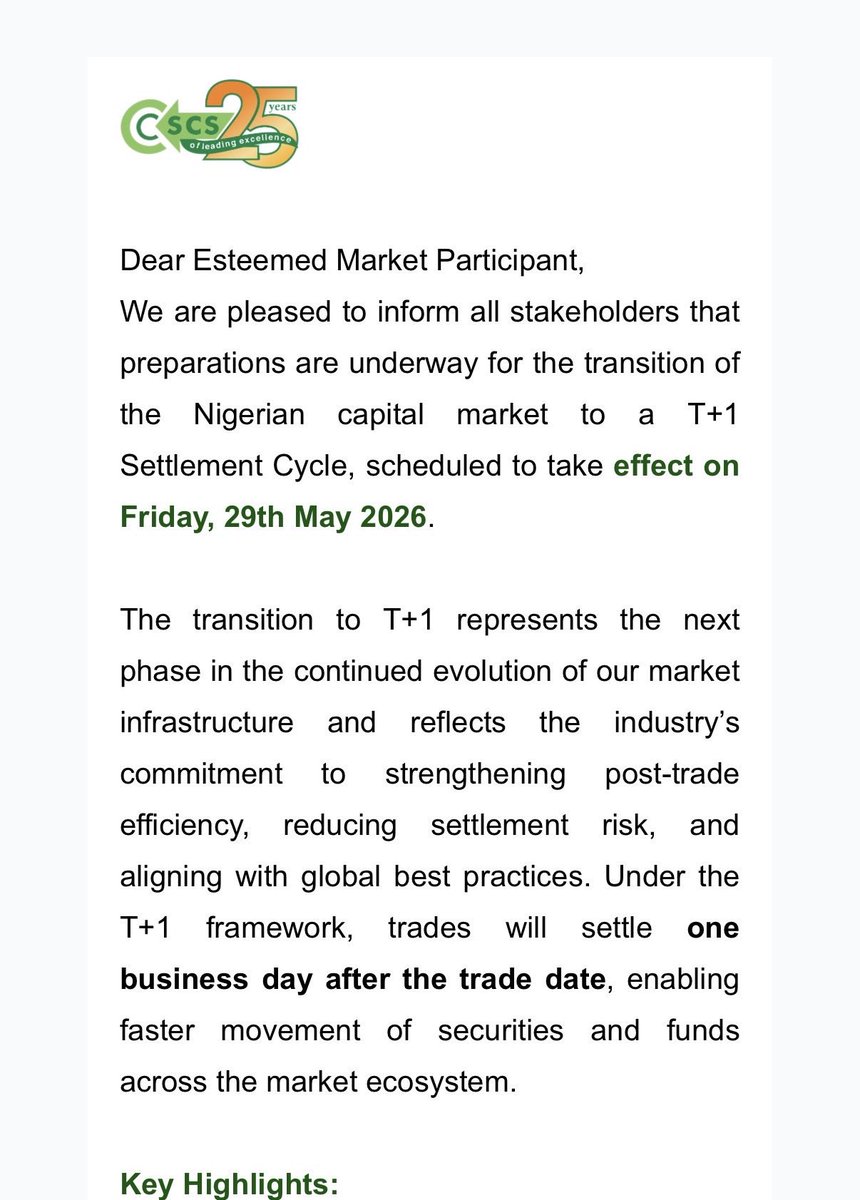
Summary
The Nigerian Exchange Group (NGX) has officially announced that the Nigerian stock market will transition from its current T+2 settlement cycle to T+1 starting May 29, 2026, sparking widespread buzz across social media platforms like X. This announcement, shared in multiple viral posts today, explains the shift in simple terms: under T+2, selling a stock today means cash settles in two business days, but T+1 will deliver funds the next business day after a sale. Posts labeling it "Big news" and "BREAKING NEWS" have racked up dozens of likes and shares, driving the topic to trend as investors and traders react to the impending faster liquidity. The decision aligns Nigeria with global markets like the US and India, which adopted T+1 earlier, and comes amid efforts by the NGX and regulators to modernize the exchange, reduce counterparty risk, and boost efficiency in Africa's largest economy. Trending right now due to these fresh, accessible breakdowns on X, the news highlights how this change could reshape trading dynamics nearly two years from implementation, fueling immediate excitement and debate online.
Common Perspectives
Speed Boost for Retail Investors
Many users celebrate the move as a win for everyday traders, emphasizing quicker access to cash after sales. Posts highlight how T+1 means "sell today, money tomorrow," potentially encouraging more frequent trading and reducing the wait time that currently ties up funds for two days.
Alignment with Global Standards
Traders view this as Nigeria catching up to international benchmarks, noting that major markets like the NYSE shifted to T+1 in 2024. This perspective frames the change as essential for attracting foreign investment and enhancing the market's competitiveness on the world stage.
Operational Challenges Ahead
Some express caution about the technical upgrades needed, pointing to potential disruptions during the transition. Discussions note that brokers, clearing houses, and banks must overhaul systems to handle same-day processing, raising concerns over readiness in Nigeria's infrastructure.
Risk Reduction for the Market
Optimists argue T+1 minimizes settlement risks by shortening the exposure window between trade and payment, which could prevent issues like those seen in past market stresses. This view positions the shift as a safeguard for stability in a volatile emerging market.
A Different View
While most focus on faster cash for sellers, this change could quietly empower short-term algorithmic trading strategies in Nigeria, where high-frequency trading has been limited by T+2 delays. Local fintech firms might seize the opportunity to deploy AI-driven bots that thrive on T+1 speed, potentially widening the gap between tech-savvy institutional players and casual retail investors—sparking a new wave of innovation or inequality not yet discussed in the trending chatter.
Conclusion
As X lights up with reactions to the NGX's T+1 announcement, this milestone signals Nigeria's bold step toward a more agile stock market, balancing excitement over speed with pragmatic concerns about execution. With nearly two years to prepare, the real test will be how smoothly the ecosystem adapts, potentially positioning Nigerian equities as a faster, more attractive frontier for global capital.
Sources and discussion
These public posts were collected while researching this story. They provide context and reactions, but may not independently verify every claim.
View the original topic on XMahmoud Sardauna | Aptos Educator
@Mahmoudsardauna
🚨Big news. From May 29, 2026 the Nigerian stock market moves to T+1 settlement. In plain English: right now when you sell a stock, it takes 2 business days for your cash to settle. That’s T+2. From May 29, 2026 it becomes T+1. Sell today, your money settles tomorrow in
Mar 16, 202653 likes8 repostsToby
@TomolaGroup
Big news. From May 29, 2026 the Nigerian stock market moves to T+1 settlement. In plain English: right now when you sell a stock, it takes 2 business days for your cash to settle. That’s T+2. From May 29, it becomes T+1. Sell today, your money settles tomorrow. Nigeria was on
Mar 16, 202652 likes9 repostsThe Compass Hub
@thecompasshub
BREAKING NEWS: From May 29, 2026 the Nigerian stock market moves to T+1 settlement. In plain English: right now when you sell a stock, it takes 2 business days for your cash to settle. That’s T+2. From May 29, it becomes T+1. Sell today, your money settles tomorrow. Nigeria
Mar 17, 202636 likes18 repostsVeryBlackMan 🖤🖤
@OlawaleAjana
BREAKING NEWS: From May 29, 2026 the Nigerian stock market moves to T+1 settlement. In plain English: right now when you sell a stock, it takes 2 business days for your cash to settle. That’s T+2. From May 29, it becomes T+1. Sell today, your money settles tomorrow. Nigeria
Mar 17, 2026