

Micron's Blockbuster Q3 Results Ignite Wall Street as AI Demand Fuels Record Revenue Surge
• From trending topic: Micron Reports Record Q3 Earnings Driven by AI Demand
Summary
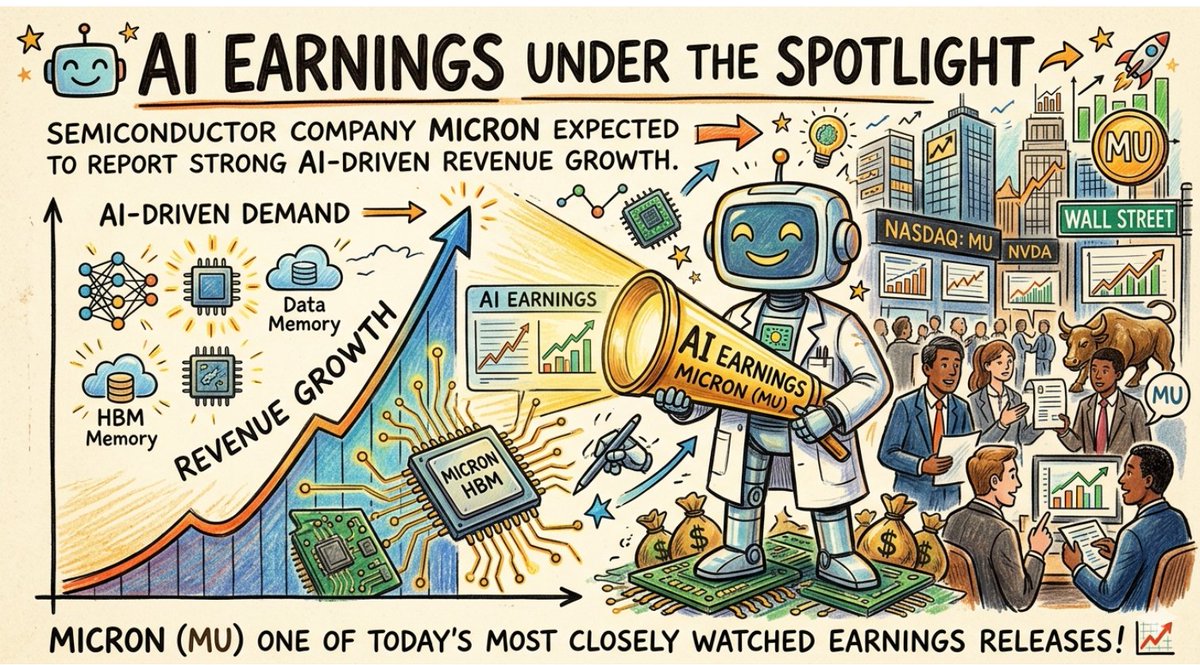
Right now, Micron Technology is dominating financial headlines after reporting its fiscal third-quarter earnings, which dramatically exceeded Wall Street expectations and triggered an immediate 12.6% surge in the company's shares during after-hours trading. The U.S.-based memory chipmaker revealed that revenue skyrocketed by 346% year-over-year, propelled by explosive demand for high-bandwidth memory (HBM) products essential for AI infrastructure. This performance comes at a critical moment when investors are closely watching semiconductor companies for signs that AI investments are translating into concrete financial results. The earnings report has positioned Micron as a bellwether for the broader technology sector's AI-driven recovery, with analysts noting that the company's ability to capitalize on memory demand for AI training and inference workloads has fundamentally altered its growth trajectory. Social media discussions on X have amplified this news, with traders and analysts highlighting how Micron's results validate the thesis that AI infrastructure spending is moving beyond hype into measurable revenue generation for chipmakers.
Common Perspectives
AI Infrastructure Investment Finally Paying Off
Many market participants view Micron's results as concrete evidence that years of AI-related capital expenditure by hyperscale data center operators are now flowing through to semiconductor suppliers. This perspective emphasizes that the company's HBM production ramp and pricing power demonstrate real demand rather than speculative positioning, suggesting the AI buildout cycle has reached an inflection point where memory requirements are scaling alongside compute capacity.
Memory Chipmakers Regaining Pricing Power
Another widely discussed angle focuses on how Micron's performance signals a reversal in the memory industry's cyclical downturn. Observers note that the company's gross margin expansion and ability to secure premium pricing for AI-optimized memory products indicate that supply discipline combined with structural demand growth has shifted bargaining power back to manufacturers after several years of oversupply and price erosion.
Semiconductor Sector Rotation Underway
Some investors interpret Micron's surge as the beginning of a broader rotation within technology stocks, where companies with direct exposure to AI infrastructure spending may outperform software and internet platforms that have dominated recent market gains. This view suggests that hardware enablers of AI, particularly those addressing memory bottlenecks, could see sustained multiple expansion as their role in the AI value chain becomes more clearly defined.
Supply Chain Constraints May Limit Upside
A more cautious perspective circulating in trading communities highlights that while demand is robust, Micron and competitors face manufacturing capacity constraints that could cap how much revenue they can actually capture in the near term. This viewpoint stresses that even with strong orders, the timeline for bringing additional HBM production online means the full financial benefit of AI demand may be realized gradually rather than immediately.
A Different View
Beyond the immediate earnings reaction, Micron's results may be revealing something more fundamental about how AI workloads are reshaping semiconductor economics. Rather than simply representing another upcycle in the memory industry, the company's performance suggests that AI training and inference are creating a new, relatively price-inelastic category of memory demand that operates somewhat independently from traditional PC and smartphone cycles. This could mean memory manufacturers are transitioning from being cyclical commodity businesses to more stable providers of specialized infrastructure components, potentially warranting structurally higher valuations over time. The current moment may mark not just a strong quarter, but the emergence of memory as a strategic bottleneck in AI development, where access to adequate HBM supply could determine which companies can scale their AI ambitions and which cannot.
Conclusion
Micron's record Q3 earnings have crystallized investor attention on the tangible financial outcomes of AI infrastructure spending, moving the conversation from potential to proven demand. As the company rides the wave of memory requirements for AI systems, its performance offers a window into how the semiconductor industry is being restructured around this new computing paradigm, with implications that extend well beyond a single earnings report.
Sources and discussion
These public posts were collected while researching this story. They provide context and reactions, but may not independently verify every claim.
View the original topic on XTorey General 👑
@torey_general
The technology sector is back in focus on Wall Street as investors await major AI-driven earnings reports. Memory-chip giant Micron is expected to report strong growth fueled by demand for artificial intelligence infrastructure, while Alphabet is preparing to join the Dow Jones
Jun 24, 20261 likesDatastreet
@EguevoiAig56258
🤖📈 EXPLAINER: Why Everyone Is Watching Micron's Earnings Micron, one of the world's leading semiconductor companies, is expected to report strong earnings driven by booming demand for AI chips and memory. Why it matters: Artificial intelligence requires massive amounts of
Jun 24, 20261 likesThe Seoul Times
@_TheSeoulTimes
[BREAKING] Micron Shares Surge 12.6% After-Hours on Blockbuster Q3 Earnings, Revenue Skyrockets 346% [SEOUL = Global Tech News] Micron Technology, the largest U.S. memory chipmaker, has delivered a historic performance that completely shattered Wall Street expectations,
Jun 24, 20261 likesKathie Obradovich
@KObradovich
About half of farmers and ranchers regularly use artificial intelligence tools to support their operations, according to a report from the agricultural marketing firm MorganMyers and Ag Access, an agricultural market researcher, @koons_cami reports.
Jun 24, 2026