

Micron Technology Shatters Wall Street Expectations with Record-Breaking Q3 Revenue Surge
• From trending topic: Micron Technology Q3 Earnings Beat
Summary
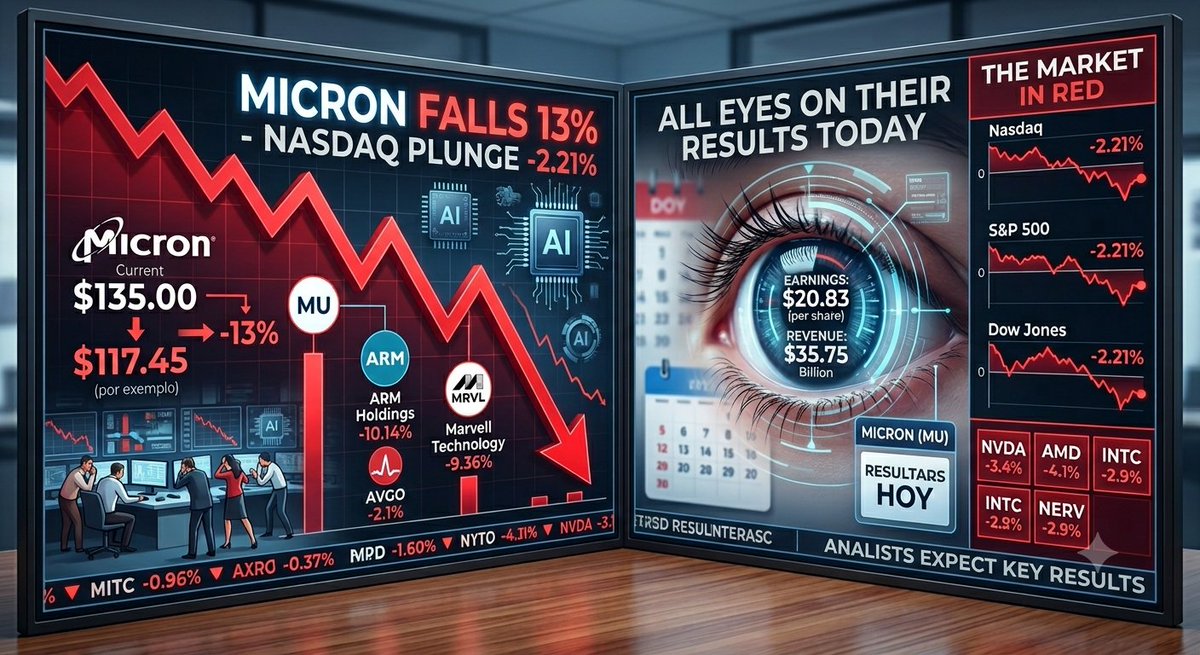
Micron Technology's third-quarter fiscal 2026 earnings report has ignited a massive market reaction, with the company's shares surging 12.6% in after-hours trading following the release. The semiconductor giant delivered revenue of $41.456 billion—more than tripling year-over-year growth and significantly exceeding analyst estimates of $35.59 billion. The company reported adjusted earnings per share of $25.11, crushing consensus forecasts. This explosive performance, driven by unprecedented AI-driven demand for memory chips, has positioned Micron as the standout performer amid a broader tech sector selloff that saw the Nasdaq drop 2.21% on Tuesday. The results come as Wall Street had been bracing for potential disappointment, with Micron shares having fallen 13% in the days leading up to the earnings release. The dramatic beat has overshadowed concerns about the broader semiconductor sector, with investors now focusing on the implications for AI infrastructure spending and memory chip demand.
Common Perspectives
AI Demand Is Transforming Memory Chip Economics
Market observers point to the unprecedented scale of artificial intelligence infrastructure buildout as the primary driver behind Micron's record results. The 346% year-over-year revenue increase suggests that AI training and inference workloads are creating sustained, structural demand for high-bandwidth memory and advanced DRAM solutions that far exceeds previous cycle peaks.
Wall Street Overreacted to Pre-Earnings Weakness
Some analysts argue that the pre-earnings selloff in Micron shares, which contributed to Tuesday's broader tech decline, reflected excessive pessimism about near-term demand visibility. The massive beat validates the view that institutional investors may have been positioned too defensively ahead of what proved to be a transformative quarter for memory chip pricing and volume.
Guidance Signals Sustained AI Tailwinds Through 2027
The ultra-bullish forward outlook provided by management indicates that current AI-driven demand is not a one-time spike but rather the beginning of a multi-year investment cycle. This perspective suggests that memory chipmakers are entering a period of elevated profitability that could reshape capital allocation priorities across the semiconductor industry.
Sector Rotation May Be Masking Individual Company Strength
Market technicians note that while the broader semiconductor sector faced selling pressure on Tuesday—with Arm Holdings and Marvell Technology also declining sharply—Micron's results demonstrate that not all memory and chip companies are experiencing uniform demand patterns. This view suggests investors may be rotating out of certain subsectors while doubling down on AI infrastructure beneficiaries.
A Different View
Rather than viewing Micron's results as simply a reflection of AI demand, consider how the company's performance signals a fundamental shift in how memory chip pricing power is being redistributed across the supply chain. The 346% revenue surge suggests that hyperscale cloud providers and AI developers are now willing to pay premium prices for guaranteed memory supply—a dynamic that inverts the traditional buyer-supplier relationship where chipmakers competed primarily on cost. This creates potential for sustained margin expansion that extends beyond typical semiconductor cycles, as memory becomes a strategic bottleneck rather than a commoditized component in AI infrastructure investments.
Conclusion
Micron's blockbuster quarter crystallizes how AI infrastructure spending is reshaping the semiconductor industry's competitive dynamics, with memory chipmakers emerging as unexpected beneficiaries of the current technology investment cycle. The dramatic market reaction underscores how individual company results can diverge sharply from sector-wide sentiment when underlying demand fundamentals shift.
Sources and discussion
These public posts were collected while researching this story. They provide context and reactions, but may not independently verify every claim.
View the original topic on XEmmanuel – Big Tech & AI Investor
@EmmanuelInvest
🚨 $MU (Micron Technology) Q3 FY2026 Earnings Explosive AI-driven beat + ultra-bullish guidance 🔥 ________________________________________ 📊 KEY METRICS (Q3 FY2026) 🔹 Revenue: $41.456B (+346% YoY) 🟢 Massive Beat (vs $35.59B est.) 🔹 Adj. EPS: $25.11 🟢 Beat (vs
Jun 24, 2026The Seoul Times
@_TheSeoulTimes
[BREAKING] Micron Shares Surge 12.6% After-Hours on Blockbuster Q3 Earnings, Revenue Skyrockets 346% [SEOUL = Global Tech News] Micron Technology, the largest U.S. memory chipmaker, has delivered a historic performance that completely shattered Wall Street expectations,
Jun 24, 20261 likesCryptoBB
@CryptoBB01
BREAKING #Micron falls 13% — all eyes on today's results. Wall Street closed Tuesday with all its indices in the red, led by the 2.21% drop in the Nasdaq, dragged down by the collapse of Micron (-13%), as well as Arm Holdings (-10.14%) and Marvell Technology (-9.36%)
Jun 24, 20261 likesalldaystocks | 24/7 Market News
@allday_stocks
🔔 CLOSING BELL | Wednesday, June 24, 2026 Rebound attempt fades • Nasdaq 100 closes lower again • Micron jumps +13.2% after hours on record earnings 🔎 Daily Overview U.S. stocks attempted to stabilize after Tuesday’s sharp tech and semiconductor selloff, but the rebound
Jun 24, 2026Christian Rosenkreutz
@fratercrc
Baldias Sphere: NEC Corporation ( major Japanese multinational information technology and electronics company headquartered in Minato, Tokyo. Next: NEC's OFFICIAL TECHNICAL REPORT on #BaldiasSphere👇 @JosCRios @gchavez101 @road_mystery #UAP #Orb #NEC
Jun 24, 20261 likesWater Tower Research LLC
@WTR_Research
This recap of the WTR Small Cap Spotlight podcast, Dr. Wang , Chief Financial Officer of Lotus Technology, Inc. (Nasdaq: $LOT ) and Tim Gerdeman and Eric Goldstein discussed the company's shift from its roots as a British sports car maker into a global intelligent and luxury
Jun 24, 20261 likes