

King Edward Medical University Expels Afghan Students After Council Order
• From trending topic: Pakistan University Expels 20 Afghan Medical Students Amid Regulator Order
Summary
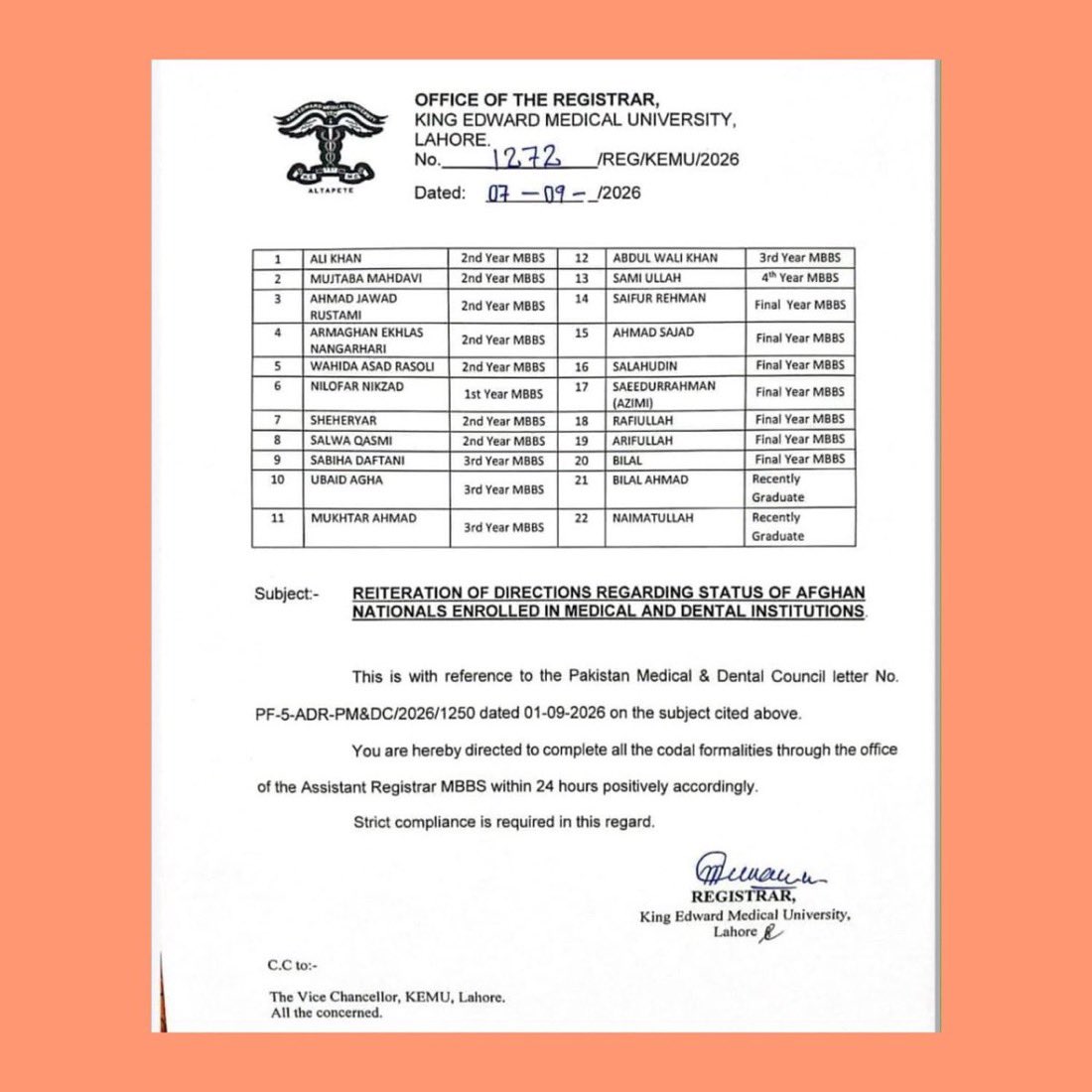
King Edward Medical University in Lahore has expelled about 20 Afghan medical students following a Pakistan Medical and Dental Council order requiring Afghan medical students to return to Afghanistan, according to the reporting collected for this story.
Amnesty International’s South Asia regional office called the council’s decision “patently discriminatory and arbitrary” and warned that its consequences were especially severe for female students. In a separate post, Ihtisham Ul Haq reported that seven of the expelled students were in their final year and described the loss of years of work. The final-year figure has not been independently verified here.
The retained sources do not include the council’s order, a university statement, or a response explaining the decision. Its legal basis, whether other universities have taken the same step, and the students’ remaining academic options are therefore unresolved.
Common Perspectives
Equal treatment for enrolled students
Amnesty International’s criticism concerns the nationality-based requirement to return home. Its description of the decision as discriminatory and arbitrary challenges the fairness of interrupting an existing course of study. That is the organisation’s stated assessment; the available material does not establish a legal finding or provide the regulator’s response.
A particularly severe consequence for women
Amnesty’s statement separately emphasises the consequences for female Afghan students. Equal treatment at the university and the practical ability to continue studying after departure are different questions: the same expulsion order need not leave every student with comparable alternatives. The retained statement does not document the circumstances or options of individual students, so those should not be assumed.
The loss of years already invested
Ihtisham Ul Haq’s post focuses on interrupted training and reports that seven students were in their final year. If that figure is accurate, some students were close to completing a long course. This criticism concerns the cost of ending an existing education, rather than the rules for future admissions. The available posts do not establish whether transfers, appeals, or other arrangements could preserve that work.
A Different View
The next practical issue is continuity of training. Leaving a university need not mean losing every completed year if another institution can recognise the coursework and clinical experience, but recognition requires arrangements that cannot be assumed. Reporting on transcripts, transfers, appeals and permission to complete clinical requirements would show whether the interruption is temporary or effectively ends these students’ route to a degree. The available sources establish concern about the expulsions, not the existence of any such arrangements.
Conclusion
The council’s order and the university’s explanation are needed to assess the legal basis for the decision. Information about appeals and transfer options would clarify what the affected students can do next.
Sources and discussion
These public posts were collected while researching this story. They provide context and reactions, but may not independently verify every claim.
View the original topic on XAmnesty International South Asia, Regional Office
@amnestysasia
The Pakistan Medical and Dental Council's decision requiring Afghan medical students in Pakistan to return to Afghanistan is patently discriminatory and arbitrary in nature. The consequences of this decision are especially severe for female students, many of whom have already
Sep 8, 20261.6K likes754 repostsIhtisham Ul Haq
@iihtishamm
Heartbreaking on every level. Politics & ignorance have shattered 20 dreams. King Edward Medical College Lahore expelled 20 Afghan students, including 7 in their final year. Years of sacrifice, sleepless nights and dreams destroyed overnight. The world must speak up to stop this.
Sep 7, 20263.9K likes1.3K reposts